Batch-prep chicken cooks
If you prepare chicken for several lunches, wraps, salads or freezer portions, the amount that fits in each load can determine how often you have to refill the bowl.


Choose a chopper for batch-cooked chicken by its usable capacity and the control you need over the finished texture, not by motor wattage alone. A larger manual pull model suits people willing to do the pulling for fewer loads, while a compact electric model suits smaller loads without manual effort; check each model’s food capacity and cleaning instructions before deciding.
If you prepare chicken for several lunches, wraps, salads or freezer portions, the amount that fits in each load can determine how often you have to refill the bowl.
If you chop one or two portions at a time, compact storage and quick operation may matter more to you than a larger bowl.
If you want distinct pieces for sandwiches, salads or tacos, look for a way to stop and check the chicken before it becomes too finely chopped.
For cooked chicken prepared across several meals, check capacity first, then how you will control the chop and clean the parts. A manual pull chopper avoids mains power but requires repeated pulls; electric models avoid that effort, though their capacities and cleaning instructions differ.
| Concern | What to check | Who this matters to |
|---|---|---|
| Capacity per load | Compare stated food capacity, not just bowl volume; check maximum-fill guidance and whether the chicken must be boneless. | I prepare chicken for several meals and want fewer refills without overfilling the bowl. Around 50% of consumers put batch size first. |
| Chop texture | Check how the model lets you make short pulses or adjust the result by the number of pulls. | For sandwich or salad fillings, I want recognisable chicken pieces rather than a very fine chop; around 30% of consumers prioritise texture control. |
| Cleaning | Check the instructions for the bowl, blades and lid separately, including which parts can go in a dishwasher. | When I prepare several portions, washing the parts after each use needs to fit my routine. Clean-up is the primary concern for around 20% of consumers. |
Motor wattage does not tell you how much chicken fits in the bowl or how easily you can stop at the texture you want. Kenwood specifies a 500W motor and 500ml capacity for its CHP61.100WH, while Tefal specifies a 900ml bowl for its manual K1320404.
Start with capacity, suitability for boneless meat, control method and cleaning instructions; then consider any motor specification.
Russell Hobbs specifies a 1-litre glass bowl but a 500ml food capacity for the Desire Matte Black Mini Chopper 24662. Filling it according to the larger figure would exceed its stated food capacity.
Compare food-capacity figures and follow the model’s maximum-fill instructions.
Cleaning instructions differ even among the cited models: Tefal describes the K1320404 bowl and blades as dishwasher friendly, Kenwood describes the CHP61.100WH tools as dishwasher safe, and Russell Hobbs lists no dishwasher-safe parts for the 24662.
Check the instructions for each removable part before choosing a chopper for frequent chicken preparation.
Chopping does not extend the time cooked chicken can be stored. The Food Standards Agency advises cooling cooked food and refrigerating it within one to two hours, then eating leftovers within 48 hours or freezing them.
Divide chicken into smaller portions to help it cool, refrigerate it promptly and plan when each portion will be used or frozen.
The manual K1320404 is relevant if you want a stated 900ml bowl and control through the number of pulls.
The powered CHP61.100WH offers a stated 500ml capacity for people preparing smaller loads.
The Desire Matte Black Mini Chopper 24662 offers one-touch operation and a stated 500ml food capacity.
This powered chopper is a larger-capacity option to consider for boneless chicken batch preparation. Its rated capacity is not the same as a confirmed maximum food fill, so check the instructions for the load you intend to process.
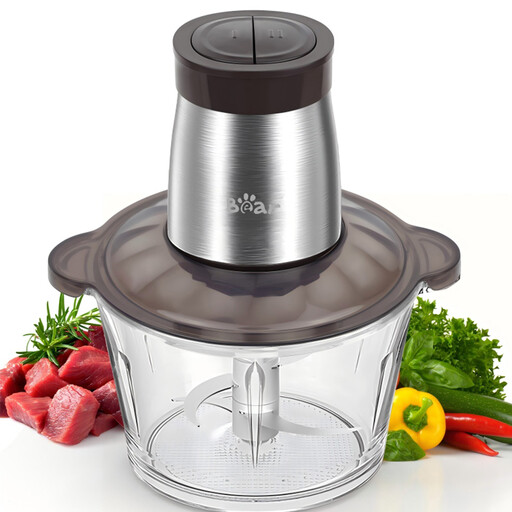 Image unavailable
Consider this model if you are chopping boneless chicken for several portions and want a larger rated bowl capacity. Its title specifies 2L rated capacity, a 300W motor, two speeds and 304 stainless-steel blades; check the maximum usable food fill before planning your loads.
Do not process bones, ice or frozen food. Follow the stated limit of 40 seconds’ continuous operation, with at least two minutes between runs and 15 minutes’ cooling after three consecutive cycles. Check the cleaning instructions for the bowl and blades; do not immerse the main unit.
Yes, if the model’s instructions permit the food and you keep within its stated limits. Tefal specifies boneless meat for the K1320404; check the instructions for any other model rather than assuming it can process bones.
It can be if you are willing to split the chicken into smaller loads. Tefal’s stated 900ml K1320404 capacity offers more room per load than the 500ml food capacities specified for the cited Kenwood and Russell Hobbs models, but follow each model’s fill guidance.
Choose a manual pull model if avoiding mains power and adjusting the chop by pulling are worth the physical effort to you. An electric model avoids repeated pulling; compare its food capacity, controls and cleaning instructions for the portions you make.
Cool it and refrigerate it within one to two hours, then use it within 48 hours or freeze it, in line with Food Standards Agency guidance. The agency also advises keeping the fridge between 0°C and 5°C and dividing food into smaller portions so it cools more quickly.
No, but they may make frequent preparation easier if you prefer not to wash every removable part by hand. Check the exact components: Tefal describes the K1320404 bowl and blades as dishwasher friendly, Kenwood describes the CHP61.100WH tools as dishwasher safe, and Russell Hobbs lists no dishwasher-safe parts for its 24662.