Family-meal batch preparers
If herbs are one part of a meal that also involves vegetables, sauces or dips, you may value fewer repeated batches more than the smallest possible appliance.


Choose the chopper’s usable capacity for the largest part of your usual meal preparation, not just the handful of herbs. A small bowl suits herbs, garlic and dressings, but a family meal that also involves vegetables or sauces may take several batches; a larger bowl reduces that burden while taking up more storage space. Check for documented pulse or speed controls and which removable parts can go in the dishwasher.
If herbs are one part of a meal that also involves vegetables, sauces or dips, you may value fewer repeated batches more than the smallest possible appliance.
If you often prepare parsley, chives, garlic, pesto or dressings, controls that let you stop at the texture you want may matter more than a large bowl.
If you usually chop small quantities and have limited cupboard space, a compact chopper may be easier to accommodate, provided you accept its smaller batch size.
For a family meal, start with the largest quantity you routinely prepare, then consider texture control, cleaning and where the chopper will live.
| Concern | What to check | Who this matters to |
|---|---|---|
| Capacity for the meal | Check usable ingredient capacity rather than relying on the physical bowl size alone. Compare it with your largest routine job. | If I prepare vegetables or dips as well as herbs, I want to avoid repeatedly filling and emptying the bowl. Around 36% of consumers put capacity for the wider meal first. |
| Herb texture and other uses | Look for documented pulse or speed controls and confirm that the exact model is intended for the ingredients you plan to process. | When I chop herbs for a sauce, I want to stop before they become finer than I intended. For around 29% of consumers, texture control and versatility are the main concern. |
| Cleaning and upkeep | Confirm which removable parts are dishwasher safe and check the exact model’s care instructions. | If I use a chopper regularly for herbs and dressings, washing the bowl, lid and blade afterwards needs to be manageable. Around 21% of consumers make cleaning and upkeep their priority. |
| Storage | Check the appliance’s dimensions and whether its parts can be stored together. | With little cupboard space and mostly small chopping jobs, I would rather store a compact appliance than accommodate a larger bowl. Storage comes first for around 14% of consumers. |
A small chopper may handle the herbs yet require extra batches for the vegetables, dips or sauces in the same meal. Good Housekeeping UK advises larger capacities for bigger households and batch cooking.
Consider the largest job you expect to do regularly before deciding how much usable capacity you need.
A motor rating does not tell you whether you can stop easily at a coarse chop. KitchenAid specifies two speeds and pulse action for its 830ml and 1.19L choppers.
Check the exact model’s controls and ingredient guidance if the finished herb texture matters to you.
Cleaning instructions apply to specific parts: Kenwood identifies the CH180B bowl as dishwasher safe, while Tefal describes dishwasher-safe parts for the MQ723140.
Follow the manual for your model and keep the motor base separate from washable components unless its instructions explicitly say otherwise.
The CH180B is a compact electric chopper aimed at smaller quantities.
Its 830ml mini chopper and 1.19L food chopper offer different bowl sizes for small jobs and broader meal preparation.
The MQ723140 has a 500ml bowl, while the Choppeo MB603165 is described for up to 1L of ingredients.
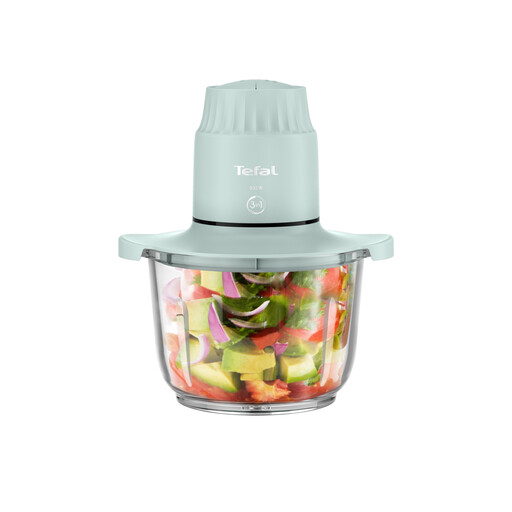
These choppers address different parts of the family-meal decision: the Tefal Choppeo has a larger stated usable capacity for broader preparation, while the Kenwood CH180B is a compact option for smaller herb jobs.
 No image available
Consider this model when herbs are part of a larger meal-preparation job. Tefal states that its glass bowl has room for up to 1L of ingredients, although the physical bowl is 2L; use the ingredient limit when judging batch size. Check the exact controls if stopping at a particular herb texture is important to you.
 No image available
Consider this compact model if you mainly chop small amounts of herbs rather than prepare the whole meal in one load. Its stated specifications include a 300W motor, a 350ml bowl, two speeds and a dishwasher-safe bowl. Allow for repeated batches if you also plan to chop larger quantities of other ingredients.
Yes, if herbs are the only ingredient you intend to chop in it. If the same meal also calls for chopped vegetables, dips or sauces, compare usable capacity with those larger jobs; Good Housekeeping UK advises a larger capacity for bigger households and batch cooking.
Prioritise documented pulse or speed controls if stopping at a particular texture is your concern. KitchenAid specifies two speeds and pulse action for its 830ml and 1.19L choppers; motor wattage alone does not establish how much control a model offers.
It can if the exact model’s ingredient guidance covers both jobs. KitchenAid lists herbs and dressings for its mini chopper, while Tefal specifies an emulsifying tool for the MQ723140; check the instructions for ingredients and cleaning before using either model.
Check the care instructions for each component of the exact model. Kenwood specifies a dishwasher-safe bowl for the CH180B, and Tefal describes dishwasher-safe parts for the MQ723140; do not extend either claim to a different chopper or assume it covers the motor base.