Single-portion hummus makers
If you usually make one snack-sized or lunch-sized serving, look for a bowl intended to handle small quantities rather than choosing capacity for family meals.


For hummus for one, start with a compact mini chopper described for small quantities and dips or sauces, then check its guidance for small wet mixtures. A larger food processor makes more sense if you regularly need its extra functions or capacity; bowl volume and motor wattage alone cannot tell you what texture a small portion will achieve.
If you usually make one snack-sized or lunch-sized serving, look for a bowl intended to handle small quantities rather than choosing capacity for family meals.
If you also chop herbs or onions and make other dips or sauces, storage space and the number of parts to wash may matter as much as the bowl size.
If you will regularly whisk, grate, slice or prepare larger quantities, a more versatile appliance may be worth the extra space, parts or charging routine.
Decide whether small-portion hummus is the main job before comparing extra functions. Which? distinguishes compact mini choppers from full-sized food processors; either route still calls for model-specific guidance on the ingredients and quantities you intend to use.
| Concern | What to check | Who this matters to |
|---|---|---|
| Small-batch fit | Check guidance for small wet mixtures and usable food capacity, not just the bowl volume. | If I make only a little hummus, I need the ingredients to move through the blades rather than collect out of reach. Around 40% of consumers put small-batch fit first. |
| Cleaning and storage | Check appliance dimensions and which removable parts can be cleaned as instructed, including any dishwasher-safe parts. | When one portion leaves several parts to wash, I may not want to use the chopper often. For around 30% of consumers, easy cleaning and compact storage come first. |
| Texture control | Look for pulse or speed controls and confirm that the model permits the ingredients you plan to process. | If I want to stop and assess the texture as I go, control matters more to me than the motor rating alone. Roughly 20% of consumers prioritise texture control. |
| Other food-prep jobs | Check the exact model’s functions, supplied accessories and capacity for the other tasks you expect to do. | If I will regularly prepare more than hummus, I can accept a larger bowl or extra parts in exchange for those functions. Around 10% of consumers put versatility first. |
A motor rating does not establish how smoothly a tiny portion of hummus will process; the bowl, blades and processing control also matter.
Start with documented suitability for small quantities and dips or sauces, then compare controls and follow the model’s ingredient guidance.
A full processor adds preparation options, but its larger bowl may be disproportionate if you mainly make hummus for one. Ninja’s BN800UK, for example, has a 1.8 L processor bowl.
Choose that route when you will regularly use the larger capacity or functions such as slicing and grating.
Allow storage space for the appliance and time to clean its additional parts.
A stated capacity does not tell you how a very small wet mixture will move around the blades.
Check the exact model’s food-capacity and fill guidance before relying on it for your usual portion.
The Morphy Richards rechargeable 3-in-1 chopper combines chopping, whisking and grating, but its 800 ml bowl serves a different capacity preference from the smallest one-person route.
Choose cordless placement and extra functions only if you expect to use them alongside hummus preparation.
A rechargeable model also needs charging between uses.
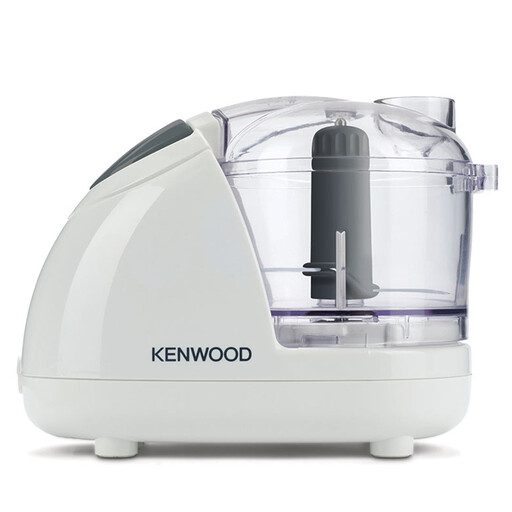
The CH180B is a compact route for small quantities, dips and sauces.
Its cited models span a chopper and a larger multi-function processor, so the model matters more than the brand name alone.
Its rechargeable 3-in-1 mini chopper is relevant when cordless use and additional preparation tasks matter.
This compact chopper is relevant if you mainly want to prepare a small portion of hummus or another dip, rather than use a full-sized processor for broader meal preparation.
 No image available
Consider this model if you want a compact chopper for small quantities and dips or sauces. It is listed with a 350 ml bowl, a 300 W motor and two speeds; check the model guidance for your usual portion rather than assuming bowl capacity establishes a minimum workable load.
Start with a compact bowl intended for small quantities, but check the exact model’s guidance for small wet mixtures. The Kenwood CH180B has a listed 350 ml bowl and is described for dips and sauces; that volume alone does not establish the smallest amount it can process.
Choose a mini chopper if one small dip and straightforward chopping are your main jobs; consider a full processor if you will regularly use its larger capacity and additional functions. Which? distinguishes these appliance types, while Ninja’s BN800UK illustrates the larger route with a 1.8 L processor bowl.
No particular hummus texture follows from wattage alone. Check whether the exact model is intended for small wet mixtures, how you can control processing, and what its instructions say about ingredients and quantities.
Follow the model-specific instructions for use and cleaning, especially when handling the blades. Electrical Safety First advises keeping food processors away from the sink and possible spills, and unplugging them when not in use.