Solo cooks short on kitchen space
If you usually make one modest portion, a compact chopper may be easier to store than a full food processor. Kenwood describes its Easy Chop as intended for small quantities.


For one-person pesto, start with a compact chopper if a modest portion, limited storage and straightforward clean-up are your priorities. A larger bowl, pulse control or attachments make more sense if you also prepare dressings, dips or sliced ingredients, but bowl capacity alone cannot tell you the smallest pesto batch a machine will process. Check the exact model's instructions for ingredient limits and minimum quantities before choosing.
If you usually make one modest portion, a compact chopper may be easier to store than a full food processor. Kenwood describes its Easy Chop as intended for small quantities.
If you prefer to stop while herbs still have some texture or add oil gradually, look at the exact controls. KitchenAid lists pulse operation and a drizzle basin for its 5KFC3516.
If you also make dips or regularly grate and slice ingredients, attachments may be worth storing and cleaning. ProCook lists these functions for its Mini Chopper and Food Processor.
Decide how much control you want over pesto texture, then weigh the bowl and clean-up against any other preparation you will regularly do.
| Concern | What to check | Who this matters to |
|---|---|---|
| Texture and oil control | Look for pulse or selectable speeds; if you want to add oil while processing, check for a documented drizzle feature. | If I want to stop before my pesto becomes too smooth, I need controls that let me work in stages. Around 42% of consumers put texture and oil control first. |
| Storage and clean-up | Compare bowl size and external dimensions, and check which removable parts are dishwasher-safe on the exact model. | With little cupboard space, I want an appliance that is easy to put away and wash after one portion. Roughly 33% of consumers prioritise compactness and clean-up. |
| Uses beyond pesto | Check the included blades and discs against tasks you will actually do, such as chopping, grating or slicing. | If pesto is only one part of my regular meal prep, I want the appliance to handle other ingredients too. About 25% of consumers place wider preparation uses first. |
Motor power does not tell you whether you can pulse the ingredients, add oil while processing or manage your usual batch size.
Compare the controls and bowl arrangement for the way you make pesto rather than treating wattage as a shortcut.
Stated capacity does not establish the minimum amount of basil, nuts, cheese and oil that the blade can process for one person.
Consult the exact model's instructions or manufacturer guidance on minimum quantities and suitable ingredients before buying.
ProCook lists slicing, grating and julienne discs for its Mini Chopper and Food Processor. Those functions matter most if they are part of your regular preparation.
If you mainly make occasional pesto, compare a simpler chopper before choosing a model with extra discs.
The additional components take space to store and time to wash.
Cleaning involves sharp removable parts as well as an electrical motor base. Electrical Safety First advises following the manufacturer's use and cleaning instructions.
Unplug the chopper before handling or cleaning its parts, take care with the blade, and keep the motor base and socket dry.
Its compact chopper models are relevant if you want straightforward controls for small-quantity preparation.
The 5KFC3516 is worth considering if you want to adjust texture and add oil during processing.
Its Mini Chopper and Food Processor suits a broader set of preparation tasks if you expect to use the attachments.
Its Mini Chopper is presented by Magimix for small-batch sauces and herb preparations.
These choppers are relevant to preparing herbs and nuts for pesto. Compare their stated controls and bowl details against the portion you plan to make, rather than assuming that a compact design guarantees a workable minimum batch.
 No image available
Consider this model if you want a compact bowl for a modest pesto portion, while checking the instructions for your minimum ingredient quantity.
Stated features include a 350 ml bowl, 300 W power, two speeds and a dishwasher-safe bowl. Check the model's operating instructions before processing ingredients continuously.
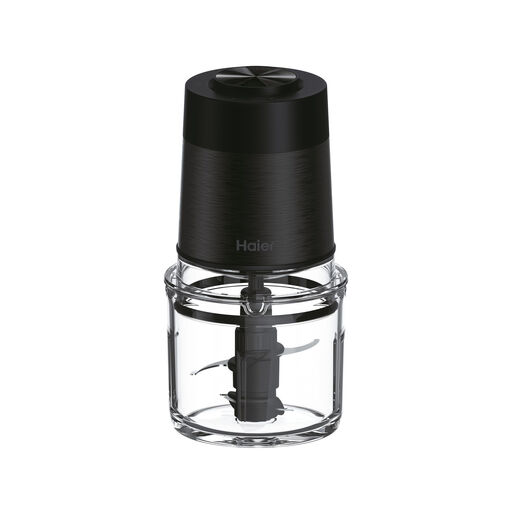 No image available
Consider this chopper for herbs and nuts if you want a glass jar; confirm its bowl capacity and minimum workable quantity for your pesto recipe.
Stated features include double-stacked blades, 550 W power, two-speed control and a dishwasher-safe bowl. If pulse control or oil addition during processing matters to you, check the exact model details before choosing.
A compact bowl is a sensible starting point when one portion and limited storage are your priorities; a larger chopper may suit you if you also make dips or several portions. For context, the product information lists the Kenwood CH180 at 0.35 L, while KitchenAid lists the 5KFC3516 at 830 ml. Neither capacity tells you the minimum amount its blade can process, so check the exact model's instructions for a very small recipe.
Choose a model with pulse or staged speed control if you want to stop and inspect the texture as you go. KitchenAid lists both pulse operation and a drizzle basin for the 5KFC3516; Magimix's pesto instructions describe pulsing ingredients before adding oil in a thin stream.
No single care instruction applies to every mini chopper or every component. Check the exact model's guidance for its bowl, lid and blade separately;the product information describes the Kenwood CH180 as having dishwasher-safe parts, while Electrical Safety First advises following the manufacturer's cleaning instructions.
Use them only if the instructions for your exact model permit them. Electrical Safety First cautions against putting bones, frozen food, crusty bread or fruit with stones into a food processor and advises following the manufacturer's directions for use.
Check the exact model identification, plug, voltage and supplied instructions rather than assuming that different regional versions are identical. GOV.UK describes the Electrical Equipment (Safety) Regulations 2016 as setting requirements for electrical equipment placed on the Great Britain market; that general rule does not establish whether a particular chopper meets them.