Small-batch holiday cooks
If you are making a sauce, salad, dip or topping for a few people, a small bowl and controls that let you check the chop may matter more than a full-size processor.


For a small batch of sun-dried tomatoes, choose a compact chopper whose controls let you stop and check the texture between short bursts. A manual chopper avoids reliance on a cottage socket but takes hand effort; a compact food processor makes more sense only if you will also use its extra preparation functions.
If you are making a sauce, salad, dip or topping for a few people, a small bowl and controls that let you check the chop may matter more than a full-size processor.
If access to a suitable socket is uncertain, a manual pull-cord chopper lets you prepare ingredients without mains power, though you supply the effort.
If the tomatoes are one part of several meals and you also plan to slice, grate or prepare larger batches, a compact processor may justify the extra equipment.
Choose it when: You want to chop small batches and may also make dips or sauces where a suitable socket is available.
Trade-off: It needs mains power, and the bowl, blade and lid need cleaning after oily ingredients.
Choose it when: Prep will be occasional and you would rather not rely on a socket.
Trade-off: You provide the pulling effort, which may be inconvenient across repeated batches.
Choose it when: Holiday meals also call for slicing, grating or larger-batch preparation.
Trade-off: The larger appliance and its accessories take more room to pack and store for a small tomato-only task.
For chopping sun-dried tomatoes during a cottage stay, decide whether texture, the kitchen setup or wider meal preparation is your main concern.
| Concern | What to check | Who this matters to |
|---|---|---|
| Chopped texture | Look for pulse, two-speed or pressure-sensitive control so you can stop between short bursts. Wattage alone does not establish texture control. | For a few oily tomatoes, I want pieces rather than an overprocessed mixture; around 42% of consumers put texture control first. |
| Cottage practicality | Check worktop and storage space, plus access to a suitable socket for an electric model. With a manual model, consider the pulling effort. | If the kitchen layout and socket access are uncertain, I need a chopper I can use comfortably there; around 33% of consumers make cottage practicality their primary concern. |
| Other meal prep | Consider a processor with a small bowl and extra tools only if you will use its additional functions during the stay. | When tomatoes are just one ingredient in several meals, I also want to slice or grate other foods; roughly 25% of consumers put broader meal preparation first. |
Motor wattage does not tell you whether you can stop a small tomato batch at the texture your recipe needs.
Check the controls, then process in short bursts and inspect the pieces between them.
A processor can handle more kinds of preparation, but its size and accessories also need space in a cottage kitchen.
Bring one if you expect to use its slicing, grating or larger-batch functions; otherwise, consider a smaller chopper.
Pull-cord models work without electricity, but repeated preparation still relies on hand operation.
Choose this format for occasional socket-independent chopping; consider an electric option if you expect several batches.
Dishwasher-safe claims apply to particular models and components, not automatically to the entire appliance.
Follow the exact model’s instructions for its bowl, lid, blades and motor unit, and handle the blades carefully.
Kenwood GB lists the Easy Chop CHP61.100WH as a 500ml, 500W electric chopper with two speeds and pressure-sensitive operation. Its CH180 is a compact 300W option for small quantities.
Cuisinart UK lists the Pixie CCH32U with a 0.7L bowl and two settings. The Easy Prep Pro FP8U pairs a 0.7L small bowl with a 1.9L larger bowl.
Tefal UK lists 500ml and 900ml manual pull-cord choppers alongside the electric, 500W, 500ml Multi Moulinette ExtraChop.
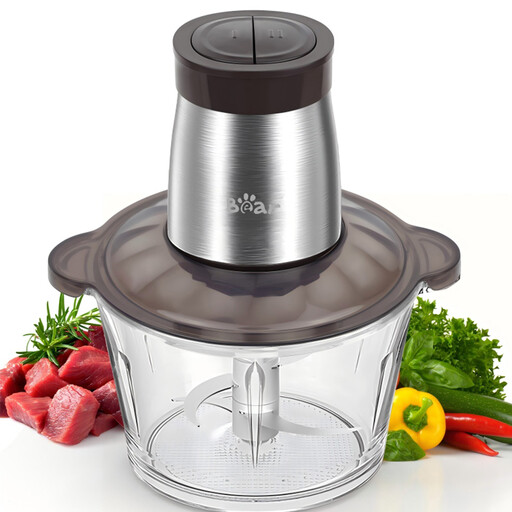
This electric chopper has a larger bowl than the compact 500–700ml starting point discussed for small batches. Consider it if you also expect to prepare more food, and check how it handles a small quantity before choosing it for tomatoes alone.
 No image available
Consider this two-speed chopper if cottage meals involve more than a small batch of tomatoes.
Its listed specifications are 2L capacity, 300W and 304 stainless steel blades.
For small quantities, check the minimum effective amount and whether the controls allow short bursts. Confirm the bowl and blade cleaning instructions for this model.
Choose a manual chopper if you want occasional prep without relying on a socket; choose an electric mini chopper if you expect repeated batches and want to stop between short bursts. Before relying on an electric model, check that the cottage has a suitable accessible socket and clear work area.
A bowl around 500–700ml is a practical starting point for small batches: Kenwood GB lists the Easy Chop at 500ml, while Cuisinart UK lists the Pixie at 0.7L. Bowl size alone cannot tell you how a small quantity will chop, so check the model’s controls too.
Yes, if you will also use functions such as slicing or grating, or prepare larger batches during the stay. A model with a separate small bowl can cover the tomato task, but the larger appliance and accessories take more room to pack and store.
Follow the instructions for the exact model and each component, removing food residue and taking care around sharp blades. Dishwasher-safe parts vary by model, so check the bowl, lid and blade instructions rather than assuming the whole appliance can go in the dishwasher.