Hosts putting out a small plate
An ordinary packet lets you serve the number of custard creams you want alongside the rest of the cream tea. Follow the pack’s directions for any biscuits left after opening.


For a small cream-tea serving, choose by how many biscuits you want to serve, not by the word ‘mini’ alone. Hill Biscuits specifies three custard creams per individual packet, while an ordinary packet lets you plate your own portions. Neither a portion pack nor a smaller outer pack establishes that each biscuit is bite-size; if its physical size matters, check the individual-biscuit dimensions before buying.
The useful distinction for a cream tea is whether you will plate biscuits yourself or hand each guest a separate packet.
An ordinary packet lets you serve the number of custard creams you want alongside the rest of the cream tea. Follow the pack’s directions for any biscuits left after opening.
Individual packets make the biscuit count predictable. Hill Biscuits specifies three custard creams per packet in its single-variety case, but the case contains 48 packets, so check whether that quantity fits your gathering.
Compare the exact product’s ingredients and labelling with each guest’s requirements. Asda lists wheat and milk in its standard custard creams, while its Free From product and the separately listed Schär gluten-free portions are distinct products.
Start with the serving format, then count the custard-cream portions you can use and check the label for the people you are serving.
| Priority | What to check | Your needs |
|---|---|---|
| Meaning of ‘mini’ | Check biscuits per inner packet separately from the physical size of each biscuit. Hill Biscuits specifies three biscuits per portion packet; outer-pack weight alone does not give individual dimensions. | I want a small serving beside scones and tea. If the biscuits themselves must be bite-size, I need an explicit individual-biscuit size before choosing. |
| Usable portions | Count custard-cream packets, not just all packets in a case. Hill Biscuits specifies 48 three-biscuit packets in its custard-cream-only case, but 20 custard-cream packets among 100 assorted packets. | For a larger gathering, I need enough portions of the biscuit guests will actually be offered, particularly if the table has several varieties. |
| Ingredients | Read the supplied product’s ingredient and allergen information. Asda lists wheat and milk for its standard 400 g custard creams; its 125 g Free From product is separately labelled gluten- and milk-free. Asda lists Schär’s five two-biscuit packs as gluten-free. | If I am serving someone with a particular dietary requirement, I need to check the exact packet rather than assume that different custard creams use the same recipe. |
| Leftovers | Check whether you can open portions separately and follow the ordinary pack’s storage instructions. Tesco says to keep its custard creams in an airtight container once opened. | When the cream tea is small, I would rather open only the biscuits being served and store any opened remainder as directed. |
Hill Biscuits’ mini-pack descriptions give packet contents, not reduced dimensions for each custard cream. A smaller serving and a physically smaller biscuit are different requirements.
If biscuit size matters for your presentation, check an explicit individual-biscuit measurement. Otherwise, compare the number of biscuits in each serving.
Hill Biscuits specifies 100 packets in its mixed case, but only 20 are custard-cream packets. The other varieties cannot be counted as custard-cream servings.
Work from the custard-cream packet count when deciding whether the assortment meets your guest numbers.
Asda’s standard custard creams list wheat and milk, while separately listed Free From and gluten-free products carry different labelling. A similar biscuit name does not establish the same ingredients.
Check the ingredients and allergen information on the supplied packet against each guest’s requirements before serving.
These examples illustrate different pack formats and recipes; the brand name alone does not tell you whether a biscuit is individually portioned or physically small.
Foodservice cases for serving biscuits in separate packets.
A conventional packet for plating your own servings.
A conventional custard-cream packet where separate servings are not required.
Own-label custard creams for a shared plate.
A 200 g own-label packet for hosts plating biscuits themselves.
Standard custard creams and a separately listed Free From product.
A 165 g extra-cream packet for a shared biscuit plate.
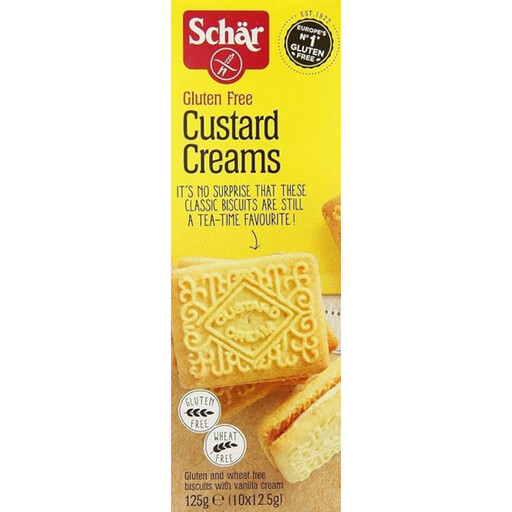
A gluten-free custard cream sold in individual portion packs.
This individually portioned gluten-free option is relevant when serving a small biscuit portion to a guest whose requirements match the supplied pack’s labelling.
 No image available
For separately served biscuits, Asda describes this Schär product as five individual packs with two custard creams in each. It is labelled gluten-free; the portion format does not establish that the biscuits themselves are bite-size. Check the supplied pack against any other dietary requirements.
Not necessarily. Hill Biscuits specifies three biscuits per packet for its custard-cream portion product, but that count does not tell you the dimensions of each biscuit. Check an explicit size specification if you need a physically smaller biscuit.
Either format can work for a cream tea. Individual packets give guests a stated biscuit count; with an ordinary packet, you can open it and plate the number you intend to serve. Check the quantity in a foodservice case before choosing it for a small gathering.
Follow the directions for the product you have bought. Tesco instructs customers to keep its custard creams in a cool, dry place and to use an airtight container once the packet is opened.
No. Asda lists wheat and milk in its standard custard creams but labels its separate Free From product gluten- and milk-free; the listed Schär portions are gluten-free. Check the supplied packet’s full ingredient and allergen information for each guest’s requirements.