Parents planning an occasional home treat
A single mini bar gives a child a defined piece rather than an open sharing bar. For the regular after-school snack, NHS Healthier Families recommends fruit and vegetables instead.


For a home after-school snack, a mini dark-chocolate bar can be an occasional, defined sweet treat, but its size alone does not make it the regular snack choice. NHS Healthier Families favours fruit and vegetable snacks; if you choose chocolate, compare the size of one piece, its nutrition information and the exact pack’s allergen label.
A single mini bar gives a child a defined piece rather than an open sharing bar. For the regular after-school snack, NHS Healthier Families recommends fruit and vegetables instead.
Individually wrapped bars make it easier to set aside one piece, but pack sizes differ considerably: Divine lists 160 bars of 12.5g, while Montezuma’s lists 26 bars of 25g. Consider how the rest of the pack will be stored and used.
Dark chocolate, a high cocoa percentage or a vegan description cannot replace a check of the exact pack. For example, Montezuma’s describes its FitzRoy mini bars as vegan but warns that they may contain milk, nuts and peanuts.
Decide whether this is a regular snack or an occasional sweet treat, then compare the actual piece you would offer. The British Nutrition Foundation’s 2025 survey of more than 2,500 UK children aged 10 to 13 reported answers to separate snacking questions; its figures below are not a single breakdown of preferences.
| Priority | What to check | Your needs |
|---|---|---|
| Piece and pack size | Check the weight of one piece, whether pieces are individually wrapped and how many the pack contains. Divine lists 12.5g bars; Montezuma’s FitzRoy mini bars are 25g each. | I want to offer one defined treat before dinner, without treating the whole pack as a serving. In the British Nutrition Foundation’s 2025 survey, 76% of the UK children aged 10 to 13 surveyed said they normally have a snack after school during the week; that figure does not measure chocolate purchases. |
| Regular snack or treat | Compare the role of chocolate with fruit, vegetables or another snack for the regular routine. For packaged chocolate, read sugars and saturates per 100g and per serving where given. | For an everyday after-school snack, I would rather choose something other than confectionery. In the British Nutrition Foundation’s 2025 survey of UK children aged 10 to 13, 32% selected chocolate among the foods they had most often as a snack; that is a reported food choice, not dietary advice. |
| The serving on the label | Check whether nutrition figures refer to 100g, one bar or another serving. Compare traffic-light labelling where it appears, rather than using cocoa percentage as a substitute for nutrition information. | Before offering a piece, I want to know what the figures say about that piece—not mistake a per-100g value for a per-bar value. |
| Recipe and allergens | Read the exact assortment, ingredients, allergen declaration and may-contain wording. Green & Black’s miniature collection mixes milk and dark bars; Montezuma’s FitzRoy mini-bar page warns of possible traces of milk, nuts and peanuts. | If every piece needs to be dark chocolate, or an ingredient must be avoided, I need the details for this pack rather than the brand name alone. |
| Where it will be served | Distinguish a snack offered at home from food supplied by a school. In England, the Requirements for School Food Regulations 2014 define chocolate as confectionery; check the applicable school-food requirements before buying for school provision. | A home treat and a school-supplied snack are different purchases. If I am buying for a school, I need to check its rules for that setting. |
A wrapper defines a piece, but it does not change the chocolate’s ingredients or nutrition information. NHS Healthier Families recommends fruit and vegetable snacks as the regular choice.
Choose the mini format when you intend an occasional sweet treat. Check the weight of one piece and keep the regular after-school snack decision separate.
Green & Black’s 12 x 15g miniature collection contains both milk and dark bars, according to Tesco Groceries. That matters when the flavour or ingredients of every piece count.
Read the assortment and ingredient list for the exact pack; choose a dark-only product if every piece needs to be dark.
Montezuma’s FitzRoy mini bars carry a may-contain warning for milk, nuts and peanuts. Lindt’s LINDOR Dark 70% truffles list milk and soya and warn of possible nut exposure.
For an allergy, check the current pack’s full ingredient, allergen and may-contain wording before serving it. Do not use cocoa percentage to judge allergen suitability.
School-provided food is a distinct setting. The Requirements for School Food Regulations 2014 define chocolate as confectionery for the England school-food rules; other UK nations have their own frameworks.
If buying for school provision, check the current requirements for that nation and school before ordering. A parent offering a treat at home after school is making a different decision.
These examples show why “mini dark chocolate” can mean different piece sizes and recipes; check the exact product rather than assuming a brand uses one format throughout.
Divine lists a 70% dark-chocolate pack of 160 individually wrapped 12.5g bars.
The FitzRoy Organic Dark Chocolate Mini Bars pack contains 26 bars of 25g each, listed at 74% cocoa.
Tesco Groceries lists a collection of 12 miniature 15g milk and dark chocolate bars.
LINDOR Dark 70% offers separate filled truffles rather than flat mini bars.
Its Dark Selectors range includes truffles, fruit-studded bites and pralines for tasting or gifting.
The cited M&S dark-chocolate product is a standard bar with at least 85% cocoa, not an individually portioned mini bar.
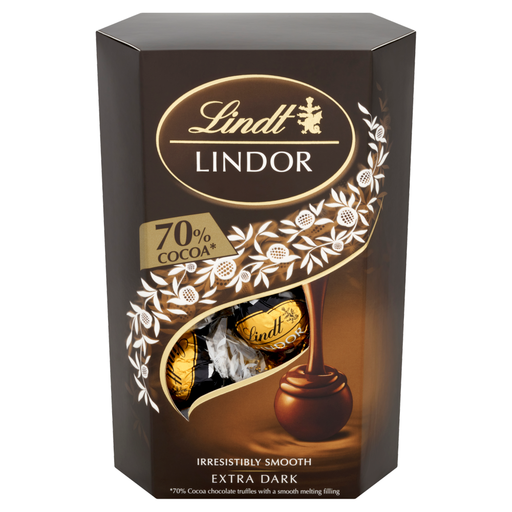
This selection is a dark-chocolate truffle pack for occasional home sharing, not a pack of mini bars with a stated weight per piece.
 No image available
Separate truffle pieces in a 200g pack offer a different format from a mini bar for an occasional home treat. If a defined serving matters, check the pack for each piece’s weight and nutrition information. The Joybuy listing identifies milk, soya and barley and warns of possible nuts; check the current pack before serving to anyone with an allergy.
A mini bar can define an occasional sweet portion, but its size does not change its role as chocolate. NHS Healthier Families recommends fruit and vegetable snacks as the regular choice; use the serving and nutrition information when deciding whether a chocolate treat fits a particular occasion.
Check the weight of one piece, the nutrition information per serving and per 100g, and the ingredients and allergen statement for the exact pack. Read any may-contain warning too: dark chocolate is not automatically free from milk, soya or nuts.
No. Cocoa percentage helps distinguish recipes, but it does not tell you the serving size, sugars, saturates or allergen suitability on its own. Compare those details on the products you are considering.
Check the school-food requirements before buying it for provision to pupils at a state-funded school in England. The Requirements for School Food Regulations 2014 define chocolate as confectionery, and the Department for Education describes requirements for food and drink provided in those schools. Those rules address school provision, not a parent offering a snack at home after school.