People who want a small tea-break portion
An individually wrapped bar makes the amount straightforward to identify. Divine lists 12.5g bite-size dark bars, while Montezuma’s lists 25g dark mini bars if you would prefer a larger bar.


Choose a 12.5g individually wrapped bar if a clearly defined small portion matters most, or a 25–35g mini bar if you want a larger single bar with tea. Truffles and batons give you pieces to serve or share, but check their piece size and the exact product’s ingredients rather than assuming a dark-chocolate label establishes portion size or dietary suitability.
The useful distinction is whether you want one bar with a stated weight or pieces you can serve from a larger pack.
An individually wrapped bar makes the amount straightforward to identify. Divine lists 12.5g bite-size dark bars, while Montezuma’s lists 25g dark mini bars if you would prefer a larger bar.
Compare the stated cocoa percentage and any flavour additions on the exact product. Divine lists 70% dark bars, while Hotel Chocolat lists both 70% and 85% dark batons.
A multipack or box provides several portions, but the total pack size and mix of varieties matter. Check every product’s ingredients and allergen wording before serving it to someone with a food allergy.
Start with the portion you intend to serve, then compare the recipe and total pack size. A cocoa percentage describes the stated cocoa content; it does not establish the product’s allergen profile.
| Priority | What to check | Your needs |
|---|---|---|
| Portion format | Compare the stated weight of a single bar with a box’s total weight. Divine lists 12.5g and 35g bars; Montezuma’s lists 25g dark mini bars. For truffles, check the piece count or piece weight if either matters. | I want to take one bar to my tea break without deciding how much to break off. Alternatively, I would rather select a few pieces to serve. |
| Cocoa and recipe | Read the cocoa-solids statement for the exact product and note added flavours or fillings. Lindt states 70% cocoa in the dark shell of its LINDOR truffles; that figure does not describe the whole truffle. | A plain dark bar appeals to me, or I would prefer a flavoured piece alongside tea. I want to compare the actual recipes, not just the word ‘dark’. |
| Ingredients and allergens | Check the exact pack’s ingredients, declared allergens and ‘may contain’ wording. Lindt’s LINDOR Dark 70% truffles list milk, soya and barley malt extract and warn of possible nut presence. | If I am serving someone with an allergy or a dietary requirement, I need to assess the specific variant before offering it. |
| Pack size and mix | Check both the number of pieces and whether every piece is the variety you want. Divine’s 12.5g bars come in a 160-bar pack; Montezuma’s 10 × 25g collection includes dark and milk-chocolate bars. | For occasional tea breaks, I may want fewer pieces to keep. For a group, the number and variety of portions matter more. |
Recipes and precautionary statements differ. Divine labels its 35g 70% bar vegan but also states that it may contain milk, gluten and nuts; Lindt’s LINDOR Dark 70% truffles list milk-derived ingredients, soya and barley malt extract.
Read the exact product’s ingredients and allergen wording before buying, and check the delivered pack before serving it to someone with a food allergy.
A small bar does not necessarily mean a small pack: Divine lists its 12.5g bars in a pack of 160.
Match the pack count to how often you will serve the chocolate, and compare smaller packs if you only want it occasionally.
A larger pack also needs somewhere suitable to store the remaining bars.
Montezuma’s 10-bar mini collection includes milk-chocolate bars as well as dark ones. Hotel Chocolat’s dark range also includes filled and flavoured products.
Check the listed varieties and each relevant ingredient statement. If every piece needs to meet the same requirement, consider a single-variety product.
Lindt’s LINDOR Dark 70% truffles come in a 200g box; the box weight does not tell you the weight of an individual tea-break portion.
Choose how many pieces to serve before opening the box, or select a mini bar with a stated single-bar weight if that is easier for your plans.
These brand references show different ways to serve dark chocolate with tea; check the individual product rather than applying a range-wide description to every recipe.
Divine lists 70% dark bars in both 12.5g bite-size and 35g formats.
Montezuma’s lists 25g dark mini bars, including FitzRoy, Royal Mint and Sea Dog varieties.
Lindt lists LINDOR Dark 70% truffles in a 200g box for people who prefer separate pieces to mini bars.
Hotel Chocolat lists 70% and 85% dark batons alongside filled and flavoured dark selections.
M&S lists dark-chocolate sharing bags, including 70% dark-chocolate-coated sour cherries and 70% dark-chocolate cocoa-dusted almonds.
This truffle box represents the piece-by-piece option for serving or sharing dark chocolate with tea, rather than the fixed-weight mini-bar formats discussed above.
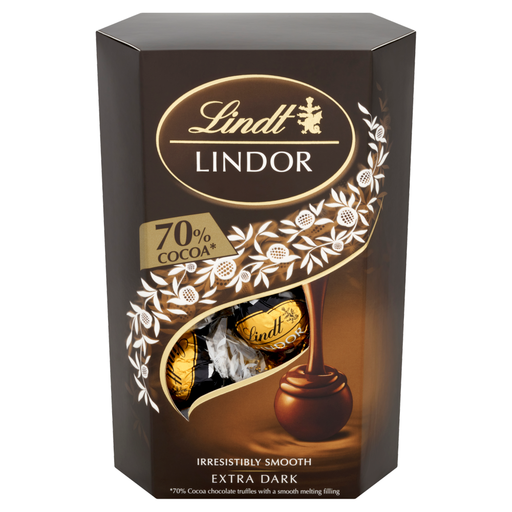 Image unavailable
A box of separate truffles for choosing pieces at tea time or serving to others. Lindt states that the 70% cocoa figure applies to the dark shell; the 200g box does not define a single serving. The listed ingredients include milk, soya and barley malt extract, and the product may contain hazelnuts and other nuts. Check the current pack before serving.
A mini bar with a stated single-bar weight gives you the clearest starting point. Divine lists 12.5g bite-size bars, while Montezuma’s lists 25g dark mini bars; with truffles or batons, check the piece details and decide how many to serve.
Not by itself. Compare the stated cocoa content alongside the ingredients, flavours and format you want. Check what the figure describes: Lindt specifies 70% cocoa in the dark shell of its LINDOR truffles, not in the whole filled piece.
No. Divine labels its 35g 70% bar vegan but states that it may contain milk, while Lindt’s LINDOR Dark 70% truffles list milk-derived ingredients. Check the exact product’s ingredients and precautionary wording for the requirement that matters to you.
Check the exact pack’s ingredients, declared allergens and ‘may contain’ statements before serving it. The UK Food Standards Agency’s allergen guidance requires food businesses to provide allergen information and identifies 14 allergens that must be declared when present as ingredients; individual recipes and cross-contact warnings still need attention.
Yes, particularly when buying for someone with an allergy or dietary requirement. Use the product listing to make an initial choice, then check the delivered packet for the ingredients and allergen wording of that exact variant.