
24/7 Customer Support

Free returns

Same-day & Next-day Delivery

Quality Guaranteed

Unlock Your Welcome Offers: FREE Delivery | Up to 80% OFF | Free 30-day JoyPlus trial
Download the APP
A mini fitness trampoline can add compact cardio to a UK home gym without taking up the floor space of a treadmill or cross-trainer. However, product listings can make similar-looking rebounders appear interchangeable. The important differences are often hidden in the maximum user weight, suspension system, storage format and handlebar design.
Before buying, watch for three common traps:
Confusing diameter with usable workout space
A 36-inch trampoline is easier to store, but it gives less room for lateral movement than a 42- or 48-inch model. Always check the assembled dimensions, not just the headline diameter.
Assuming every handle provides meaningful support
A trampoline with handle may improve balance, but a handlebar is not a substitute for a stable frame, correct installation or safe positioning. Check whether the height is adjustable and whether it must be secured before use.
Ignoring the suspension type and noise level
Steel springs and elastic bands produce different rebound characteristics. A bungee rebounder or resistance-band trampoline may be quieter, while a spring model may provide a more familiar responsive bounce. Neither system removes the need for routine inspections.
The stated maximum load is a safety limit, not a suggested target. Select a model with a suitable margin for the intended user and do not exceed the published figure.
For example, the products below range from 25kg children’s models to adult rebounders listed with load capacities of up to 250kg, depending on size. A compact frame may be convenient in a flat or spare room, but a larger frame can offer more room for controlled movement.
Also measure the ceiling height and surrounding clearance. Place the trampoline on a level, stable floor away from walls, furniture and other obstacles. Only one person should use it at a time.
The suspension system affects feel, sound and maintenance:
A quieter system may be more suitable for flats, upstairs rooms or early-morning workouts, but advertised noise levels can vary with flooring, footwear and jumping style. A non-slip mat beneath the equipment may help protect flooring and reduce movement.
A folding fitness trampoline is useful where equipment must be stored after each session. Check the folded dimensions as well as the assembled footprint. Pre-assembled mats, springs or bands can reduce set-up time, but every joint, fastener and handle connection still needs checking before use.
An adjustable handlebar trampoline can support balance during controlled exercise. Adjust it to a comfortable height and confirm that it locks securely. Foam padding or a full-coverage spring pad may reduce contact with the suspension components, but users should still avoid high-risk manoeuvres and somersaults.
The product listings featured here state compliance with EN ISO 20957-1, alongside GB and ASTM references, for several SPORTSOUL models. Treat this as product information to review rather than a replacement for reading the supplied instructions and safety warnings.
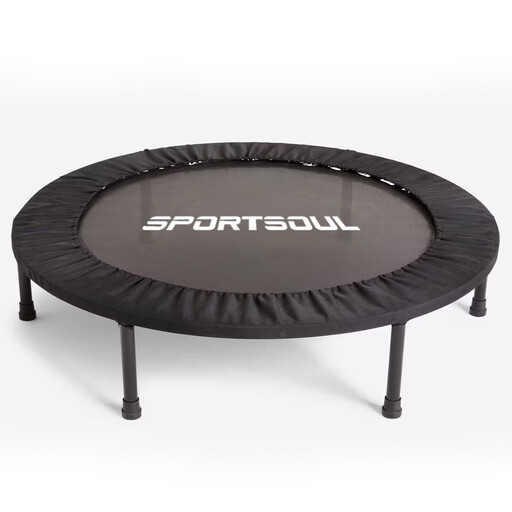
Why This Fits Their Persona: Its 40-inch footprint and 6.6kg net weight suit adults who want a straightforward indoor rebounder trampoline for occasional cardio in a smaller room.
The listing states the exact 1016mm footprint, 36 steel springs and 100kg maximum user weight, making the core specifications clear.
Steel frame; silent, non-slip foot covers; no assembly is required according to the listing.
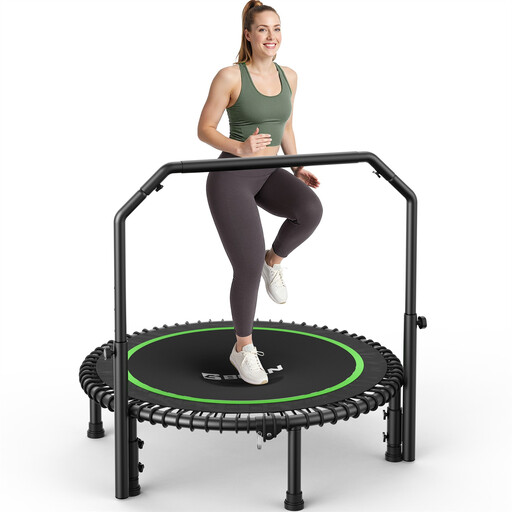
Why This Fits Their Persona: Buyers prioritising a quieter, robust set-up can choose between 102cm and 122cm sizes, with an adjustable handle and listed capacities of 204kg or 250kg.
The suspension is identified as bungee cord rather than left as an unspecified “silent” feature, and the capacity varies clearly by size.
Bungee suspension; adjustable handlebar; suitable for indoor or outdoor use according to the listing.
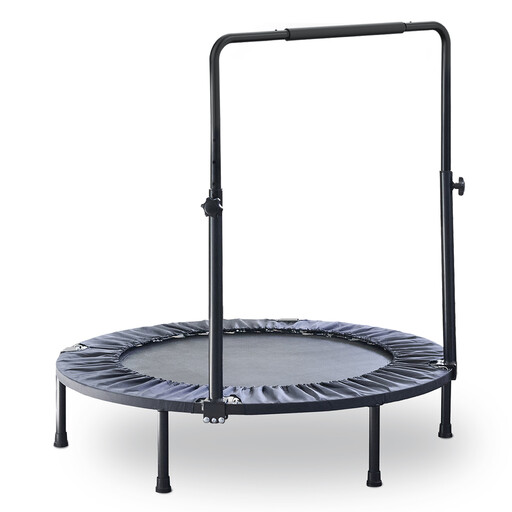
Why This Fits Their Persona: The larger 48-inch surface and adjustable handrail suit adults who want balance support during controlled home workouts and have storage space available.
Its 80kg maximum load is clearly stated, preventing buyers from assuming that a larger frame automatically supports heavier users.
Folding format; 40 steel springs; integrated foam pad and pre-assembled components.
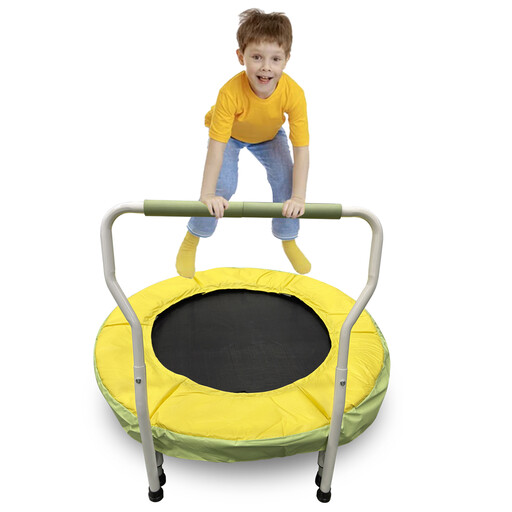
Why This Fits Their Persona: This 36-inch children’s indoor trampoline has a T-shaped adjustable bar, full-coverage spring pad and a 25kg maximum capacity for supervised use.
The 25kg limit and one-child-at-a-time warning are explicit. The full pad covers all 24 listed steel springs.
Adjustable handle; full-coverage spring safety pad; 916mm assembled width.
We have compiled a complete, real-time list of products that fully satisfy these strict selection criteria and UK safety regulations.
Use the trampoline on a firm, level surface with adequate overhead clearance. Keep it away from radiators, damp areas and sharp furniture edges. If it has folding joints, unfold it completely and confirm that each locking point is secure before exercising.
For a spring model, inspect the mat, frame, springs and protective pad before every session. For a resistance-band or bungee model, look for fraying, stretching or loose attachment points. Wipe the frame and mat with a soft, damp cloth and mild soap, then dry thoroughly.
A mini trampoline does not require electricity, so its direct running cost is limited. The longer-term costs are replacement suspension components, protective pads and floor protection if parts wear. Avoid outdoor exposure unless the listing specifically permits it, and store the equipment indoors where possible.
Yes, provided the selected model’s maximum user weight, dimensions and intended use match the adult using it. Adult options in this guide range from 70kg or 80kg models to the BCAN sizes listed at 204kg and 250kg. Always follow the product instructions and use only one person at a time.
Bungee cords and elastic bands are designed to reduce noise compared with some steel-spring designs, but the result depends on the floor, frame movement and exercise intensity. A stable surface and suitable floor mat may help. Check the suspension type rather than relying only on phrases such as “quiet” or “silent”.
There is no universal lifespan. Durability depends on user weight, frequency of use, storage and maintenance. Inspect the mat, frame, springs, elastic bands, bungee cords and handlebar before each session. Stop using the trampoline if any structural or suspension component is damaged, and follow the supplier’s guidance for replacement parts.