
24/7 Customer Support

Free returns

Same-day & Next-day Delivery

Quality Guaranteed

Unlock Your Welcome Offers: FREE Delivery | Up to 80% OFF | Free 30-day JoyPlus trial
Download the APP
A mini fitness trampoline can make home cardio more engaging while taking up far less space than a treadmill or cross-trainer. However, product photos and phrases such as “low impact”, “professional rebound” and “heavy duty” do not tell you everything you need to know.
The important details are often less visible: the user-weight limit, rebound system, handlebar stability, folded dimensions and the amount of clearance needed around the frame. A careful comparison helps prevent an unsuitable purchase, particularly in smaller UK homes where storage and flooring matter.
A compact frame does not automatically mean it can support an adult. Some children’s models have a 25kg maximum user weight, while adult fitness trampolines may support 70kg, 80kg, 100kg or more.
Always compare the stated capacity with the intended user’s weight. Do not rely on frame appearance or the diameter alone. The limit applies to one user at a time and should not be exceeded.
A rebounder may feel gentler than some other cardio equipment, but jumping still creates a fall and impact hazard. A mat, springs or resistance bands can wear, and an unsecured handle may move during use.
Look for practical safety features such as:
Children should always use a kids’ mini trampoline under direct adult supervision. Somersaults and high-risk manoeuvres are not appropriate for these products.
“Folding” does not mean the product becomes completely flat or fits in every cupboard. Check both the open footprint and the packaged or folded dimensions. A 48-inch model requires noticeably more floor space than a 36-inch indoor rebounder trampoline.
Also consider whether you have a clear, level surface available each time you exercise. Carpets, uneven flooring and nearby furniture can affect stability.
A spring trampoline generally provides a responsive bounce and is commonly used for adult cardio workouts. Steel springs should be covered by a protective pad and inspected regularly for stretching, corrosion or damage.
Resistance-band systems replace metal springs with elastic bands. They may produce less mechanical noise, which can be useful in flats or terraced homes where sound travels through floors. Their feel can also be different, with a softer response in some designs. Elastic bands still require inspection and replacement if they show cracking, fraying or loss of tension.
Neither system removes the need for controlled movement. Choose according to the desired bounce, noise level and maintenance preferences rather than relying on promotional wording.
Common compact sizes include 36, 40, 42 and 48 inches. A larger jumping surface can provide more room for controlled movement, but it also needs more floor area.
A trampoline with handle can provide an additional point of contact for balance. An adjustable handlebar rebounder is particularly useful when users of different heights share the equipment. Check that the bar locks securely at its chosen height and does not become a substitute for proper balance or supervision.
Remember to measure ceiling height, especially if the trampoline is used in an upstairs room. Leave space around the equipment so the user is not close to walls, lamps, shelves or furniture.
The maximum user weight is one of the most important technical figures. Consider the stated limit a boundary, not a target. A suitable model should leave a sensible margin for the intended user and movement style.
Steel frames and polypropylene jumping mats are common materials in this category. A powder-coated steel frame can help protect the surface finish, while foam pads cover springs or elastic bands. These features are useful, but they do not eliminate wear.
Some listed models reference EN ISO 20957-1, alongside other standards. This standard relates to general safety requirements for stationary training equipment. A product listing’s stated compliance should not be treated as permission to ignore the manufacturer’s instructions. Check the current product page for the exact specifications and warnings before purchase.
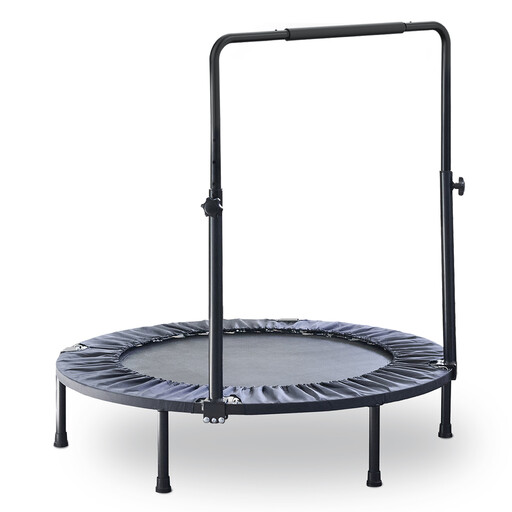
Why This Fits Their Persona: Its 40-inch footprint suits a home gym corner, and the folding design can help households store equipment between sessions. The adjustable handle offers support for users beginning controlled home cardio.
The listing states a 70kg maximum user weight, pre-assembled springs and an integrated foam pad, making the key limitations clearer than a generic “fitness” label.
40-inch round frame; 36 steel springs; adjustable handle; minimal assembly.
Why This Fits Their Persona: Users wanting a larger jumping area and a higher stated capacity may prefer this wider home exercise trampoline, provided they have enough room to use and store it.
The 80kg capacity and 48-inch diameter are specified clearly, helping shoppers compare actual measurements rather than vague “large” claims.
48-inch surface; 40 steel springs; foam spring cover; adjustable handle.
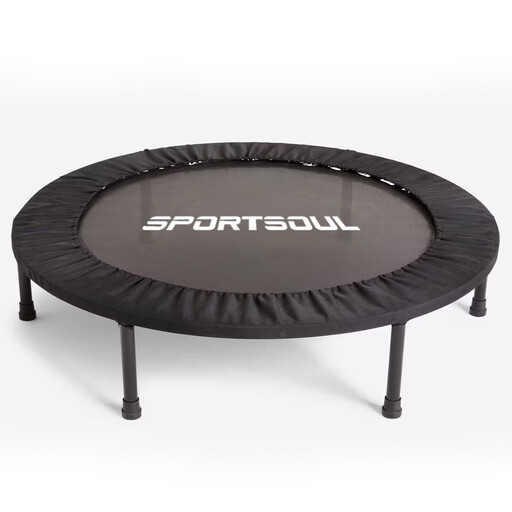
Why This Fits Their Persona: This option is aimed at adults who prioritise a higher stated load limit in compact home gym equipment and do not require a handlebar.
The stated 100kg maximum user weight is visible, while silent, non-slip foot covers address floor contact and movement during use.
40-inch diameter; 36 steel springs; 100kg stated capacity; no assembly required.
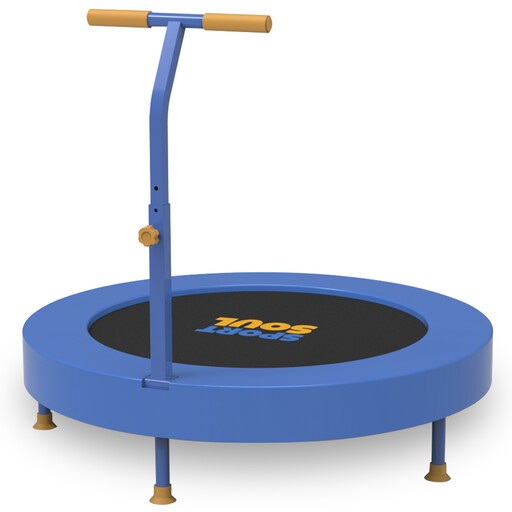
Why This Fits Their Persona: The 36-inch frame, adjustable T-shaped bar and springless resistance-band design suit lighter users, including children using the equipment indoors under adult supervision.
Its 25kg capacity is clearly intended for lighter users, while the foam-covered band area and adjustable bar provide defined safety features.
24 elastic resistance bands; foldable frame; adjustable T-shaped handle; minimal assembly.
Place the mini fitness trampoline on a level, stable surface away from walls and furniture. Confirm that the frame is fully unfolded or assembled, the handle is locked if fitted, and the mat and protective covering are correctly positioned.
Before every session, check for:
Use suitable athletic footwear, keep to one user at a time and avoid high-risk movements. Wipe the frame and mat with a soft, damp cloth and mild soap, then dry thoroughly. Store the equipment indoors when possible, particularly in damp UK conditions.
We have compiled a complete, real-time list of products that fully satisfy these strict selection criteria and UK safety regulations.
It can be, provided the product is used on a stable floor with sufficient clearance and the noise level is acceptable for your building. Resistance-band models may be quieter than spring designs, while non-slip feet can help reduce movement. Avoid exercising during noise-sensitive periods and check your tenancy or building rules if relevant.
No. A standard rebounder is manually powered, so there is no electricity cost during use. Ongoing costs may include replacement springs, resistance bands, mats or protective pads if these parts become worn.
There is no universal lifespan. It depends on user weight, frequency of use, storage conditions and maintenance. Regular inspections are more useful than relying on a fixed time promise. Stop using the trampoline if the frame, mat, springs, bands or padding are damaged, and consult the product supplier about compatible replacement parts.