
24/7 Customer Support

Free returns

Same-day & Next-day Delivery

Quality Guaranteed

Unlock Your Welcome Offers: FREE Delivery | Up to 80% OFF | Free 30-day JoyPlus trial
Download the APP
A mini fridge can solve a genuine space problem, whether you live in a student room, run a home office or need extra capacity for drinks and fresh food. However, compact appliances vary considerably. A small-footprint fridge designed for a desk is not interchangeable with an undercounter fridge intended for everyday food storage.
The main buying traps are usually hidden in the product category rather than the price tag.
Choose capacity according to what you actually intend to store:
Check the full measurements, not just the width. For example, the COMFEE’ 88L models measure 44.5W × 47D × 82.7H cm, while the Sharp 122L undercounter refrigerator measures 838H × 540W × 595D mm. Leave space around the appliance as specified in its instruction manual and avoid blocking ventilation openings.
A countertop fridge should be assessed differently from an undercounter model. Confirm that the surface can support its weight and that the door will open without hitting a wall, desk or bedside table.
Compressor refrigerators are designed for regular chilled food and drink storage. They generally offer a more suitable temperature range than thermoelectric models, although noise, energy use and defrosting requirements vary.
Thermoelectric products, including some personal beauty fridges, are typically measured by how far they cool below ambient temperature. For instance, the AstroAI 4L model states cooling of up to 20°C below ambient, while the 6L model states 18–22°C below room temperature, with a minimum temperature specification rather than freezer performance. These models cannot freeze and their cooling depends on the surrounding temperature.
For milk, fresh food and larger quantities of drinks, look for a conventional refrigerator with an adjustable thermostat. If you are storing food, follow the manufacturer’s instructions and UK food-safety guidance rather than assuming that a marketing term such as “rapid cooling” guarantees a particular storage result.
The UK energy label uses an A to G scale, with the annual consumption shown in kWh. Comparing the kWh figure is more useful than relying on phrases such as “energy saving”, because running costs depend on your electricity tariff and usage.
Among the listed full-size compact models, several are rated E. The Sharp SJ-UE121M4W-EN specifies 145 kWh per year, while the Sonlu CS-100L specifies 84 kWh per year. Capacity, cooling system and test conditions differ, so compare like with like.
Noise is especially important for an office or bedroom fridge. A stated rating of 40 dB(A), as shown for the Sharp and Sonlu models, can help with comparison. Portable thermoelectric models may state lower figures, such as under 25 dB, but their cooling performance and capacity are also much smaller.
Useful fittings include:
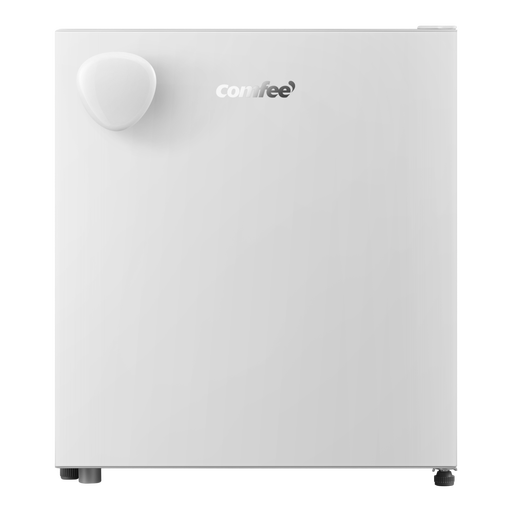
Why This Fits Their Persona: Its 44.5cm width suits single-person households, narrow kitchen gaps, offices and smaller UK flats where floor space is restricted.
It provides three temperature settings, height-adjustable storage and a separate chill box rather than relying on a vague portable-cooling claim.
43L capacity, 110 kWh annual consumption and a removable handle. Available in white and black variants.
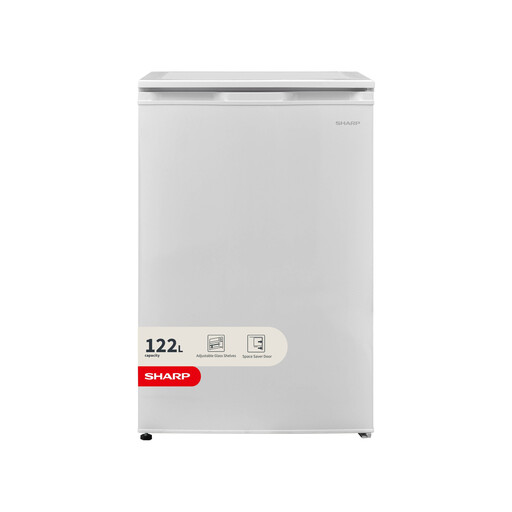
Why This Fits Their Persona: It is suited to shoppers wanting a larger compact refrigerator for a kitchen, flat or secondary food-storage area.
Its stated measurements, 40 dB(A) noise level and 145 kWh annual consumption give clear comparison points before purchase.
122L total capacity, reversible door, two adjustable glass shelves, LED light and an icebox.
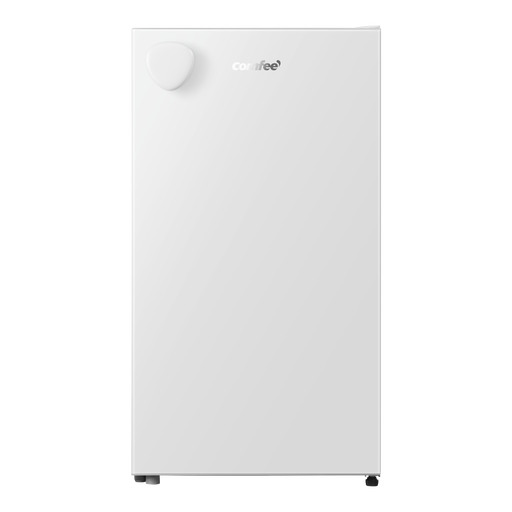
Why This Fits Their Persona: Its balance of everyday capacity and compact sizing works for offices, studio flats, guest rooms and secondary drink storage.
The specifications identify its 88L storage, reversible door and removable shelves, while the cooler zone is clearly described for short-term chilling only.
44.5cm width, 47cm depth, crisper drawer, interior light, adjustable thermostat and removable handle.
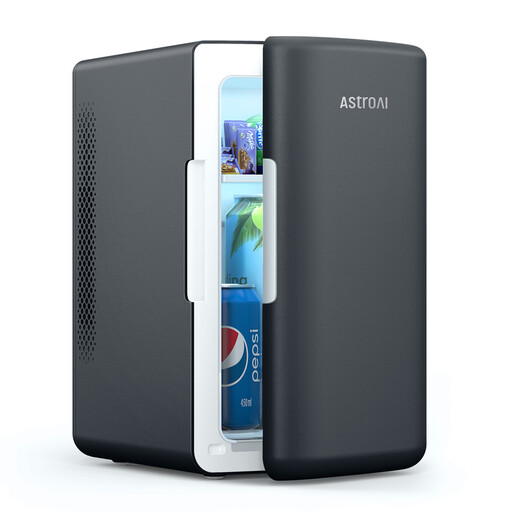
Why This Fits Their Persona: A useful choice for a bedroom, desk, gaming area, office or car where a full-size fridge would be impractical.
Its listing states that it uses a cooling chip rather than a compressor and cannot freeze, making its limits clearer than generic “mini fridge” wording.
6L capacity, AC and 12V DC power options, cooling and warming modes and a removable water catch tray.
Place a compact refrigerator on a level, stable surface with adequate ventilation. Do not cover the vents or push a compressor model tightly against a wall. After transport, follow the manufacturer’s guidance before switching it on.
To estimate running cost, multiply the annual kWh figure by your electricity tariff. A product with a lower purchase price may not be the most economical choice if it has higher annual consumption. For a thermoelectric portable mini fridge, also consider that continuous power may be required to maintain cooling.
Before ordering, measure the installation area, check the door hinge direction, confirm whether a freezer compartment is included and verify the delivery route. If your priority is a bedroom appliance, compare noise ratings and avoid selecting a large undercounter fridge simply because it offers more litres than you need.
We have compiled a complete, real-time list of products that fully satisfy these strict selection criteria and UK safety regulations.
Yes, provided the dimensions, noise rating and ventilation requirements suit the room. A small compressor fridge can store food and drinks, while a thermoelectric model is more suitable for cans, snacks or personal items. Check the stated dB(A) level before placing one beside a bed.
Running cost depends on annual electricity consumption in kWh and your tariff. Use the product’s energy-label figure for an estimate. Thermoelectric models may have a lower capacity but can require continuous power, so compare the complete specification rather than purchase price alone.
Lifespan varies with construction, usage, ventilation and maintenance. Keep the door seal clean, avoid overloading, allow airflow around the appliance and defrost manual-defrost models when ice builds up. Always follow the manufacturer’s care and safety instructions.