
24/7 Customer Support

Free returns

Same-day & Next-day Delivery

Quality Guaranteed

Unlock Your Welcome Offers: FREE Delivery | Up to 80% OFF | Free 30-day JoyPlus trial
Download the APP
A mini fridge can solve a genuine space problem in a flat, student room, office or campervan. However, compact refrigeration products are not interchangeable. A 4-litre thermoelectric cooler is designed for cans and snacks, while an 88-litre under-counter fridge is intended for everyday food storage.
The most common buying mistakes come from focusing on appearance or headline capacity while overlooking installation, cooling technology and running costs. Use this guide to compare small fridges, drinks fridges, wine coolers and portable car fridges before ordering.
A product may advertise its total capacity, but internal shelves, compressor housing and door compartments reduce the space available for larger bottles or food containers. Check the internal layout, shelf adjustability and whether the stated capacity is suitable for your actual routine.
A bedroom fridge for milk, snacks and a few drinks needs different storage from an office fridge used by several people. If you need fresh food storage, a full-size compact fridge is generally more appropriate than a cosmetic or drinks cooler.
Thermoelectric models cool relative to the surrounding temperature and usually cannot freeze. Their performance may also be affected by a warm room, direct sunlight or frequent door opening. Compressor models, by comparison, are used in many portable camping fridges and can provide substantially lower temperatures, sometimes including freezer operation.
Read the temperature range carefully rather than relying on phrases such as “deep cooling” or “rapid chilling”.
A mini fridge still produces heat. Blocking the ventilation area can increase energy use and place additional strain on the appliance. Built-in and freestanding models also have different clearance requirements.
Measure the available width, depth and height, then allow room for ventilation, the power cable and the door to open fully. A reversible door can be especially useful in a studio flat or narrow kitchen.
For everyday food storage, models around 80–90 litres offer a useful balance between footprint and capacity. The Sonlu CS-100L, for example, provides 82 litres, adjustable glass shelves, a crisper drawer and door racks in a freestanding format.
An under-counter fridge should be checked against the actual worktop aperture rather than a rounded product description. The Comfee 88L models measure 44.5 cm wide, 47 cm deep and 82.7 cm high, making them suitable for many compact kitchen layouts, offices and studio flats. Always compare these measurements with the manufacturer’s installation instructions.
A small fridge intended for a bedside table or car is a different category. A 4-litre appliance may hold up to six 330 ml cans, but it will not replace a food-storage fridge.
Look for a clearly stated cooling method:
A drinks fridge may only need adjustable chilling, whereas a camping fridge should ideally include battery protection and a suitable DC connection. For wine, check the temperature range, number of zones and bottle capacity rather than treating all beverage coolers as interchangeable.
UK fridge energy labels use a scale from A to G. An E-rated model is not automatically unsuitable, but annual consumption should be considered alongside capacity and intended use. For example, the Sonlu 82L refrigerator lists 84 kWh annual consumption, while the Comfee 43L model lists 110 kWh per year. These figures should be read in context: capacity, operating conditions and usage all influence actual electricity costs.
Noise is important in a bedroom, open-plan flat or home office. Several listed models specify operation around 39–40 dB, but compressor cycling can still be audible in a quiet room. Check the product specification and position the appliance on a level surface.
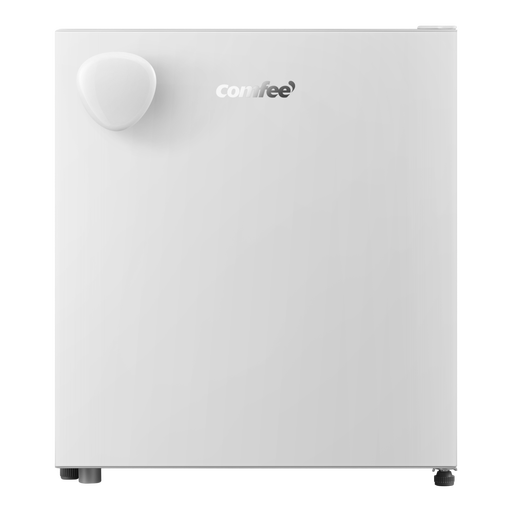
Why This Fits Their Persona: Its 44.5 cm width is practical for narrow gaps, rented rooms and smaller kitchens where floor space is limited.
It provides a stated 43L capacity, three-stage temperature adjustment and removable storage features rather than relying only on a small external footprint.
Adjustable shelves, a vegetable compartment, bottle storage and a removable handle.
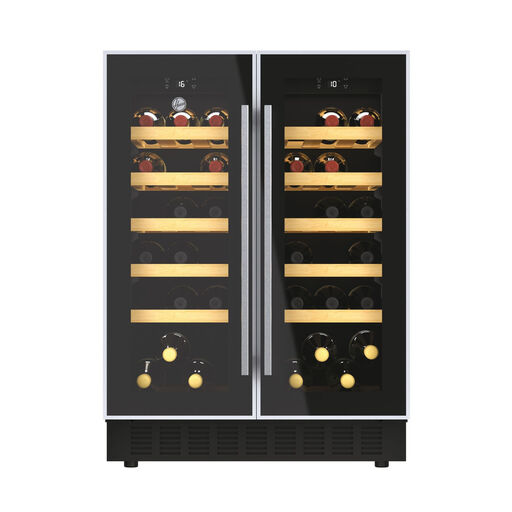
Why This Fits Their Persona: Designed for an integrated kitchen installation, it suits wine enthusiasts planning a coordinated under-counter layout.
Its built-in format, reversible door and stated dimensions make installation planning clearer than choosing a freestanding cooler by appearance alone.
Dual temperature zones, 38-bottle capacity, UV-resistant smoked glass and 39 dB stated noise level.
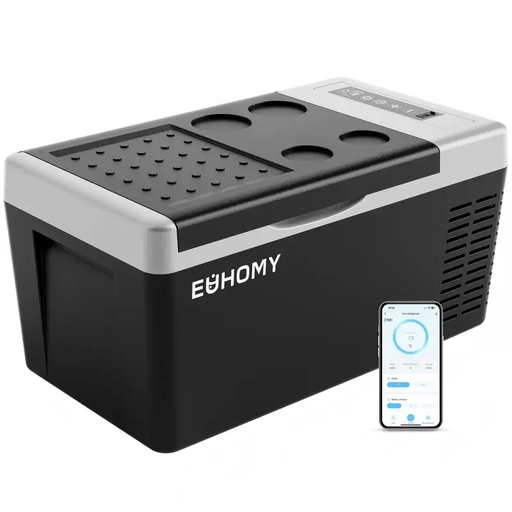
Why This Fits Their Persona: It is suited to motorists, campers, boat users and campervan owners who need portable refrigeration rather than a mains-only appliance.
Its compressor system is specified for refrigerator or freezer use, while three-stage battery protection helps manage vehicle power consumption.
18L capacity, -20°C to +20°C stated range, 12/24V DC and 100–240V AC compatibility, plus app control.

Why This Fits Their Persona: Its small footprint works for personal drinks, snacks or skincare in a bedroom, home office, car or travel setting.
The listing clearly identifies thermoelectric cooling and states that it cannot freeze, helping prevent unsuitable food-storage expectations.
Holds up to eight cans, supports AC and 12V DC power, and offers cooling and warming modes.
We have compiled a complete, real-time list of products that fully satisfy these strict selection criteria and UK safety regulations.
Running cost depends on the appliance’s annual kWh figure, electricity tariff, room temperature and usage. Compare annual consumption between similar-capacity models rather than relying only on the energy class. A smaller appliance is not automatically cheaper if it has higher stated annual consumption or is used heavily.
Yes, provided the model is intended for indoor use and has adequate ventilation. Noise is worth checking carefully: specifications around 39–40 dB may be suitable for many rooms, but individual sensitivity varies. Place it on a firm, level surface and leave the recommended clearance around the appliance.
Lifespan varies with build quality, operating conditions, cleaning and maintenance. Keeping vents clear, avoiding overloading and checking door seals can reduce unnecessary strain. Follow the supplied instructions, and do not attempt to repair the refrigerant circuit yourself.