
24/7 Customer Support

Free returns

Same-day & Next-day Delivery

Quality Guaranteed

Unlock Your Welcome Offers: FREE Delivery | Up to 80% OFF | Free 30-day JoyPlus trial
Download the APP
A mini fridge can solve everyday storage problems in a small flat, shared home, office or student room. However, compact appliances vary considerably. A desktop cooler designed for six cans is not a substitute for an undercounter fridge, while a larger 88L model may be impractical for a bedside table or car journey.
The key is to match the appliance to the way you will use it, rather than relying on attractive photos or broad marketing claims.
Many small and portable mini fridges use thermoelectric technology. These models can cool below the surrounding temperature, but performance depends on room or vehicle temperature. They generally cannot freeze, and continuous power is required to maintain cooling.
That makes them suitable for drinks, snacks, skincare or short-term personal storage, but not automatically suitable for replacing a compressor refrigerator for fresh food.
A compact fridge may fit neatly beside a desk, yet hold fewer cans or bottles than expected. Check both the external dimensions and the internal layout, including shelf height, door storage and usable depth.
For example, a 4L portable mini fridge may hold up to six 330ml cans, while a 43L fridge provides separate areas for bottles, chilled items and vegetables.
Energy use depends on the appliance’s rated consumption, your electricity tariff, room temperature and how often the door is opened. Look for the EU-style energy class shown on the product listing, annual energy consumption where provided and the appliance type.
The COMFEE’ 43L models listed here specify 110 kWh/year and Energy Class E. This is a more useful comparison point than an unqualified “low energy” description.
Choose capacity according to your routine:
Capacity figures are not directly comparable with the number of cans a product can hold. Shelves, drawers and door racks take up part of the internal space.
Measure the intended position carefully. Record the available width, depth and height, then allow room for ventilation and for the door to open fully. Do not place a compressor or household fridge tightly against a wall unless the instructions permit it.
An undercounter fridge such as an 88L model measures approximately 44.5W × 47D × 82.7H cm. A 43L model has a listed width of 44.5cm, making it suitable for some narrow gaps. Confirm the opening direction too: a reversible door can be useful in a small kitchen or shared room.
A portable thermoelectric model may offer cooling and warming modes, but it is not equivalent to a compressor fridge. The AstroAI 4L model cools up to 20°C below ambient temperature and warms items up to 66°C. The 6L version specifies cooling of approximately 18–22°C below room temperature, with a stated minimum of 0°C.
For home use, check the supplied 220–240V AC cable. For travel or motorists, confirm that a 12V DC cable is included and follow the vehicle manufacturer’s guidance. The AstroAI models provide both AC and DC connections. Never use a household appliance in a way that conflicts with its instructions or electrical rating.
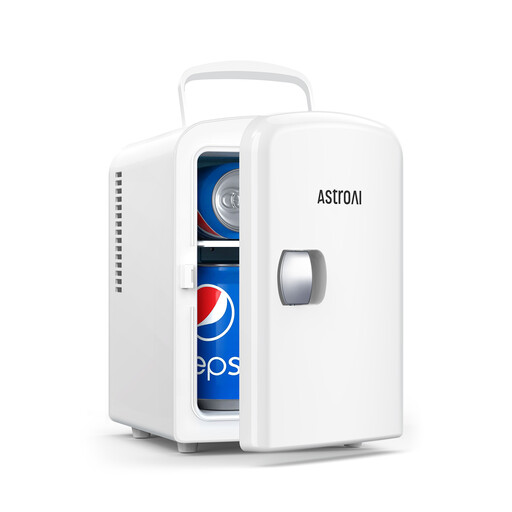
Why This Fits Their Persona: Its 4L capacity suits a student, shared-home resident or first-time buyer who needs personal storage without giving up floor space.
The listing states its internal and external dimensions, capacity and thermoelectric limitations, so expectations are clearer than with vague “personal fridge” wording.
Holds up to six 330ml cans and includes 220V AC and 12V DC cables for home, office or car use.
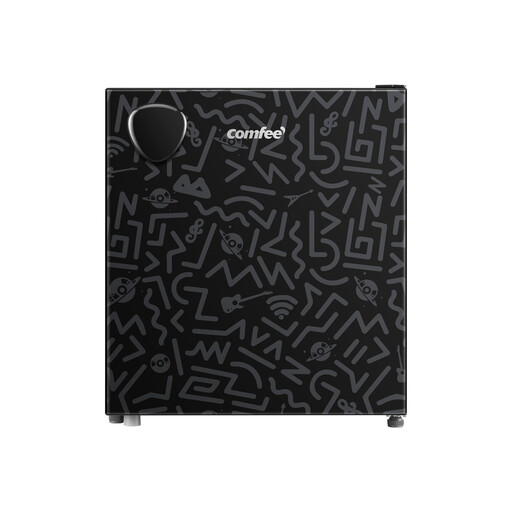
Why This Fits Their Persona: A solo household or studio-flat resident can gain organised everyday storage while keeping a relatively narrow footprint.
The 43L capacity, 44.5cm width and annual energy figure of 110 kWh are specified, helping you compare space and consumption more realistically.
Three temperature settings, height-adjustable shelving, a vegetable compartment and a removable handle.
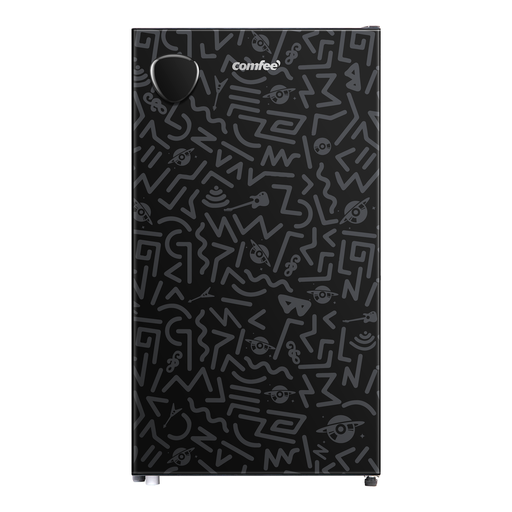
Why This Fits Their Persona: Its larger capacity suits an office, bedroom or studio flat where drinks, fresh food and everyday essentials need dedicated storage.
Its stated 88L capacity and 82.7cm height make it easier to distinguish from a desktop cooler. The product information also specifies that the drinks cooler zone is for short-term cooling only.
Removable glass shelves, crisper drawer, interior light, adjustable thermostat and reversible door.

Why This Fits Their Persona: Travellers, motorists and skincare users get a little more room than a 4L model while retaining a portable format.
The listing gives separate internal and external measurements and explains that the cooling chip cannot freeze, preventing confusion with a conventional refrigerator.
Fits up to eight 330ml cans and provides AC 220–240V and DC 12V operation, plus a condensation water catch tray.
We have compiled a complete, real-time list of products that fully satisfy these strict selection criteria and UK safety regulations.
Yes, provided its dimensions, operating noise and cooling method suit the room. A 4L or 6L thermoelectric model is convenient for personal drinks or skincare. For regular food storage, consider a household 43L or 88L refrigerator and follow the manufacturer’s placement and ventilation instructions.
Use the annual kWh figure shown in the product information and multiply it by your electricity tariff. Actual consumption can vary with ambient temperature, thermostat setting, ventilation and door opening. The listed COMFEE’ 43L model states 110 kWh/year, providing a reference figure for comparison.
Lifespan depends on the cooling system, maintenance, ventilation and usage. Keep air openings clear, avoid overloading shelves, clean spills promptly and follow the manual when transporting the appliance. Portable thermoelectric coolers and household compressor refrigerators are different product types, so compare like with like when considering durability and replacement cost.