
24/7 Customer Support

Free returns

Same-day & Next-day Delivery

Quality Guaranteed

Unlock Your Welcome Offers: FREE Delivery | Up to 80% OFF | Free 30-day JoyPlus trial
Download the APP
A mini fridge can be a game-changer for convenience, whether you're a university student kitting out your dorm, a professional wanting fresh snacks in the office or a beauty enthusiast looking to preserve your skincare. However, the market is filled with options that look great online but fail to deliver in practice. Many buyers find themselves with a noisy, inefficient or surprisingly small appliance.
As a Joybuy Product Recommendation Officer, my role is to help you navigate these choices. Before you add one to your basket, let's look at the three most common pitfalls that lead to buyer's remorse and how you can sidestep them.
To ensure your new small fridge meets your expectations, focus on these core parameters instead of just the marketing headlines.
This is the single most important factor determining a mini fridge's performance.
portable fridge or car fridge, this technology uses an electric current passing through a plate to transfer heat from one side to the other. This means it can only cool to a certain level below the ambient temperature (e.g., 16-20°C lower). On a hot 25°C day, the inside might only get down to 5-9°C. They are lightweight, often have a warming function and are silent in operation, but they are not suitable for reliably storing sensitive foods and can be less efficient if run constantly. They are perfect for a skincare fridge or keeping drinks cool on a road trip.Look beyond the litre number. Check the internal dimensions and features like removable shelves and door storage, which offer flexibility. More importantly, check the manufacturer's requirements for ventilation clearance. A table top fridge needs space for air to circulate around the motor to prevent overheating and ensure efficiency. A typical requirement is 5-10cm of clearance at the back and sides, a crucial detail often overlooked in small spaces.
If your appliance is for a living area, look for a specific decibel (dB) rating. For context:
bedroom fridge.A model advertised as a quiet mini fridge should have a rating of 41 dB or lower to ensure it won't disturb your sleep or concentration.
Here are a few options from our catalogue, matched to specific needs to help you make a practical choice.

Why This Fits Their Persona: This offers a generous 46L capacity for essentials without a large footprint. It's ideal for a dorm room or a small kitchen where you need reliable overflow storage for milk, snacks and drinks. The reversible door is a huge plus for fitting it into awkward layouts.
It uses a compressor cooling system for consistent, powerful chilling, avoiding the thermoelectric trap. Its 41 dB noise rating is clearly stated, making it a suitable and quiet mini fridge for a bedroom.
Reliable cooling performance for perishables and a reversible door for ultimate placement flexibility.
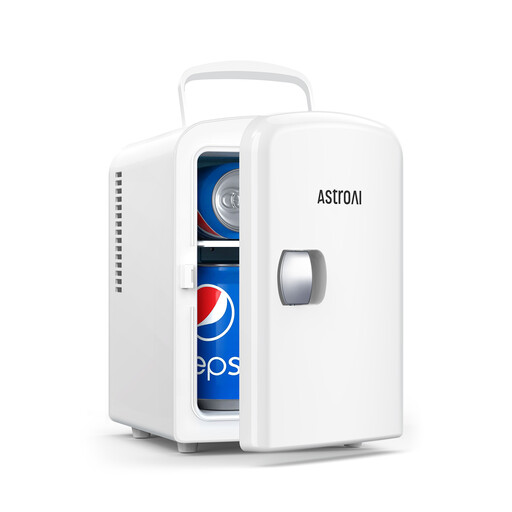
Why This Fits Their Persona: This is the definition of a portable fridge. It's lightweight (2kg), has a carry handle and comes with both a standard mains plug and a 12V DC car adapter. It's perfect for keeping drinks cool on a family staycation or a panini warm on the way to a job site.
It is clearly positioned as a thermoelectric cooler and warmer, setting the right expectation. It doesn't pretend to be a high-power fridge, but a versatile travel companion.
Dual power options (AC/DC) for home and vehicle use, plus a warming function for added versatility.
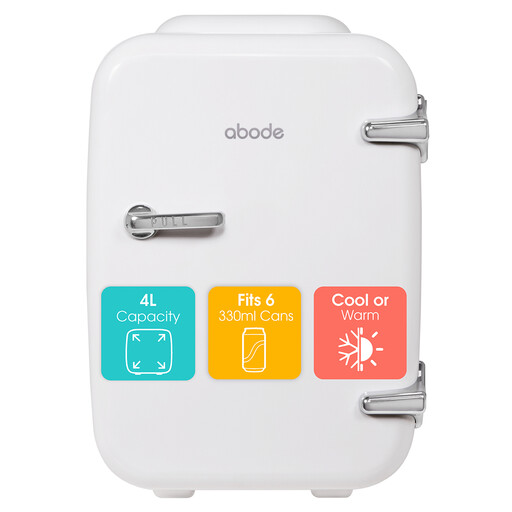
Why This Fits Their Persona: This is the quintessential skincare fridge. Its tiny footprint fits perfectly on a vanity or bathroom shelf, providing the ideal cool environment for serums, face mists and sheet masks. The thermoelectric cooling is more than sufficient for this purpose.
The product information is very clear that it cools up to 20°C below ambient temperature and cannot freeze. This manages expectations perfectly, ensuring buyers understand its function as a cooler, not a freezer.
Extremely compact and portable design, with a freon-free, eco-friendly cooling system ideal for personal use.
We have compiled a complete, real-time list of products that fully satisfy these strict selection criteria and UK safety regulations.
1. How much does a mini fridge cost to run in the UK? The running cost depends on the model's energy efficiency. Look for the Energy Class on the product label, which ranges from A (most efficient) to G. For example, an E-rated model using around 0.35 kWh per day would cost approximately ?40-?45 per year to run, based on current average electricity prices. Compressor models are typically more efficient for long-term use than thermoelectric ones.
2. How long should I let a new mini fridge settle before plugging it in? This is a critical step, especially for compressor models. After delivery, you must let the fridge stand upright in its final position for at least 4 hours before plugging it in. This allows the compressor oils and refrigerant gases, which may have been disturbed during transport, to settle. Plugging it in too soon can cause permanent damage to the cooling system.
3. Can I place a mini fridge directly on a carpet? It is not recommended. Mini fridges, particularly compressor models, need a hard, flat and stable surface to operate correctly and safely. Placing one on a thick carpet can block ventilation underneath the unit, causing the motor to overheat. It can also make the appliance unstable. Always place it on a solid floor, desk, or countertop.