Parents planning an occasional treat
A mini format can make it easier to decide how many pieces to serve at home. It is still worth distinguishing a sweet treat from the snack a child has most days after school.


Mini fudge can be an occasional sweet treat at home, but a smaller piece does not make it an everyday snack choice. For a regular after-school snack, NHS guidance suggests options such as fruit, chopped vegetables, plain rice cakes or toast; if choosing fudge, check the portion, nutrition information and current allergen label, and ask the school about its policy before sending any in.
A mini format can make it easier to decide how many pieces to serve at home. It is still worth distinguishing a sweet treat from the snack a child has most days after school.
Allergen wording differs between products. Marks & Spencer says its Sweet and Salty Pretzel Fudge Mini Bites are not suitable for people with nut or peanut allergy; Tesco says its Finest Caramelised Biscuit Bites may contain peanuts and nuts. Check the exact current pack before serving.
A treat served at home and food taken onto school premises raise different questions. Check the individual school’s packed-food and allergy policy before sending a product in.
Start with the occasion, then compare the serving information and exact pack label. A mini-bite tub and a pack of conventional fudge need not provide the same per-piece information.
| Priority | What to check | Your needs |
|---|---|---|
| Snack occasion | Decide whether this is an occasional sweet treat or a regular after-school snack. Identify whether the product is plain fudge or a fudge-containing cake or biscuit bite. | For an everyday snack, I would rather choose something other than confectionery. NHS after-school snack suggestions include fruit, chopped vegetables, plain rice cakes and toast. |
| Serving and nutrition | Look for the piece weight and nutrition per piece as well as per 100g. Read any traffic-light information alongside the stated serving size. | I want to know what one piece contains before serving it. Tesco lists 5.8g sugars and 2.5g saturates per 13g Finest Caramelised Biscuit Bite; those figures describe that fudge-containing product, not every mini fudge. |
| Allergens | Read the named allergens, suitability statements and any ‘may contain’ wording on the current pack. Do not infer nut suitability from the word ‘fudge’. | If someone eating it has a food allergy, I need the declaration for the exact product. Marks & Spencer’s Pretzel Fudge Mini Bites are labelled unsuitable for nut or peanut allergy, while Tesco’s Caramelised Biscuit Bites carry a may-contain warning for peanuts and nuts. |
| School setting | Check the school’s packed-food and allergy policy before sending food in. Distinguish personal food from food provided by a school. | A snack for home does not answer whether my child can take it to school. Department for Education school-food guidance addresses food and drink provided in state-funded schools in England; the individual school’s policy matters for food brought in. |
Piece size helps with portioning, but does not establish the product’s sugar or saturated-fat content. Tesco labels the sugars and saturates in one 13g Finest Caramelised Biscuit Bite as high.
Compare the figures for the amount you intend to serve, rather than choosing by the word ‘mini’ alone.
Marks & Spencer’s Pretzel Fudge Mini Bites are labelled unsuitable for people with nut or peanut allergy, and Tesco’s Caramelised Biscuit Bites say they may contain peanuts and nuts.
Read the current physical pack each time you buy, particularly when choosing for someone with an allergy.
Department of Health and Social Care guidance on high-fat, sugar or salt promotions concerns specified retail promotions in England. Department for Education school-food guidance concerns food provided in state-funded schools in England. Neither, by itself, establishes a particular school’s policy for snacks brought in.
For food eaten at home, use the product label to make the serving decision. For food taken to school, check that school’s current packed-food and allergy policy.
M&S lists Sweet and Salty Pretzel Fudge Mini Bites in its mini-bites range. They are a fudge-containing sweet bite rather than plain fudge.
Tesco lists conventional fudge as well as Finest Caramelised Biscuit Bites containing fudge pieces.
Waitrose lists conventional products including Clotted Cream Fudge 150g and Dark Chocolate & Caramel Fudge 130g.
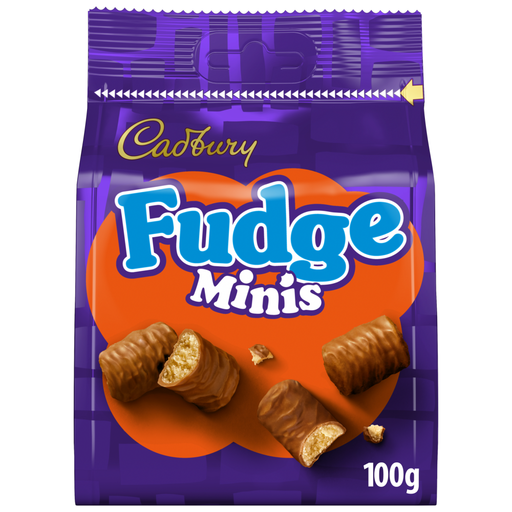
This mini-fudge option is relevant when choosing an occasional sweet treat to serve at home. Check its current pack before deciding on a portion or serving it to someone with an allergy.
 No image available
A mini-fudge format to consider for an occasional treat at home. Check the current pack for nutrition per piece and nut or peanut precautionary wording before serving; do not assume it meets a school’s food policy.
A mini piece can help you decide on a serving, but fudge remains a sweet treat rather than the default choice for a regular snack. NHS guidance suggests after-school alternatives such as fruit, chopped vegetables, plain rice cakes and toast.
No conclusion about sugar or saturated fat follows from the size alone. Compare the label per piece and per 100g: Tesco lists 5.8g sugars and 2.5g saturates in one 13g Finest Caramelised Biscuit Bite, with both marked high on its nutrition display.
Check both the exact pack and the school’s policy before sending it in. Marks & Spencer says its Pretzel Fudge Mini Bites are unsuitable for people with nut or peanut allergy; Tesco says its Caramelised Biscuit Bites may contain peanuts and nuts. Neither statement establishes the suitability of a different fudge product.
Department for Education guidance on school food in England addresses food and drink provided in state-funded schools, not an after-school treat eaten at home. If a child will bring food onto school premises, check that school’s packed-food and allergy policy.