Who is each format for?
The useful distinction for a mid-morning treat is whether you want a clearly identified portion, pieces to share or a particular kind of fudge.
Shoppers who want a clear portion
A bar with a stated serving size or a product labelled per bite makes it easier to work out the nutrition for one piece. Check whether the pack gives that information before assuming a mini format answers the question.
People sharing a coffee break
A tub offers several small pieces for a home or workplace table. Decide how many to put out, and check whether the contents are fudge, biscuit clusters or cake-style bites if that distinction matters to your group.
Shoppers checking allergens
Read the exact product label rather than relying on the word “fudge”. For example, Tesco’s Chocolate Fudge Mini Bites carry a peanut and nut warning, while M&S All Butter Fudge Cubes list milk and soya ingredients.
What should you check before buying?
Start with the product type and the amount represented by one bar or bite. Then use the ingredient and nutrition panels to compare the portions you would actually serve.
| Priority |
What to check |
Your needs |
| Portion format |
Look for a stated serving weight or per-bite panel. For a loose tub, check the serving count and decide how many pieces to serve. |
I would rather pick up one clearly described portion than estimate a serving from an open tub. |
| Product type |
Read the description for fudge cubes, chocolate-covered fudge, biscuit clusters, brownies or blondies with fudge pieces. Similar names do not mean similar recipes. |
If I want fudge itself, a cake bite containing fudge pieces is a different choice. |
| Nutrition |
Compare energy, sugars and saturates per bar or bite when given. Use per-100-g figures as a common-weight comparison, particularly when piece sizes differ. |
I want to understand the amount in the pieces I plan to eat, not just the figures for 100 g. |
| Ingredients and allergens |
Check the current ingredients, declared allergens and any “may contain” statement on the exact variant. A dietary label is not a substitute for these checks. |
Before sharing, I need to know whether this particular pack suits the people who will eat it. |
| School setting |
For food provided to pupils at state-funded schools in England, check the applicable school food standards rather than treating a small piece as an exception. |
I am choosing a school-provided mid-morning snack, not a treat for a home coffee break. |
Brand and product references
These examples show why the product description matters more than the word “fudge” on its own; they do not indicate which brands are stocked on Joybuy.
Tesco
Tesco lists both conventional fudge and Chocolate Fudge Mini Bites in its grocery range.
- Its Chocolate Fudge Mini Bites listing gives nutrition per mini bite: 63 kcal and 5.4 g sugars.
- The mini bites are chocolate-coated biscuit, fudge and crisped-rice clusters, not pieces of plain fudge; the listing says they may contain peanuts and nuts.
Cadbury
Cadbury Fudge Treat Size is a multipack of chocolate-covered fudge bars listed by Tesco.
- Tesco’s detailed panel states a 13.5 g serving and 8.8 g sugars for that serving.
- This is milk-chocolate-covered fudge, so check the exact pack if you want uncoated fudge or need to review milk ingredients.
Thorntons
Sainsbury’s lists Thorntons Chocolate Fudge Brownie Mini Cake Bites as a ten-serving bakery product.
- The listing gives approximately 12 g, 55 kcal and 5.5 g sugars per serving.
- They are chocolate-dipped brownies baked with fudge pieces, rather than small pieces of fudge.
Sainsbury’s
Sainsbury’s own-label Double Chocolate Brownie Mini Bites come in a multi-serving tub.
- Its listing states approximately 25 servings and gives 43 kcal and 4.3 g sugars per mini bite.
- These are brownies, not fudge. The listing warns that they are not suitable for customers with a peanut or nut allergy because of manufacturing methods.
Waitrose
Waitrose lists confectionery fudge as well as bakery-style mini bites, including Cinnamon Fudge Blondie Bites.
- The blondie listing gives 50 kcal and 4.0 g sugars per bite.
- Those bites are white-chocolate and cinnamon blondies with fudge pieces, not plain fudge; the listing says they may contain nuts.
M&S
M&S lists fudge-containing mini bites separately from its All Butter Fudge Cubes.
- Its mini-bites range includes Sweet and Salty Pretzel Fudge Mini Bites, while the cubes offer a distinct fudge format.
- M&S presents the All Butter Fudge Cubes for decorating and baking rather than as a stated single-serving snack; their panel lists 72.9 g sugars per 100 g.
Fudge options on Joybuy
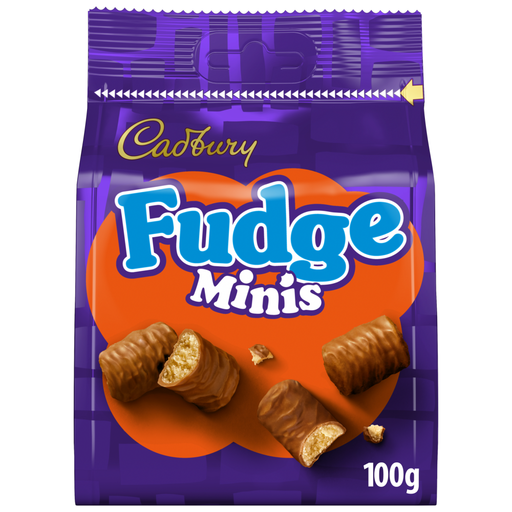
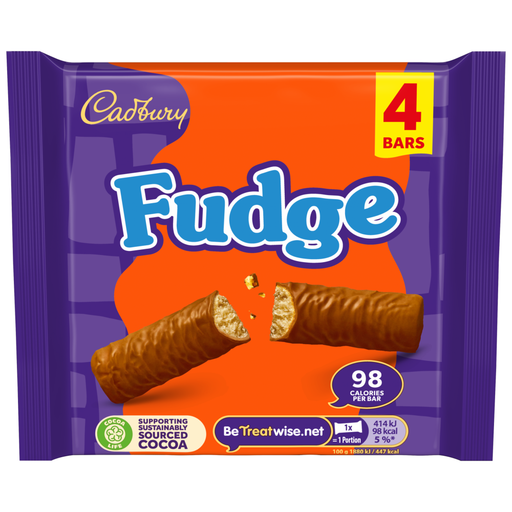
These Cadbury options offer two formats for a mid-morning fudge treat: a bag of chocolate-covered minis and a four-pack of chocolate-covered fudge bars. Check the pack’s portion details if the amount in one piece is central to your choice.
 No image available
Cadbury Fudge Minis 100g
The bite-sized, chocolate-covered pieces have a fudge centre, making this a bag format to consider for sharing or portioning out. The product information gives nutrition per 100 g and identifies milk and soya; check the pack for the number and size of pieces and the nutrition per mini if you need a one-piece comparison.
View on Joybuy
 No image available
Cadbury Fudge Bar 4 Pack 88g
This four-pack offers bars rather than loose minis; each is described as fudge with a milk-chocolate coating. The product information identifies milk and gives nutrition per 100 g. If separated portions matter, check the pack for individual wrapping, bar weight and nutrition per bar.
View on Joybuy
Questions about mini fudge
Are fudge mini bites always pieces of plain fudge?
No. Tesco describes its Chocolate Fudge Mini Bites as chocolate-coated clusters containing biscuit and fudge, while Sainsbury’s describes Thorntons Chocolate Fudge Brownie Mini Cake Bites as brownies with fudge pieces. Check the product description if you want fudge itself.
What nutrition information helps me choose a portion?
Start with the figures per bar or bite and the stated number of servings, where available. Use per-100-g figures to compare products on the same weight basis, but remember that a brownie bite, a chocolate-covered bar and a fudge cube may be different sizes and recipes.
Can confectionery mini fudge be served as a school mid-morning snack?
Not as food provided to pupils at a state-funded school in England. The Department for Education’s September 2026 school food guidance says confectionery, chocolate and chocolate-coated products must not be served across the school day, and says the standards are a legal requirement for state-funded schools. Do not assume this England-specific rule states the requirements for other UK nations or settings.
Does “mini” tell me whether a product suits someone with an allergy?
No. Check the ingredients, allergen declaration and cross-contact warnings on the exact current pack. For example, Tesco’s Chocolate Fudge Mini Bites say they may contain peanuts and nuts, and Sainsbury’s gives a peanut and nut allergy warning for its Double Chocolate Brownie Mini Bites tub.


