Elevenses snack sharers
If you want to pass around small, ready-to-eat pieces, check that the product is sold as a snack rather than assuming any small fudge cube has that purpose.


Choose a ready-to-eat mini-bites format if you want small pieces to pass around at elevenses; a compact bag of traditional fudge is another option if the pack suits how you plan to serve it. Baking cubes are sold for a different purpose, and neither the word “mini” nor a small pack establishes the sugar content of a serving, so check the current label.
If you want to pass around small, ready-to-eat pieces, check that the product is sold as a snack rather than assuming any small fudge cube has that purpose.
Compare the pack size and nutrition information, including sugars per 100 g and any stated serving, before deciding how much to put out.
Read the ingredient and allergen information on the exact current pack before serving it to someone with an allergy or intolerance.
Start with the intended use and pack format, then compare labels on a like-for-like basis before choosing a serving.
| Priority | What to check | Your needs |
|---|---|---|
| Snack format | Check whether the product is sold as ready-to-eat bites, a bag of fudge or cubes for baking. Look at the whole pack size as well as the size of each piece. | I want pieces I can offer straight away, rather than an ingredient bought mainly for a recipe. Marks & Spencer labels its 225 g Sweet and Salty Pretzel Fudge product “Mini Bites”, while describing its All Butter Fudge Cubes for baking and decorating. |
| Nutrition | Compare sugars per 100 g on the same basis, then check any stated per-serving figures. Use front-of-pack traffic-light information where it appears. | “Mini” tells me about format, not the sugar content of what I serve. In the Food Standards Agency and Ipsos Northern Ireland’s 2024 Making Food Better Tracker Survey, approximately 49% of Northern Ireland respondents actively used traffic-light labels when shopping for food; this was not a fudge-specific measure. |
| Allergens | Read the current ingredient list and allergen statement for the exact product and variant. Recheck when buying a different pack. | If I am serving someone with an allergy, a flavour name is not enough to establish whether that pack is suitable. |
| Serving and storage | Check the number or size of pieces if that matters to your plans, alongside the best-before date and storage instructions on the pack. | I may only want a few pieces at elevenses, even when the product comes in a larger tub or multipack. |
Marks & Spencer describes its All Butter Fudge Cubes for baking and decorating cakes and other bakes. Their small shape does not change that stated use.
For immediate sharing, choose a product presented as a ready-to-eat snack; choose baking cubes when you want that recipe format.
Small pieces may still come in a sizeable pack: Marks & Spencer’s Sweet and Salty Pretzel Fudge Mini Bites are sold in a 225 g pack.
Decide how much to put out and compare the nutrition panel per 100 g and per stated serving, where available.
The word “fudge” does not identify every ingredient in a coated bite, cube or bar.
Check the exact current pack’s ingredient and allergen information before serving it to someone with an allergy or intolerance.
These examples show why a product’s stated use and pack format matter more than the word “fudge” alone.
Marks & Spencer lists both Sweet and Salty Pretzel Fudge Mini Bites in a 225 g pack and All Butter Fudge Cubes intended for baking and decorating.
Thorntons lists an 85 g Vanilla Fudge Bag, a compact traditional-fudge format to consider alongside mini bites.
Waitrose lists Clotted Cream Fudge in 150 g and 200 g packs, providing conventional fudge formats for comparison.
Cornish Fudge Co. describes fudge boxes and loose fudge among its confectionery formats.
These options cover fudge minis for small ready-to-eat pieces and a fudge-bar multipack for shoppers considering a different snack format. A bar pack is not necessarily a substitute when individual bite-size pieces are the priority.
 No image available
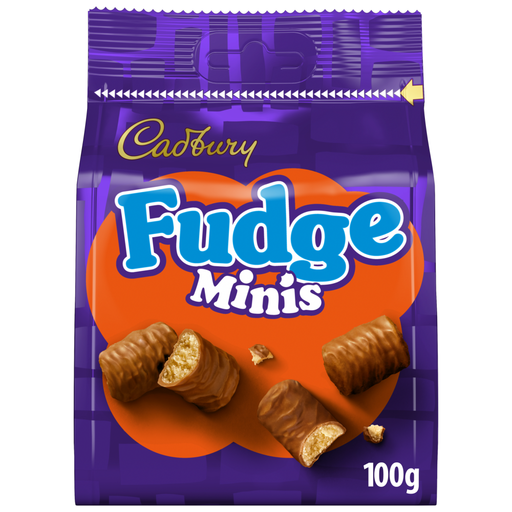
A ready-to-eat mini format to consider for sharing at elevenses. The pack is 100 g; listed sugars are 65.0 g per 100 g, and the product contains milk and soya. Check the current pack if piece size or per-piece nutrition matters to your serving plan.
 No image available
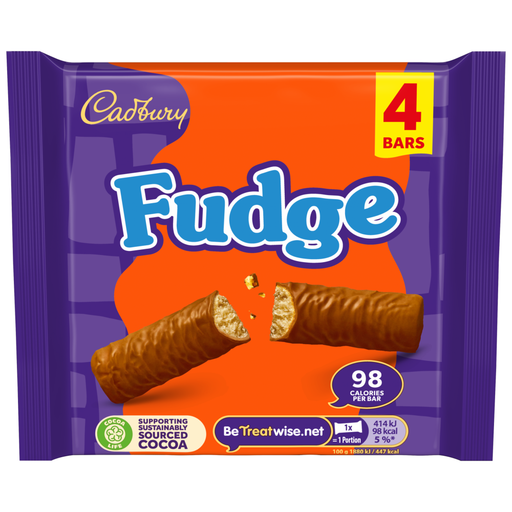
A ready-to-eat bar format if a multipack suits your elevenses plans better than mini pieces. The four-pack weighs 88 g; listed sugars are 65 g per 100 g, and it contains milk. Check the pack if bite-size dimensions or individual wrapping are important.
No. “Mini” describes the format, not the sugar content of a serving. Check sugars per 100 g to compare products on the same basis, then look at the amount you intend to serve.
Check the exact product and pack if you plan to eat them as they are, but do not assume baking cubes are intended as a ready-to-eat snack. Marks & Spencer describes its All Butter Fudge Cubes for baking and decorating; its Mini Bites are the more clearly labelled bite-size snack format.
Read the ingredient and allergen information on the exact current pack before serving it. A flavour or format name cannot establish suitability; for example, the listed Cadbury Fudge Minis contain milk and soya.
Compare the nutrition panels per 100 g, then check any per-serving information against the amount you plan to put out. The Food Standards Agency’s Check the Label guidance explains how front-of-pack traffic-light information, where present, can help compare calories, fat, sugar and salt.