Runners who prefer a chewable sweet
A small, labelled piece could add variety to selected training runs if you can count its carbohydrate and are comfortable eating it while moving.


Mini fudge can contribute carbohydrate to a marathon-training run, but a labelled, pre-tested portion makes more sense as an occasional sweet addition than as the whole fuelling plan. Tesco Groceries lists 10 g carbohydrate and 2.1 g fat per Cadbury Fudge Treat Size bar, while one Tesco Chocolate Fudge Mini Bite has 8.8 g carbohydrate and 2.6 g fat; check the amount you would need to carry and whether eating it while running suits you. For longer efforts, plan carbohydrate intake around the session rather than assuming a few bites will be enough.
A small, labelled piece could add variety to selected training runs if you can count its carbohydrate and are comfortable eating it while moving.
A training run gives you a chance to try the portion, timing and chewing involved before deciding whether to carry fudge on a more demanding run. Check the exact product’s ingredients and fat content as part of that choice.
If you want fudge as a treat rather than a measured in-run portion, an individually weighed bite matters less. A sharing pack still needs portioning if you intend to count its carbohydrate towards a run plan.
Decide whether fudge is an occasional addition or whether you need a repeatable hourly carbohydrate plan; then compare the nutrition information for the portion you would actually carry.
Consider it when: You can count the carbohydrate in each portion and have practised eating that format during training.
Trade-off: Several confectionery pieces may be needed to make a substantial carbohydrate contribution, bringing their declared fat and the practical task of chewing them too.
Consider it when: You need to plan carbohydrate intake across a long or demanding session rather than rely on an occasional sweet.
Trade-off: You still need to practise the products, amounts and timing you intend to use; a plan does not establish that any one product will suit you.
| Priority | What to check | Your needs |
|---|---|---|
| Countable carbohydrate | Find carbohydrate per bar or bite, not just per 100 g. Tesco Groceries lists 10 g per 13.5 g Cadbury Fudge Treat Size bar and 8.8 g per Tesco Chocolate Fudge Mini Bite. A review in Ned Tijdschr Geneeskd advises 30–60 g carbohydrate per hour for exercise lasting 1–2.5 hours; its guidance is not a serving instruction for either sweet. | I want to know what the portion I carry contributes, rather than judge it by how small it looks. |
| Format and practice | Compare the declared fat alongside carbohydrate: Tesco Groceries lists 2.1 g fat per Cadbury treat-size bar and 2.6 g per Tesco mini bite. Try the intended amount and timing during training, including the practicalities of chewing while running. | A solid sweet appeals to me, but I need to find out whether I can comfortably eat the amount I have planned during a run. |
| Ingredients and allergens | Read the ingredients and allergen information on the current pack. GOV.UK guidance says the ingredients list for pre-packed food must emphasise the allergens required to be declared; product formulations and warnings differ. | If I avoid particular ingredients, I need the information for this exact flavour and pack, not an assumption based on the word “fudge”. |
Tesco Groceries lists 8.8 g carbohydrate per Tesco Chocolate Fudge Mini Bite and 7.2 g per approximately 12 g Thorntons brownie bite. Each is a contribution, not the same amount as the 30–60 g per hour discussed for 1–2.5 hours of exercise in the Ned Tijdschr Geneeskd review.
Calculate the carbohydrate in the number of pieces you intend to take, then practise that amount and its timing on a training run.
The formats include a treat-size bar, a chocolate fudge mini bite and a brownie bite containing fudge pieces. Their declared portions and nutrition values differ.
Compare the exact product name and the label’s unit of measurement before counting pieces towards a plan.
For example, Marks & Spencer lists barley, wheat, milk and soya for its Sweet and Salty Pretzel Fudge Mini Bites and states that they are not suitable for people with a nut or peanut allergy.
Read the current pack’s ingredients and allergen statement, especially when changing flavour or format.
These examples illustrate why the declared serving matters more than a shared “fudge” description; they do not establish that every product from a brand has the same ingredients or nutrition.
Tesco Groceries lists both a Fudge Treat Size bar with nutrition per 13.5 g bar and a separate Fudge Bites product with nutrition per portion.
Tesco Chocolate Fudge Mini Bites has nutrition declared for one mini bite.
Thorntons Chocolate Fudge Brownie Bites is a brownie-bite format, not a piece of plain fudge.
Sweet and Salty Pretzel Fudge Mini Bites combines pretzel and fudge in a sharing format.
The Cornish Fudge catalogue lists Clotted Cream Fudge and Caramel & Seasalt Fudge in 150 g bag formats.
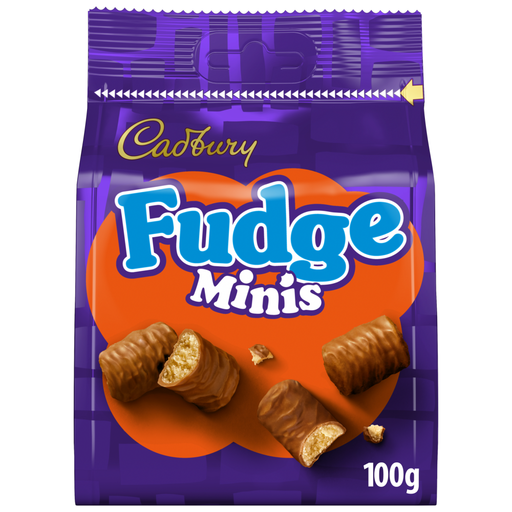
This Cadbury fudge-mini pack is a solid sweet option to consider around training. If you plan to count it as in-run carbohydrate, work from a measured portion rather than assuming a fixed amount per mini.
 No image available
A mini fudge format to consider if you prefer a solid sweet around training. The pack is 100 g; check the current pack for the carbohydrate in the portion you intend to carry, as well as its ingredients and allergen information. Practise eating that portion during training before considering it for a run.
It depends on the exact product and its declared unit. Tesco Groceries lists 10 g carbohydrate per Cadbury Fudge Treat Size bar, so three bars provide 30 g; its Tesco Chocolate Fudge Mini Bites have 8.8 g per bite, so four provide 35.2 g. Those amounts do not tell you whether either food will be comfortable to eat while running.
Mini fudge can add carbohydrate, but do not assume a few pieces will cover a long run’s planned intake. A review in Ned Tijdschr Geneeskd advises 30–60 g carbohydrate per hour for exercise lasting 1–2.5 hours; for longer high-intensity exercise, it says well-trained endurance athletes can metabolise up to 90 g per hour when glucose and fructose are combined. Work out what your chosen portions contribute and practise your fuelling plan in training.
Read the current pack’s ingredients and allergen statement for the exact product. GOV.UK guidance says the ingredients list for pre-packed food must emphasise allergens required to be declared; the listed fudge and fudge-bite formats differ in ingredients and warnings, so one product’s label cannot stand in for another’s.