Tea-break portion planners
A counted pack gives you a clear number of pieces. Tesco also lists nutrition per mini bite for its loose sharing product, so you can check a single piece rather than relying only on figures per 100g.


Choose a counted pack when you want a defined piece for each person; a loose bag suits sharing when you are happy to decide how many bites to serve. If you want traditional fudge, check that fudge is the product rather than an ingredient in a brownie or chocolate snack, then compare the serving information and current allergen labels.
A counted pack gives you a clear number of pieces. Tesco also lists nutrition per mini bite for its loose sharing product, so you can check a single piece rather than relying only on figures per 100g.
A loose bag can be put out for a group, while a counted multipack makes it straightforward to offer one piece per person. Check the product description if guests expect plain fudge rather than cake or biscuit bites.
Check the ingredients and precautionary statements on the current pack. The Tesco, Thorntons and M&S examples have different ingredient combinations and nut or peanut warnings.
Start with the kind of sweet you want, then check how the pack defines a serving and what its label says about ingredients.
| Priority | What to check | Your needs |
|---|---|---|
| Serving format | Check the piece count, any stated serving weight and whether nutrition is given per piece. Tesco lists nutrition per mini bite; Tesco and Sainsbury's describe the Thorntons brownie-bite pack as ten servings of about 12g each. | I'd like one clearly defined piece with tea, or enough bites to put out for several people without treating an open bag as one serving. |
| Type of fudge | Read what the product actually is: plain fudge, a brownie with fudge pieces or a chocolate-coated snack. Look for biscuit, cereal or cake components if texture matters. | If I'm expecting soft, traditional fudge, a brownie or crunchy cluster will be a different choice, even if its name includes fudge. |
| Allergens | Read the current ingredients and any precautionary statements, including those for nuts and peanuts. Do not use another flavour's label as a substitute. | When buying for someone with an allergy, I need to check the exact product being served, not just recognise the brand or packaging. |
| Sugars | Compare sugars per piece where stated, and per 100g when pack sizes differ. Tesco lists 5.4g sugars per mini bite; its Thorntons listing gives 5.5g per approximately 12g serving. | I want to know what the piece I plan to eat contains. The word 'mini' does not tell me its sugar content. |
Tesco's chocolate fudge mini bites contain biscuit and crisped rice, while Thorntons' bites are brownies with fudge pieces. Neither gives the same type of sweet as a piece of traditional fudge.
Read the product description before choosing: is fudge the main product, or one part of a cake, cluster or chocolate snack?
Piece size alone does not establish sugar content. Tesco lists 5.4g sugars for one of its mini bites, and its Thorntons listing gives 5.5g per approximately 12g brownie bite.
Use the serving figure on the label and decide how many pieces you intend to put out or eat from a sharing pack.
A nut or peanut warning may matter even when neither appears in the product name. The Thorntons brownie bites may contain nuts, and Tesco's mini bites may contain peanuts and nuts.
Check the current pack for the exact product and flavour before serving it to someone with an allergy.
These examples illustrate different fudge and fudge-containing formats; a brand name alone does not tell you which format a particular pack contains.
A counted, cake-style option: Tesco and Sainsbury's list Thorntons Chocolate Fudge Brownie Bites as a ten-serving pack.
Tesco's own-label Chocolate Fudge Mini Bites offer a loose sharing format.
M&S Blond Fudge Bites take a confectionery approach, with a fudge core, biscuit crumb and chocolate coatings.
Waitrose & Partners describes its Clotted Cream Fudge as bites made with West Country clotted cream.
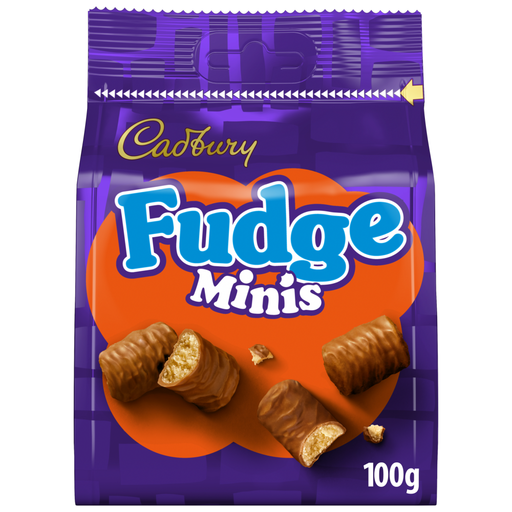
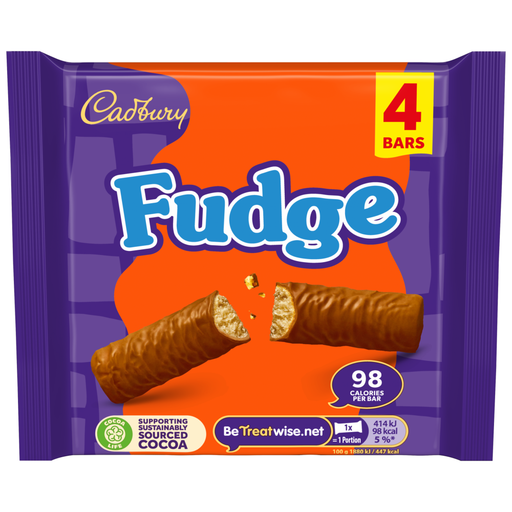
These Cadbury options cover fudge-labelled minis and a four-bar pack for a tea break. The bar pack should not be assumed to contain mini-sized pieces or traditional plain fudge.
 No image available
For a morning tea break, this 100g pack is a mini-format option. Check the current pack for its piece count, per-piece nutrition and ingredients if you need a defined serving or have an allergy.
 No image available
This four-bar, 88g pack offers a counted format for sharing or separate tea breaks. Its name does not establish that each bar is mini-sized; check the current pack for per-bar details, ingredients and whether the bars are individually wrapped.
No. Tesco's example is a chocolate-coated cluster with fudge, biscuit and crisped rice, while the Thorntons example is a brownie with fudge pieces. If you want traditional fudge, choose a product described as fudge itself and check its ingredients.
A counted pack makes the number of pieces clear, but you should still check what the label defines as a serving. The Thorntons brownie-bite listings describe ten servings of approximately 12g; Tesco instead provides nutrition per mini bite for its loose product.
Yes. Read the current pack for the exact product and flavour when an allergy or intolerance matters. The Tesco and Thorntons examples have different ingredients and precautionary nut statements, so a familiar name or older listing is not enough.
No. Check the sugars for the piece you plan to eat rather than drawing a conclusion from its name: Tesco lists 5.4g sugars per mini bite, and its Thorntons listing gives 5.5g per approximately 12g brownie bite.
Not necessarily. The NHS explains that the total-sugars figure can include sugars naturally present in ingredients such as milk, fruit and vegetables. Use the labelled total-sugars figure for a like-for-like product comparison, but do not assume it is a measure of free sugars alone.