Parents choosing routine toddler snacks
If a biscuit is convenient, compare it with the everyday snack examples in NHS guidance. Consider how the food will be served as well as what is on the label.


For routine toddler snacks, start with foods such as the fruit, appropriately prepared vegetables, toast, bread or plain yoghurt suggested by the NHS, rather than relying on ginger biscuits. If you choose a biscuit, a ‘mini’ label does not establish that its shape or texture suits your child: assess it as served, supervise eating, and check the current packet for sugars and allergens.
If a biscuit is convenient, compare it with the everyday snack examples in NHS guidance. Consider how the food will be served as well as what is on the label.
Read the particular packet against the child’s allergy needs. The name ‘ginger nuts’ does not establish whether a product contains nuts, and a shared setting may have its own allergy arrangements.
Check the requirements and allergy arrangements for the setting. In England, Department for Education guidance addresses food provided by early-years providers; retail promotion rules do not decide what a setting may serve.
Decide whether you want a routine snack or a biscuit, then assess the actual food and its current label rather than choosing by the word ‘mini’.
| Priority | What to check | Your needs |
|---|---|---|
| Everyday snack choice | The NHS suggests fruit, appropriately prepared vegetables, toast, bread and plain yoghurt as snack examples from 12 months, and advises avoiding sugary snacks. If choosing a biscuit, read its ingredients and sugars information. | I want something for regular snack time, not a biscuit chosen simply because its pieces are small. |
| Size and texture | Assess the food’s size, shape and texture as served. Follow NHS advice to keep young children seated upright and supervise them while eating. | A mini label alone does not tell me whether this food suits the individual child eating it. |
| Allergens | Read the current ingredients and allergen statement, including precautionary warnings. If food is going into a shared setting, check its allergy arrangements too. | I need to check the child’s particular allergens rather than infer nut content from the name ‘ginger nuts’. |
| Biscuit comparison | Compare sugars per biscuit alongside biscuit weight, then use sugars per 100g when portions differ. The checked Asda, Tesco and McVitie’s listings give 24g, 25.5g and 28.9g sugars per 100g respectively; these are label figures for their standard biscuits, not measures of toddler suitability. | If I decide to offer a biscuit, I want to compare the product I will actually serve rather than judge it by pack size or a single per-biscuit figure. |
A smaller piece can still have a shape or firm texture that needs consideration for the individual child.
Assess it as served, and follow NHS advice on seated, upright and supervised eating.
The checked ginger biscuits contain sugars, while NHS guidance recommends other snack examples for toddlers and advises avoiding sugary snacks.
Start with an age-appropriately prepared everyday option; if choosing a biscuit, compare its current ingredients and nutrition label.
‘Ginger nuts’ does not establish nut content, and a product listing cannot tell you a particular setting’s allergy arrangements.
Check the current packet and ask the setting about its policy before bringing food in.
These standard ginger biscuits and related ginger snaps provide label points to check; their listings do not establish that they are mini or toddler-specific snacks.
Ginger Nuts are listed in a 250g pack.
Own-label Ginger Nuts are listed in a 300g pack.
Own-label Ginger Nuts are listed in a 250g pack.
Own-label Ginger Snaps are a related ginger biscuit, rather than a product labelled Ginger Nuts.
Ginger Snaps are listed in a 250g pack and are a related format, not an exact ginger-nut match.
Essential Ginger Nuts are listed in a 300g pack.
These options cover a mini gingerbread product labelled for ages 12+ months and a ginger-and-dark-chocolate biscuit. Neither should be treated as an exact mini ginger-nut match or chosen on size alone.
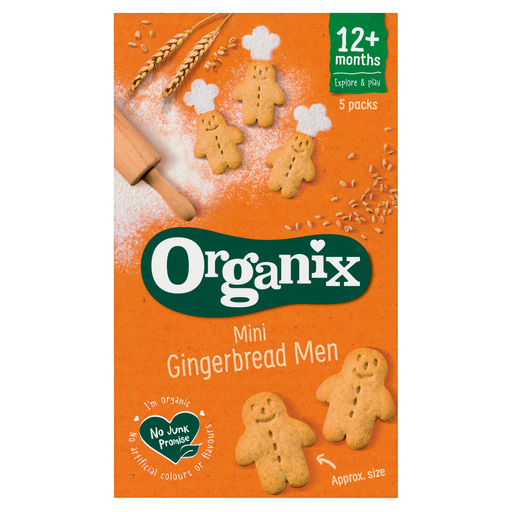 No image available
This mini gingerbread product is labelled for ages 12+ months and comes as 5 x 20g. Check its current ingredients and sugars information, and assess the pieces’ shape and texture as served while supervising eating.
 No image available
This 285g ginger-and-dark-chocolate biscuit is a different format from mini ginger nuts. For toddler snack time, check the current ingredients and nutrition label, then assess the food’s size, shape and texture as served.
No. NHS guidance says to consider a food’s size, shape and texture, and to keep young children seated upright and supervised while eating. Assess the biscuit as served rather than relying on ‘mini’ in its name.
The name alone cannot tell you that. The checked McVitie’s and Asda listings identify wheat; read the current packet, including precautionary allergen warnings, against the child’s particular needs.
The setting must consider the requirements for the food and drink it provides, rather than decide from a biscuit listing alone. The Department for Education says early-years provision must be healthy, balanced and nutritious, and that providers must take its nutrition guidance into account unless there is good reason not to.
Do not assume a universal rule. For an English school, check its allergy safety policy and the arrangements for the particular pupil; the Department for Education notes that food without nuts as an ingredient may still carry a ‘may contain nuts’ warning.