Multiplayer gaming hosts
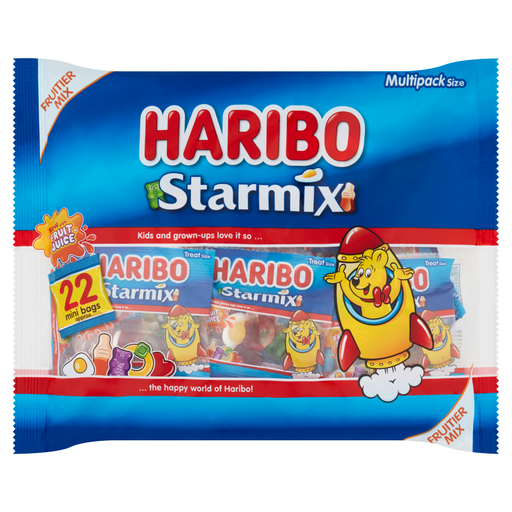
Separate mini bags give each player a packet without passing around one open bag. The Haribo Starmix multipack listed by Sainsbury’s contains 22 bags of 16g each.


Choose separate mini bags when each player needs their own snack; for one player, a small bite-size bag may be simpler. A larger sharing bag works when you plan to put servings into bowls before play. Whichever format you choose, check the exact pack’s serving information, ingredients and dietary statements rather than treating “mini” as a portion size or a sign of suitability.
Separate mini bags give each player a packet without passing around one open bag. The Haribo Starmix multipack listed by Sainsbury’s contains 22 bags of 16g each.
A smaller bag avoids opening a large sharing pack for one person. Rowntree’s Jelly Tots come in a 42g bag, while Tesco Mini Jelly Beans come in an 85g bag; check each pack’s stated serving basis.
Choose by the exact product’s ingredients and dietary statement, not its size. ASDA labels its Mini Gems suitable for vegans; Rowntree’s says the ingredients in core Jelly Tots are suitable for vegans and vegetarians, while noting shared production lines.
Decide how the sweets will be handed out, then compare the serving basis and product label for the packs you are considering.
| Priority | What to check | Your needs |
|---|---|---|
| Pack format | Check whether sweets come in separate packets or one open bag. Haribo Starmix has 22 mini bags of 16g; ASDA suggests eight servings from its 160g Mini Gems bag. | For several players, I want a straightforward way to give everyone a separate snack. If I choose a sharing bag, I can put servings into bowls before play. |
| Serving and sugars | Compare figures on the same stated basis. Tesco lists 10.9g sugars per 21g, or one quarter of its Mini Jelly Beans bag; ASDA lists 9g per one-eighth of its Mini Gems bag. Rowntree’s lists 7.6g per seven Jelly Tots. | A small-looking bag might contain more than one stated serving, so I want to know what amount the label’s figures describe. |
| Dietary suitability | Read the current ingredients and product-specific statement. ASDA labels Mini Gems vegan; Rowntree’s describes core Jelly Tots ingredients as suitable for vegans and vegetarians and notes shared production lines. M&S describes its Mini Gems as vegetarian-friendly. | Someone in my group needs a particular dietary option, so I need to check the sweets we will actually serve rather than assume all jelly sweets are alike. |
| Allergens and age warnings | Check the current pack’s allergen information and warnings. M&S states that its Mini Gems are not suitable for children under 36 months because of a potential choking hazard. | Before sharing sweets with guests or young children, I want to make sure the exact product is appropriate for the people present. |
“Mini” can describe the sweets or the packaging. Tesco presents its 85g Mini Jelly Beans bag as four 21g portions, while ASDA suggests eight servings from a 160g Mini Gems bag.
Use the serving information on the exact pack to decide how many bags or bowls to set out.
Product statements differ: Rowntree’s describes core Jelly Tots ingredients as suitable for vegans and vegetarians, whereas M&S describes its Mini Gems as vegetarian-friendly.
Check the current ingredients and dietary statement for the product you intend to share.
Unlike separate mini bags, one open bag does not provide a packet for each player.
If separate packets matter, choose a mini-bag multipack; otherwise, put sweets from the sharing bag into bowls before play.
Retail promotion and placement restrictions for specified less healthy foods are separate from school-food requirements. The Department for Education’s school-food guidance addresses state-funded schools in England, not every gaming setting across the UK.
For a school event, confirm the applicable nation’s current requirements and the school or catering provider’s policy before choosing snacks.
These examples illustrate pack formats and product-specific label checks; they do not imply that every product from a brand has the same ingredients or serving information.
Haribo Starmix is available as a 22 × 16g mini-bag multipack, a format for handing out separate packets.
Rowntree’s sells Jelly Tots in a 42g bag for shoppers considering a smaller, bite-size pack.
Tesco Mini Jelly Beans come in an 85g assorted fruit-flavour bag.
Sainsbury’s lists the Haribo Starmix 22 × 16g multipack and a 150g Rowntree’s Jelly Tots sharing bag.
ASDA Mini Gems are a 160g bag for shoppers planning to serve sweets from a larger pack.
M&S describes its Mini Gems as vegetarian-friendly and free from artificial colours or flavours.
This mini-bag multipack is an option for giving players separate packets during a gaming session.
 No image available
The separate mini bags provide a packet for each player rather than one open sharing bag. The multipack contains 22 bags of 16g each. Its ingredients include gelatine; check the current pack for dietary suitability, serving information and sugars.
Choose mini bags if each player should receive a separate packet; choose a sharing bag if you plan to put servings into bowls before play. Haribo Starmix comes in a 22 × 16g mini-bag multipack, while ASDA suggests eight servings from its 160g Mini Gems bag.
Not necessarily. Tesco gives nutrition information for 21g, or one quarter of its 85g Mini Jelly Beans bag, while Rowntree’s gives figures per seven Jelly Tots. Read the serving basis on the exact pack.
ASDA labels Mini Gems suitable for vegans, and Rowntree’s says core Jelly Tots ingredients are suitable for vegans and vegetarians, while noting shared production lines. M&S describes its Mini Gems as vegetarian-friendly; check each current pack rather than extending these statements to other products.
Read the exact product’s age warning and allergen information. M&S states that its Mini Gems are not suitable for children under 36 months because of a potential choking hazard; ingredients and product information may also change.
Do not treat a consumer snack listing as permission to supply sweets at school. The Department for Education’s school-food guidance covers legal requirements for state-funded schools in England; check the current rules for the relevant UK nation and confirm the school or catering provider’s policy before buying.