What should you check before buying?
Start with the run and your usual eating routine, then decide whether a measured sweet adds anything useful for you. If it does, compare the portion, shape and ingredients rather than treating all marshmallows as interchangeable.
| Priority |
What to check |
Your needs |
| Run and routine |
Consider how long the effort will take and what you normally eat beforehand. World Athletics gives 0–20 g carbohydrate per hour as an option for 45–75 minutes of endurance exercise; the British Dietetic Association says a normal diet can meet the needs of a general fitness programme. |
If my 5K is short or follows a normal meal, I may not want a separate sweet for the run. |
| Portion |
Use carbohydrate per 100 g or a declared serving to work out the amount you plan to carry. Tesco lists 3.8 g carbohydrate per 5 g of its mini marshmallows; Tesco lists 19.3 g per declared 25 g serving of Barratt Mini Flumps. |
I want to measure a small amount, rather than assume a handful or a whole bag is one portion. |
| Piece shape |
Check whether the pack contains loose mini pieces, twists or regular marshmallows. A stated serving weight can help with portioning, but does not make twists the same shape as loose minis. |
Small individual pieces matter to me if I plan to pack only a few; otherwise, a twist or regular marshmallow may suit the portion I have in mind. |
| Ingredients |
Read the current ingredients and allergen information. Waitrose and Tesco mini products list pork gelatine; M&S labels its regular marshmallows vegan but gives separate milk, nut and peanut allergy warnings. |
My dietary requirements come before piece size. I need to check the exact pack rather than rely on the word ‘vegan’ for allergy suitability. |
| Timing |
Try the exact product and amount during training if you intend to eat it near a run. For general exercise planning, the British Dietetic Association describes a light meal or carbohydrate snack two to three hours beforehand as an option. |
Before an event, I would rather follow a food and timing routine I already know than introduce an unfamiliar sweet. |
Which product lines illustrate the options?
These product lines show how loose minis, twists and a vegan non-mini option differ; their inclusion does not mean they are Joybuy products.
Waitrose Cooks' Ingredients
Its Mini Pink & White Marshmallows come as loose mini pieces in a 150 g bag.
- Waitrose lists 77.3 g carbohydrate per 100 g, which provides a basis for measuring a portion by weight.
- The ingredients list includes pork gelatine; check the current pack if ingredients or allergens affect your choice.
Tesco
Tesco Mini Marshmallows are pink-and-white mini pieces in a 60 g bag.
- Tesco lists 77.0 g carbohydrate per 100 g and 3.8 g per 5 g, allowing a small weighed portion to be estimated.
- They contain pork gelatine. Check the current listing if you intend to buy this particular pack.
Barratt
Barratt Mini Flumps are marshmallow twists in a 150 g bag, rather than loose mini pieces.
- Tesco lists a 25 g serving containing 19.3 g carbohydrate, giving shoppers a stated serving to work from.
- The ingredients include pork gelatine, and the twist shape may not suit someone specifically looking for loose minis.
M&S Plant Kitchen
Its Vegan Marshmallows offer a regular-marshmallow format when avoiding animal-derived ingredients matters more than mini size.
- M&S labels the product vegan and lists 83.7 g carbohydrate per 100 g.
- It is not a mini format. M&S states that it is not suitable for people with milk, nut or peanut allergy.
Joybuy marshmallow options
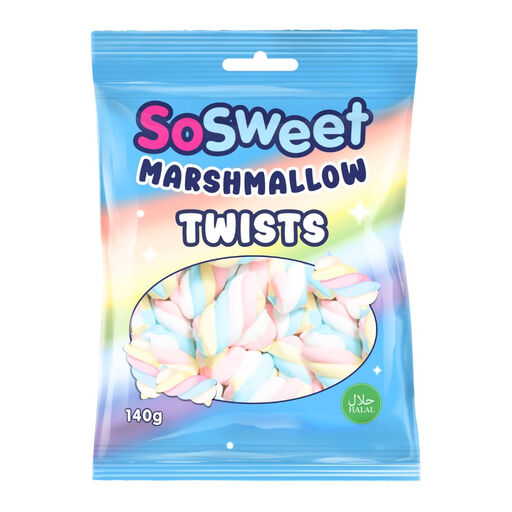
The Joybuy option here is a bag of marshmallow twists for shoppers willing to check piece size and measure a portion by weight. If loose, bite-size minis are essential, confirm the twist dimensions before choosing it.
 No image available
SoSweet Marshmallow Twists, 140 g
For a planned portion around training, the listed 80 g carbohydrate per 100 g lets you work from the weight you choose. This is a 140 g bag of twists; check the piece size if you specifically want bite-size minis, and weigh your portion rather than assuming a particular number of pieces. The description identifies beef gelatine and labels it halal, so check the current pack if that designation is essential; the gelatine also makes it unsuitable for a vegetarian or vegan requirement.
View on Joybuy
Questions about marshmallows and 5K runs
Do I need mini marshmallows during a 5K?
No, not automatically. World Athletics lists 0–20 g carbohydrate per hour as an option for 45–75 minutes of endurance exercise, while the British Dietetic Association says a normal diet can meet the carbohydrate needs of a general fitness programme. Consider your expected run duration and usual meals before deciding whether to carry a sweet.
How can I measure a marshmallow portion?
Use the pack’s carbohydrate figure and a measured weight or declared serving, rather than guessing from a handful. Tesco lists 3.8 g carbohydrate per 5 g for its mini marshmallows, Waitrose lists 77.3 g per 100 g for its minis, and Tesco lists 19.3 g per 25 g serving for Barratt Mini Flumps. Check the current label for the pack you buy.
Should I try marshmallows immediately before a run?
Use a product, amount and timing that you have tried in training rather than introducing a new sweet just before an event. For general exercise planning, the British Dietetic Association describes a light meal or carbohydrate snack two to three hours beforehand as an option; choose a routine that fits the session.
Are mini marshmallows vegetarian, vegan or suitable for people with allergies?
Check the particular product: Waitrose and Tesco list pork gelatine in their mini marshmallows, while M&S labels its regular marshmallows vegan but says they are not suitable for people with milk, nut or peanut allergy. Read the current ingredients and allergen information on the pack rather than inferring suitability from the product category or vegan label.


