Large-batch buffet cooks
If you want to avoid repeated small batches, compare actual tray area and permitted two-level cooking before relying on a capacity figure. A larger oven also needs enough worktop space and ventilation clearance.


For buffet cauliflower, choose by usable tray space and whether the oven can cook on two levels, rather than cavity litres alone. A 42–45L mini oven offers a larger cavity and, on some models, hotplates for sides; a two-level convection oven suits separate trays, while a compact multi-tier air-fryer oven is a choice for smaller top-up batches. Check tray dimensions, worktop clearance and electrical requirements before buying.
If you want to avoid repeated small batches, compare actual tray area and permitted two-level cooking before relying on a capacity figure. A larger oven also needs enough worktop space and ventilation clearance.
If you plan to replenish a smaller dish during service, a multi-tier oven with circulating hot air may suit that task. Check how much cauliflower fits on the supplied trays without piling it up.
For a modest gathering, a compact convection oven may fit your available space, provided you can accept smaller batches. Check its external dimensions as well as the size of its cooking tray.
Decide which constraint would affect your buffet most: getting enough florets ready, browning smaller batches or fitting the appliance safely alongside other preparation.
Consider it when: You want a larger cavity and a surface for heating a side dish.
Check: Cavity litres do not tell you the usable tray area, and simultaneous oven and hotplate use needs checking against the appliance instructions.
Consider it when: Cooking cauliflower on separate trays, or alongside another dish, is your priority; Ninja specifies two-level cooking for its DT200UK.
Check: Confirm the permitted tray arrangement for your cooking mode and allow for the oven's stated 33.5 × 43.5 × 50.5cm external dimensions.
Consider it when: Smaller, crisp-edged replenishment batches matter more than preparing the whole buffet load at once.
Allow for: The Instant Vortex Plus has a 13L cavity, so check its tray area against the amount you need to serve.
Consider it when: You are cooking for a modest gathering or using another oven for the main buffet load.
Check: Tefal's OF445840 has a 19L cavity, but its six cooking heights should not be mistaken for six usable food-filled trays.
| Concern | What to check | Who this matters to |
|---|---|---|
| Batch space | Compare supplied tray dimensions and confirm whether the chosen cooking mode permits two trays. | If I need enough florets ready without repeated small batches, I want room to spread them out; around 42% of consumers put batch throughput first. |
| Browning | Check for convection or hot-air circulation and the permitted tray arrangement. | When I am making smaller top-up batches, I care most about browned edges rather than filling a large cavity; around 33% of consumers prioritise browning. |
| Worktop and side dishes | Measure the space including required clearance, and check hotplate-use and electrical instructions. | I need the oven to fit safely beside buffet preparation, perhaps while heating a side dish; for around 25% of consumers, worktop fit and multitasking come first. |
A 45L capacity does not show how much flat tray space is available or whether two loaded trays can be used together. That can leave you cooking more batches than planned.
Compare internal tray dimensions and supplied accessories with your intended cauliflower quantity. If you need two trays, check the manual for permitted positions and any rotation guidance.
Cooking and hot holding are different jobs. GOV.UK guidance for food businesses says hot food that is not served straight away should be kept at or above 63°C, using suitable equipment.
For a food-business buffet, plan how you will transfer and monitor cooked food rather than assuming an ordinary mini oven's low setting is suitable for hot holding.
Suitable hot-holding equipment and a thermometer may be needed in addition to the cooking oven.
A countertop oven needs the clearance specified for its particular model. Electrical Safety First warns that ovens can overload an extension lead when used with other large appliances.
Measure the worktop, follow the manual's ventilation instructions and check the appliance rating against the socket or extension lead you intend to use.
Manufacturer comparisons for the Ninja and Instant ovens use particular test conditions; they do not establish how either appliance will perform with your quantity of cauliflower.
Make the choice on the cooking mode, permitted tray arrangement, usable space and worktop fit that you need.
Its IG7145 is a 45L mini oven with double hotplates for cooks who also want to heat buffet sides.
Its DT200UK countertop convection oven is relevant when separate cooking levels matter to the buffet plan.
Its 13L Vortex Plus Air Fryer Oven is a compact multi-tier option for smaller replenishment batches.
Its Optimo OF445840 is a 19L convection mini oven to consider for modest quantities.
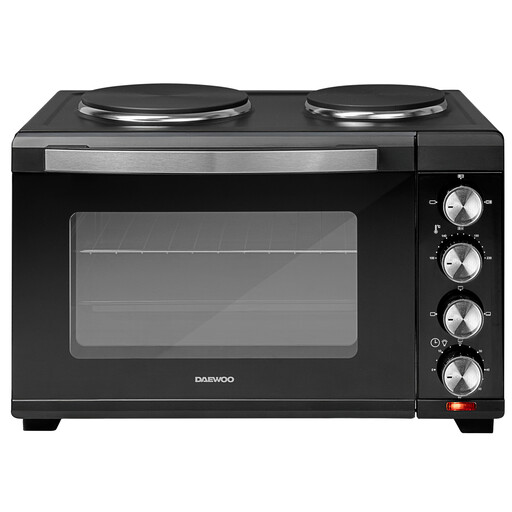
This countertop oven is relevant if you want to bake cauliflower while having hotplates available for a buffet side. Check its tray space against your planned batch size.
 No image available
Consider this oven if you want to bake cauliflower and have hotplates available for a side dish. Its product name specifies a 32L capacity and 3000W. Check the supplied tray dimensions and the instructions for cooking levels and electrical use before planning simultaneous dishes.
Choose by the tray space needed for your batch, not a litre figure on its own. A 42–45L mini oven or a model specified for two-level cooking is worth considering for larger batches, but check the supplied tray dimensions and whether your chosen mode permits simultaneous trays.
Do not assume an ordinary mini oven is suitable for buffet hot holding. GOV.UK catering guidance calls for suitable equipment to keep hot food at or above 63°C when it is not served straight away; plan to monitor the food rather than relying on an unconfirmed oven setting.
GOV.UK guidance for food businesses allows hot food to be kept below 63°C for up to two hours; after that, it must be cooled as quickly as possible to 8°C or below, or discarded. Its caterer guidance says the below-63°C display period can be used only once, so monitor the food and plan service accordingly.
Check the oven's rating and the extension lead's marked current rating before doing so. Electrical Safety First warns against overloading extension leads, particularly when an oven shares one with other large appliances; follow the appliance's electrical instructions as well.