Buffet batch bakers
If you need one large tart or several predictable batches, start with the tin's fit, the available rack space and the timer. Hotplates may also be useful when another buffet dish needs a pan.


Choose a mini oven for buffet custard tarts by checking whether your tin fits at a usable rack height and how many batches you need, rather than choosing by litres alone. A 42L conventional model with hotplates suits a larger-batch workflow if the tin fits; a two-level multifunction oven makes more sense if you will use its other modes, while a compact air-fryer oven calls for particular care over tin fit and batch size.
If you need one large tart or several predictable batches, start with the tin's fit, the available rack space and the timer. Hotplates may also be useful when another buffet dish needs a pan.
If the appliance will also handle regular roasting, reheating and other cooking, a two-level oven may be worth considering. Check that both levels work for the food you plan to make, rather than assuming they will bake identical tarts at once.
A compact multi-use oven may be easier to accommodate, but its stated capacity does not establish whether a buffet-size tart tin will sit level inside it.
Consider it when: A larger tart batch and separate pan cooking are central to buffet preparation; Tower specifies both a baking tray and wire rack for its T14045.
Trade-off: Tower's stated 42L capacity and 10-inch pizza fit do not establish whether your tart tin fits at the rack height you need.
Consider it when: You will use two cooking levels and functions beyond baking; SharkNinja UK lists a Bake mode among ten functions for the Ninja DT200UK.
Trade-off: The DT200UK needs worktop space for its stated H33.5cm × W43.5cm × D50.5cm footprint. Two levels alone do not establish how your tart recipe will bake on each.
Consider it when: Smaller everyday cooking jobs matter more than making a large tart batch; Breville lists baking and three cooking levels for its 10.6L Halo Rotisserie Air Fryer Oven.
Trade-off: Confirm the tin's fit and the number of batches before relying on a compact oven for buffet baking.
| Concern | What to check | Who this matters to |
|---|---|---|
| Tin fit and batch size | Compare the tin's outer diameter and height, including its rim or handles, with usable rack dimensions and door clearance. Check how many batches you can prepare. | If I need enough tart for a buffet, I want the tin to sit level without forcing an extra batch. Around 45% of consumers put usable baking space first. |
| Baking control | Check the temperature range, timer limit and available baking modes; plan a trial bake before the event. | When I repeat a tart recipe for guests, I need time to learn how its filling and pastry behave in this oven. For around 36% of consumers, repeatable baking control is the primary concern. |
| Worktop and other uses | Measure the intended worktop position and check which hotplates, cooking levels or functions you would actually use. | In a small kitchen, I need the oven to fit my worktop and earn its space after the buffet. Versatility and footprint come first for around 19% of consumers. |
Capacity describes cavity volume, not the usable width, depth or rack clearance. Even a stated pizza size does not confirm that a tart tin with a rim or handles will fit.
Measure the whole tin and ask for usable rack or tray dimensions and door clearance before ordering.
If you have to switch to a smaller tin, the buffet bake may take additional batches and preparation time.
Manufacturer cooking-speed comparisons do not establish a suitable time or temperature for a particular custard filling and pastry.
Start with the appliance's baking guidance and make a trial tart rather than changing the recipe solely on the strength of a speed claim.
For food-business service in England and Wales, the Food Standards Agency's Safer Food Better Business guidance sets separate controls for food held hot for display. An oven's baking temperature control does not establish that it can fulfil that role.
If hot food will be displayed as part of a food business, plan suitable holding arrangements and follow the applicable local guidance.
Separate hot-holding equipment may be needed for the service setup.
Food Standards Agency guidance for food businesses in England, Northern Ireland and Wales requires allergen information for both prepacked and non-prepacked food. The relevant information depends on the actual tart recipe and how it is prepared.
Keep an accurate ingredient and cross-contact record and provide allergen information where the buffet is supplied as a food business.
Tower's conventional tabletop oven range includes different cavity sizes; its T14045 is relevant when a larger buffet batch and hotplates are priorities.
The DT200UK is a countertop option for cooks who expect to use two cooking levels and several modes beyond tart baking.
The 22780 Mini Kitchen is relevant if you want a fan-assisted oven alongside two hotplates.
This countertop oven is an option if your buffet preparation calls for both tart baking and hotplate cooking. Confirm that its usable baking space fits your tin before planning the batch.
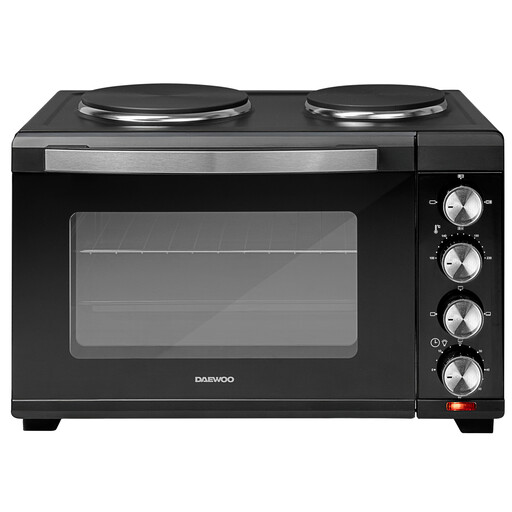 Image unavailable
Consider this countertop oven if you need to bake a buffet tart while also using hotplates for pans, provided your tart tin fits. Its stated capacity is 32L and the product title gives a 3000W rating; check usable rack dimensions, door clearance and the timer against your recipe.
Yes, if the tin fits the usable rack or tray space and the oven has suitable baking controls for your recipe. Make a trial tart before the buffet so you can assess the filling and pastry in that appliance.
No. Litre capacity is a starting point, but you also need usable width, depth, height and rack clearance. Tower describes its 42L T14045 as fitting a 10-inch pizza, while Euronics describes a rack fitting a 12-inch pizza for the Ninja DT200UK; neither description confirms that your tart tin will fit.
Not necessarily. The Russell Hobbs 22780 offers fan-assisted cooking, while the researched Tower conventional ovens have adjustable thermostats. Use the chosen appliance's baking guidance and a trial bake when adapting your recipe rather than assuming either format will give the same result.
Do not assume that baking controls provide suitable hot holding. For food-business service in England and Wales, the Food Standards Agency's Safer Food Better Business caterer guidance says food held hot should be kept at 63°C or above; where suitable hot holding is not possible, it describes a once-only display period of up to two hours. It directs Northern Ireland caterers to separate guidance.
If the buffet is supplied as a food business in England, Northern Ireland or Wales, Food Standards Agency guidance requires allergen information for prepacked and non-prepacked food. Base that information on your actual ingredients and cross-contact arrangements; the requirement described here does not establish the position for a private home buffet or Scotland.