Hosts serving several buffet dishes
If carrots need to cook alongside other food or in successive batches, check the usable tray area and rack arrangement rather than relying on the cavity size alone.


Choose by usable tray area and rack layout before extra functions. A two-level countertop oven is worth considering if carrots must roast alongside other buffet dishes; a 30-litre fan-assisted mini oven may suit more modest batches, particularly if integrated hotplates would be useful. Treat a 12-litre oven as a small-batch or top-up option, and check tray dimensions and safe worktop space before buying.
If carrots need to cook alongside other food or in successive batches, check the usable tray area and rack arrangement rather than relying on the cavity size alone.
A modest batch still needs room for the oven, its door to open and the clearance specified in its instructions. Check where the power cable can reach before settling on a worktop position.
A compact oven may be useful for an extra small tray after the main cooking is done. Check that its tray fits the quantity you need; a compact cavity does not establish buffet-scale capacity.
Decide whether the oven must handle several dishes, a modest carrot batch or a small top-up. That choice determines which tray, placement and serving-time checks matter most.
Consider when: carrots and another buffet dish need oven space at the same time; Ninja describes two-level cooking and a Roast function for the DT200UK.
Allow for: the DT200UK measures H33.5 × W43.5 × D50.5 cm according to SharkNinja UK, before any model-specific installation clearance.
Consider when: one oven cavity is sufficient and integrated hotplates would help with another buffet dish; Russell Hobbs lists both for the 22780.
Allow for: the 30-litre figure does not tell you how many carrots fit across the supplied tray.
Consider when: you need only a small roast or a top-up batch; De'Longhi lists the EO12012 as a 12-litre Bake and Grill oven.
Allow for: a small cavity may mean further batches if the carrot quantity has not been planned.
| Concern | What to check | Who this matters to |
|---|---|---|
| Batch capacity | Check usable tray dimensions, rack positions and whether the instructions permit roasting on two levels at once. | If I need enough carrots ready with the other dishes, I want to know how much fits spread across the trays; around 29% of consumers put batch capacity first. |
| Roast control | Check the available Roast or Bake settings and the instructions for rack placement or tray rotation; do not assume two shelves brown alike. | When consistent browning matters more to me than maximum batch size, I need to plan how the trays will cook; around 29% of consumers prioritise roast control. |
| Safe placement | Measure the appliance and door-opening space, then follow its clearance instructions. Check socket and extension-lead ratings if other appliances share the supply. | With serving dishes already taking up my worktop, I need space to position and power the oven safely; around 24% of consumers make placement their primary concern. |
| Serving schedule | Decide whether the oven is for the initial roast, another batch or short-term warming. For a food business, plan suitable cooking, holding and temperature monitoring. | If carrots need topping up while guests are eating, I care most about when each batch will be ready; around 18% of consumers put the serving workflow first. |
A 30-litre or 12-litre label does not show how much tray space is available to spread the carrots out. A crowded tray may require a change to the batch plan.
Ask for the supplied tray and internal rack dimensions, then compare them with the quantity you intend to cook.
SharkNinja UK gives the DT200UK a depth of 50.5 cm. The Russell Hobbs 22780 manual separately requires at least 50 mm of space around that appliance; the requirement must not be transferred to another model.
Measure the full footprint and door-opening space, and use the chosen model's instructions for ventilation clearance.
Electrical Safety First warns that overloading an extension lead or adaptor can cause overheating and a fire risk, a concern when several buffet appliances are in use.
Check the marked rating against the combined load, avoid daisy-chaining extension devices and fully unwind cable reels.
A mini oven alone does not cover a food business's cooking, holding and temperature-monitoring arrangements. The Russell Hobbs 22780 manual specifies household use only.
If you are supplying food as a business, check the appliance's intended use and plan the wider operation against Food Standards Agency guidance.
These models illustrate different countertop-oven arrangements; their stated capacities and functions do not establish how many carrot portions fit on a tray.
The DT200UK illustrates the larger two-level countertop-oven route for cooking carrots alongside other buffet food.
The 22780 Mini Kitchen illustrates a fan-assisted, single-cavity option for modest batches where integrated hotplates would also be useful.
The EO12012 illustrates a compact oven for a small carrot batch or an additional tray rather than an unplanned buffet quantity.
This 30-litre air fryer toaster oven is a countertop option to consider for roasting carrots in batches. Check its usable tray area and installation instructions against your buffet plan.
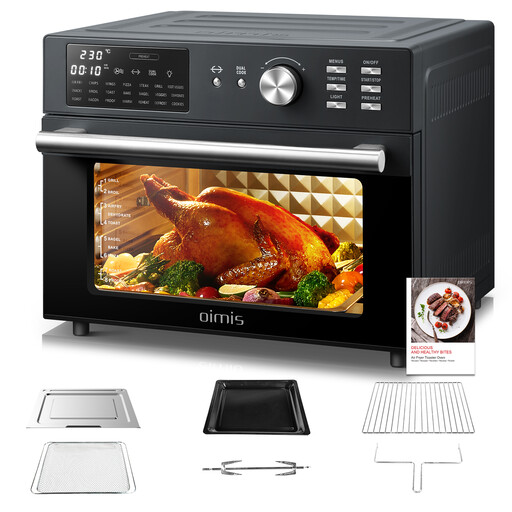 Image unavailable
Consider this 30-litre countertop oven if you need space for a planned carrot batch, but confirm how much fits on its usable tray.
The product name specifies 21 presets, an 1800 W rating, a rotisserie and a dehydrator. Check the roast settings and required ventilation clearance before choosing where to use it.
Choose by the carrot quantity and usable tray area, not cavity litres alone. Check the supplied tray and rack dimensions: a 12-litre model is a small-batch starting point, while a 30-litre cavity or two-level arrangement may give you more ways to plan batches, without proving a particular portion count.
Use one only if its rating accommodates the connected appliances and you can follow the oven's instructions. Electrical Safety First advises against exceeding an extension device's rating or daisy-chaining devices, and says cable reels should be fully unwound.
Follow the clearance requirements for the exact model. The Russell Hobbs 22780 manual specifies at least 50 mm around that appliance; another oven may have different instructions, so also measure the room needed to open its door.
A private home buffet is not automatically a food business, but operating a food business calls for separate checks beyond choosing an oven. For a UK food business, the Food Standards Agency says registration should take place at least 28 days before trading or food operations start; cooking, holding and temperature-monitoring arrangements also need to suit the operation.