Occasional baker with limited space
You want to make a small cake without installing a full cooker. Check that your tin fits the oven and that the appliance has enough worktop clearance.


Choose a mini oven by checking your cake tin against the usable cavity and rack space, then look for temperature controls that suit your recipe. A compact model may suit an occasional small bake; a larger fan-assisted oven or one with hotplates makes more sense if you also want to prepare other food. Allow for the appliance’s required worktop clearances and plan separately for any topping that needs chilling at the picnic.
You want to make a small cake without installing a full cooker. Check that your tin fits the oven and that the appliance has enough worktop clearance.
You want to bake the cake and prepare other food. A larger cavity, fan assistance or hotplates may be useful, provided the appliance fits your kitchen.
You would use baking programmes, convection or a view into the cavity regularly. Check those features on a model that is currently available and fits your tin.
Start with the tin and the space available for safe use; decide which extra cooking functions earn their worktop space after those checks.
| Concern | What to check | Who this matters to |
|---|---|---|
| Cake-tin fit and baking control | Compare the tin’s outside dimensions, including handles, with usable rack and cavity space. Check the temperature controls against your recipe. | If my usual cake tin will not sit level with room around it, the oven cannot make the bake I have planned. Around 36% of consumers put tin fit and baking control first. |
| Worktop space | Compare the appliance’s outside dimensions and its manual-required clearances with your available space, while still checking tin fit. | A compact oven helps only if I can position it safely without giving up the tin I intend to use. Worktop fit is the first concern for around 29% of consumers. |
| Other cooking uses | Look for functions you would actually use, such as grill or hotplates, rather than treating an air-fry or speed claim as a cake-baking result. | If the appliance will also prepare picnic food, I need its extra functions to justify the space it takes. Around 21% of consumers prioritise that flexibility. |
| Safe use and picnic packing | Follow the manual’s siting and electrical instructions; arrange cooling for any topping normally kept refrigerated. | I need a workable place to use and clean the oven, then a way to carry a chilled topping safely. Those practical steps come first for around 14% of consumers. |
Capacity does not tell you the usable width or height at the rack. De'Longhi specifies a maximum round-plate diameter of 26cm for its 12L EO12012, illustrating why the tin needs its own fit check.
Measure your tin, including handles, and compare it with the exact oven’s cavity, rack and supplied-tray dimensions.
If your existing tin will not fit, you may need different bakeware.
Russell Hobbs’ speed and energy comparisons for the 26680 concern specified tests, including preheating and frozen chips, not a lemon drizzle cake.
Check for a suitable Bake function and temperature control, then use the recipe and appliance instructions to guide your baking time.
Electrical Safety First warns that ovens used alongside other high-power appliances can overload extension leads and advises against connecting extension leads to one another. Required clearances vary by appliance.
Check the model’s electrical and siting instructions, keep nearby materials clear as directed, and never exceed an extension lead’s marked rating.
A cake topped with cream, cream cheese or another ingredient normally kept refrigerated needs a different picnic plan from a cake without a chilled topping. The Food Standards Agency advises keeping foods that normally go in the fridge cool at a picnic.
Use a cool bag or cool box with ice or frozen gel packs, and keep it out of direct sun.
Plan for the space and equipment needed to carry chilled food.
Its cited mini ovens offer two different routes: a 20L multifunction model and a 30L fan-assisted mini kitchen.
Its 28L Mini Oven with Hob is an option to examine if you want an oven and hotplates in one appliance.
The EO12012 illustrates the small-cavity route for an occasional bake in a compact kitchen.
The Smart Oven Pro BOV820 provides a reference point for bakers considering programmed functions and cavity visibility.
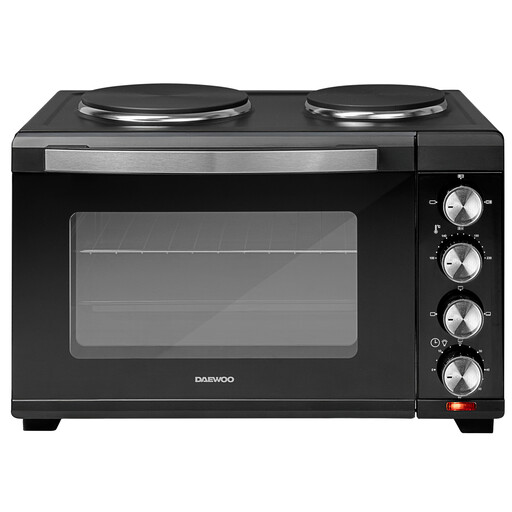
This countertop oven is worth considering if you want to bake a cake and use hotplates for other food preparation. Check its usable oven space and siting instructions against your kitchen before choosing it.
 No image available
Consider this countertop model if you want an oven for the cake alongside two hotplates for other cooking tasks.
Stated capacity: 32L. Stated power: 3000W. Check that your tin fits the usable rack space, and follow the model’s electrical and worktop-clearance instructions.
Measure the tin’s outside width, depth and height, including handles, and compare them with the exact oven’s usable cavity and rack dimensions. Leave the space around the tin required by the appliance instructions; litres alone are not a fit measurement.
Fan assistance is a feature to consider, not a guarantee of a particular cake result. Electrical Safety First describes fan ovens as distributing heat evenly, but your tin still has to fit and baking should follow the recipe and the chosen oven’s instructions.
Check the oven’s electrical requirements and the lead’s marked rating before doing so. Electrical Safety First warns against overloading extension leads, particularly with other high-power appliances; do not connect one extension lead to another, and fully unwind a cable reel before use.
If your cake has a topping or filling normally kept refrigerated, keep it cool during the picnic. The Food Standards Agency advises using a cool bag or cool box with ice or frozen gel packs for foods you would normally refrigerate.