Family-batch muffin bakers
If you are baking for several people, the number of muffins that fit in each batch matters more than the cavity volume alone. Check the space available for your own tin before choosing a model.


For carrot muffins at a family gathering, start with a conventional or fan-assisted mini oven that has a baking tray and enough usable shelf space for your muffin tin. A 28–32L model is a sensible format to consider for repeated batches, but its litre rating cannot confirm tin fit. A compact 19L oven may mean smaller or more batches; an air-fryer oven makes more sense if its other cooking functions matter to you and your tin fits its rack.
If you are baking for several people, the number of muffins that fit in each batch matters more than the cavity volume alone. Check the space available for your own tin before choosing a model.
If the oven will stay on a limited worktop, its outside dimensions and required ventilation space matter alongside baking capacity. A smaller cavity may mean making more batches.
If you also want hotplates, air frying or roasting, consider those functions separately from muffin capacity. Check how the oven's rack or tray accommodates your bakeware and whether combined functions have operating limits.
Consider it when: Muffins are the main job and you expect to bake successive batches for a gathering.
Trade-off: The larger format takes worktop space, and its litre rating still cannot confirm that your tin fits.
Consider it when: Worktop space is a stronger constraint than the number of muffins you can bake at once.
Trade-off: A smaller usable tray may mean additional batches.
Consider it when: You also expect to use functions such as air frying or roasting.
Trade-off: Its rack layout and stated capacity cannot be treated as equivalent to a conventional mini oven's muffin-tin space.
| Concern | What to check | Who this matters to |
|---|---|---|
| Batch capacity and tin fit | Measure your muffin tin, including handles and height. Compare it with the exact oven's usable shelf or tray dimensions and door clearance. | I want to make enough muffins without committing to too many batches, so my tin must fit flat with room above it. Around 42% of consumers put practical batch capacity first. |
| Baking control | Check that the stated temperature range covers your recipe and that the manual explains the appropriate baking mode and rack position. | When I bake successive batches, I need a setting I can follow consistently rather than assuming a fan will brown every tray evenly. For around 33% of consumers, baking control is the primary concern. |
| Worktop space and other uses | Measure the available space against the oven's external dimensions and manual clearances. If it has hotplates, check simultaneous-use limits. | I have limited room to leave an oven out and would also use it for other meals, even if that means smaller muffin batches. Worktop space and extra functions come first for around 25% of consumers. |
Cavity volume does not tell you the usable width, depth or headroom for a muffin tin. Different oven and rack layouts can make similar-looking capacity figures misleading for this task.
Measure the tin you own and ask for the exact model's internal shelf or supplied-tray dimensions before ordering.
A tin that does not fit could mean using different bakeware or making more batches.
A fan-assisted or convection setting identifies a cooking mode; it does not establish temperature accuracy or even browning with your recipe and tin.
Follow the model manual's rack-position guidance and, if possible, make a trial batch before the gathering. Rotate the tray only if the recipe and manual permit it.
A countertop oven needs a suitable position as well as room for the baking tray. Tefal's Optimo manual calls for air to flow freely around that appliance and warns that surfaces become hot.
Check the exact model's placement instructions before choosing a stable, heat-resistant worktop location.
Combined appliances can have model-specific limits. For example, only one hob on a Cookworks 28L Mini Oven with Hob can be used while the oven operates.
Check the listing and manual for the model you are considering before planning to bake muffins and prepare the rest of the meal at the same time.
Its Mini Kitchen 22780 is a 30L countertop oven to consider if you want conventional, fan-assisted baking alongside hotplates.
Tower's researched mini-oven models include 23L and 32L formats for different space and batch-size priorities.
The 19L Optimo OF445840 is a compact conventional mini-oven option if worktop room matters more than a large muffin batch.
The Halo Rotisserie Air Fryer Oven is an alternative if baking is one of several cooking tasks you want from a countertop appliance.
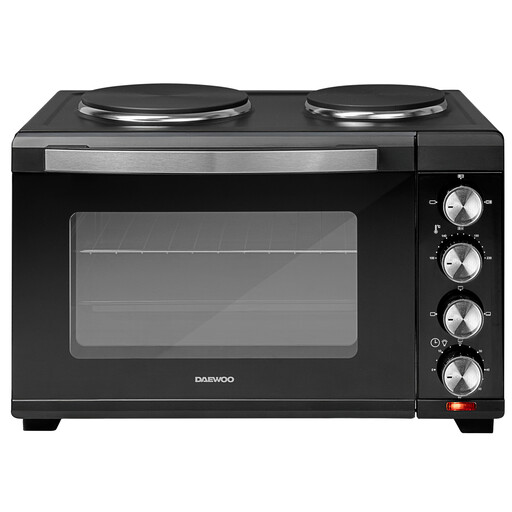
This countertop oven is a conventional-baking option to consider for family-batch muffins, particularly if you would also use hotplates. Check your muffin tin and worktop against the exact model before choosing it.
 No image available
Consider this countertop format if you plan to bake muffins for a gathering and would also use hotplates for other cooking tasks.
The product title states a 32L capacity and 3000W rating. Confirm that your muffin tin fits the usable shelf or baking tray, then check the model's placement instructions before choosing a worktop position.
It might be, but 30L alone cannot tell you how many muffins will fit in one batch. Measure your tin and compare it with the oven's usable shelf or tray dimensions, including the space needed for the door to close and for clearance above the muffins.
A conventional or fan-assisted mini oven is the more direct format to consider when baking batches is your main purpose; an air-fryer oven is worth considering if you will also use its other functions. Whichever format you choose, check that your oven-safe tin fits its shelf or rack and that the baking mode suits your recipe.
Place it according to the exact model's manual, on a stable, suitable worktop with the required room for airflow. Tefal's Optimo instructions call for air to circulate around that appliance and warn of hot surfaces; use your chosen oven's own clearance and safety instructions rather than assuming the same arrangement applies to every model.