Small-batch vegetable cooks
If cauliflower is usually a side dish for one or two, focus on a tray that holds your usual portion in one layer rather than choosing by cavity volume alone.


Choose a bake-capable mini oven that reaches your recipe’s temperature and has enough usable tray space to spread the cauliflower florets in one layer. Veg Power / Simply Veg calls for 220°C in a conventional oven or 200°C in a fan oven; a larger cavity or extra cooking modes are worth considering if you also cook bigger batches or other dishes, provided the appliance fits with its required clearance.
If cauliflower is usually a side dish for one or two, focus on a tray that holds your usual portion in one layer rather than choosing by cavity volume alone.
If you also want air-fry, grill or toast functions, compare the available modes while checking that the cooking surface still fits your cauliflower batch.
If the oven will do more than roast a vegetable side, a larger cavity, fan assistance or hotplates may be useful. Allow for the appliance’s worktop footprint and model-specific clearance.
Start with your recipe’s temperature and your usual batch size, then check whether the oven can sit safely in the space available. Extra modes matter most if you will use them for other cooking too.
| Concern | What to check | Who this matters to |
|---|---|---|
| Roasting temperature | Check the bake setting and thermostat range against your recipe: Veg Power / Simply Veg specifies 220°C conventional or 200°C fan. | If I plan to follow a particular cauliflower recipe, I need an oven that reaches its specified setting rather than relying on a similar-sounding cooking mode. Around 37% of consumers put recipe temperature first. |
| Tray space and batch size | Compare the usable tray or internal dimensions with the quantity of florets you normally cook; litres alone do not establish the tray footprint. | When I want to cook my usual batch at once, I need room to spread the florets without piling them up. For around 36% of consumers, batch space is the primary concern. |
| Worktop fit and controls | Measure the intended position with the model’s required clearance, then consider whether its timer and controls suit how you cook. | In a small kitchen, I need an oven I can position safely and operate without unwanted complexity, even if that limits batch size. Compactness and straightforward controls come first for around 27% of consumers. |
Cavity capacity does not show how much cauliflower will fit across the tray in one layer. A narrow cooking surface may mean roasting in batches.
Look for tray or internal dimensions and compare them with your usual quantity. The HOMCOM listing, for example, gives a 31.8 × 27.5 cm internal footprint.
Russell Hobbs’ stated speed and energy comparison for its Express Air Fry Mini Oven uses a frozen cheese pizza cooked at 200°C. It does not establish the same result for cauliflower florets.
Choose cooking modes and temperature range for the recipes you use, and follow the appliance instructions rather than assuming a shorter roasting time.
An appliance can fit on the worktop yet be unsuitable for the space around it. The Russell Hobbs 22780 instructions require at least 50 mm around that model and warn against use near or below combustible materials.
Check the exact model’s manual before choosing a position, and keep combustible items clear.
Offers for a model can differ by seller and supplied documentation. The HOMCOM listing is from a third-party marketplace seller.
Confirm the exact model, seller, plug and voltage suitability, supplied accessories, warranty and returns route for the offer you intend to buy.
Its 26095 Express Air Fry Mini Oven suits a search for several cooking modes; its 22780 Mini Kitchen is a larger option with hotplates.
The EO12012 is a compact conventional-oven option for shoppers prioritising bake and grill functions.
The 20 L Mini Oven and Grill is a conventional bake-and-grill option with straightforward temperature and timer controls.
The mini toaster oven is worth considering when published internal dimensions are important to your tray-space decision.
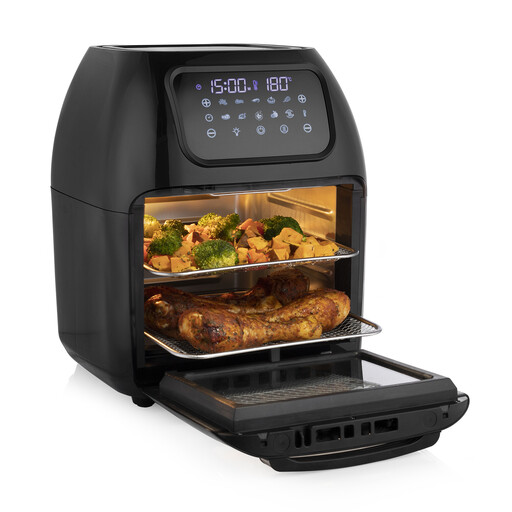
This air-fryer oven is an option for shoppers considering a compact, multi-programme appliance for cauliflower and other dishes. Check its baking temperature setting and usable cooking area against your recipe and batch before choosing it.
 No image available
Consider this model if you want an air-fryer-style oven for smaller cauliflower batches and other cooking tasks. Its name specifies touchscreen controls and 10 programmes. Before buying, confirm that a suitable programme reaches your recipe’s temperature and that the cooking surface holds your usual florets in one layer; also check the appliance’s external dimensions and clearance instructions.
It should reach the setting specified by the recipe you plan to use. Veg Power / Simply Veg calls for 220°C conventional or 200°C fan heat and roasts the florets for 25–30 minutes, until soft and just catching at the edges; check the oven’s stated range and cooking mode before buying.
No: a conventional mini oven with a bake function, the required temperature setting and a suitable tray can roast cauliflower. Consider an air-fry or convection model if you also want its other modes, but follow that appliance’s instructions and check the florets rather than assuming a conventional-oven cooking time will transfer unchanged.
Follow the clearance instructions for the exact model. The Russell Hobbs 22780 manual specifies at least 50 mm around that appliance, while Joybuy’s Tower T14045 listing calls for at least 20 cm on all sides; neither figure applies to every mini oven.
For the Veg Power / Simply Veg recipe, look for florets that are soft and just catching at the edges. Check their progress as they roast, particularly if you change from a conventional oven setting to a fan or air-fry mode.