One-off bake-sale tart makers
Start with the tart tin you plan to use. A suitable oven must accommodate it and offer settings that cover your recipe; functions you will not use need not drive the choice.


Choose a mini oven that fits your tart tin on its rack or tray, then check that its temperature settings and timer suit the recipe. A larger litre capacity alone cannot establish fit, and extra functions are worth considering only if you will use them for other bake-sale preparation or regular cooking. Check the oven’s placement and electrical requirements before baking.
Start with the tart tin you plan to use. A suitable oven must accommodate it and offer settings that cover your recipe; functions you will not use need not drive the choice.
If you will bake beyond this sale, compare usable tray space, rack positions, temperature settings and the worktop space the oven requires.
An oven with hotplates may be useful if you also need to prepare fillings or other food. Check that its size and electrical requirements work in your kitchen, as well as whether the oven fits your tin.
Measure the tin and the available worktop first; then compare oven controls with the recipe and decide whether you need cooking functions beyond baking.
| Concern | What to check | Who this matters to |
|---|---|---|
| Tart-tin fit | Compare the tin’s outside diameter and height with the usable rack or tray and internal dimensions; allow space to remove it safely. | I need the tin to fit securely with the door closed, rather than relying on a litre label. Around 36% of consumers put physical fit first. |
| Heat and timing | Check the recipe temperature against the stated range, the required bake time against the timer, and whether the recipe calls for fan or conventional heat. | When following a particular tart recipe, I want settings that let me use its specified heat and timing. Recipe controls come first for roughly 29% of consumers. |
| Other cooking tasks | Decide whether hotplates or additional oven functions serve another planned task; check the appliance’s power requirements. | If I am also preparing fillings or other food, I may want more than an oven in the same appliance. About 21% of consumers make those additional tasks their primary concern. |
| Worktop and electrical setup | Measure the intended space, follow the exact model’s clearance instructions and check that the socket arrangement is suitable. | In a crowded kitchen, I need a place to use the oven without obstructing ventilation or placing it near flammable items. Safe placement and electrical setup lead the decision for around 14% of consumers. |
A 28L, 30L or 34L capacity does not tell you whether your particular tart tin fits on the supplied support.
Measure the tin, including its rim, and compare it with the oven’s usable rack or tray and cavity dimensions before ordering.
A stated temperature range tells you which settings are available, not how accurately an oven holds them or how evenly it browns pastry.
Check that the range covers your recipe and preheat as instructed. If consistent results matter for repeat baking, consider an appropriate oven thermometer and a test bake.
A countertop oven needs space around it, while an extension lead shared with other large appliances may be overloaded, as Electrical Safety First warns.
Use a stable, heat-resistant surface, keep flammable items away and follow the exact model’s clearance and electrical instructions.
A chocolate tart’s ingredients and preparation may introduce allergens. How the food is packed and sold affects which requirements apply.
Keep an accurate ingredient record, take steps to prevent cross-contact and confirm the organiser’s arrangements before selling portions. The Food Standards Agency states that food businesses selling food prepacked for direct sale in England, Wales and Northern Ireland must provide the food name and a full ingredients list with allergens emphasised.
A countertop-oven line with a documented 30L example worth checking against a measured tart tin.
A multifunction option to consider when bake-sale preparation calls for hob cooking as well as an oven.
A 34L countertop-oven example for consumers comparing a larger format with their available worktop space.
A multifunction countertop-oven option for consumers expecting to cook more than a single bake-sale tart.
A multifunction countertop-oven line to examine if you expect to bake and cook regularly.
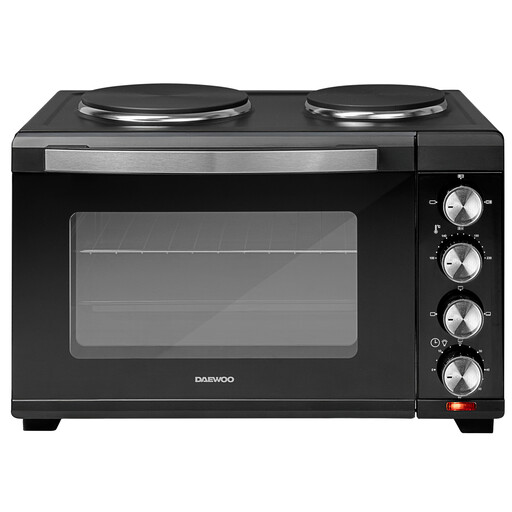
This countertop oven has hotplates for other food preparation alongside the tart-baking task. Check that its usable oven space fits your tin and that its electrical requirements suit your setup.
 No image available
Consider this model if preparing other food alongside the tart makes its two hotplates useful. Its stated capacity is 32L and its stated power is 3000W; compare your tin with the usable rack or tray dimensions, and check the model’s electrical instructions before buying.
Choose by the dimensions of your tart tin and the oven’s usable support space, not litres alone. Measure the tin’s outside diameter and height, then check the rack or tray and cavity dimensions, leaving room to handle the tin safely.
Not necessarily: use an oven setting and temperature appropriate to your recipe. A fan-assisted function may also serve other cooking tasks, but its presence alone does not establish a better result for pastry.
Check the oven’s electrical instructions and your socket arrangement before use. Electrical Safety First warns that ovens and grills may overload an extension lead when it is used with other large appliances; seek advice from a qualified electrician if you are unsure about the setup.
Follow the clearance instructions for the exact model you buy. Sage’s BOV820 manual, for example, specifies at least 10cm at each side and 15cm above, but those distances should not be applied to every oven. Use a stable, heat-resistant surface and keep flammable items away.
Check how the tart will be offered and packed, and give the organiser an accurate ingredient record. The Food Standards Agency states that food businesses producing food prepacked for direct sale in England, Wales and Northern Ireland must label it with the food name and a full ingredients list with allergens emphasised. Confirm the requirements for your particular sale rather than assuming every home-baked or charitable sale is treated alike.