Small-batch tart bakers
You bake one tart at a time and want adjustable heat and a timer. Your own tart tin must sit level on the oven’s rack or tray with enough clearance.


Choose a conventional or fan-assisted mini oven if baking one tart at a time is your main use and you want an oven-style rack with adjustable heat. An air-fry mini oven makes more sense if you will regularly use its other cooking modes. Either way, measure your tart tin against the usable rack space and check the oven’s worktop clearance before buying.
You bake one tart at a time and want adjustable heat and a timer. Your own tart tin must sit level on the oven’s rack or tray with enough clearance.
You need room for an oven on a small worktop and may also use it for toast, grilling or simple meals. Its external size and required safety clearance matter as much as its stated capacity.
You expect to use air-fry or other modes regularly as well as Bake, so the accessory layout and controls matter alongside tart-tin fit.
Choose it when: An oven-style rack or tray and adjustable baking temperature are your priorities.
Check: The usable rack dimensions and the space the appliance needs on your worktop; capacity in litres establishes neither.
Choose it when: You will use air frying or other cooking modes often enough to make the extra functions worthwhile.
Check: An upright, multi-level layout may leave a different space for bakeware than an oven-style rack; confirm that your tin sits level with adequate clearance.
For a chocolate tart, establish that the tin fits before comparing worktop space, cooking modes and day-to-day convenience.
| Concern | What to check | Who this matters to |
|---|---|---|
| Tart-tin fit and baking control | Compare the outside width and height of your tin with usable rack space and clearance. Check the adjustable temperature range and timer. | If my tart tin cannot sit level, the oven cannot do the job, however large its stated capacity. Around 36% of consumers put fit and baking control first. |
| Worktop space | Compare external dimensions and the exact model’s placement instructions with your intended spot. | I need a place where the oven can stand safely without taking over my worktop. Worktop space comes first for roughly 29% of consumers. |
| Everyday versatility | Choose modes you will use regularly, and check that Bake is stated and the supplied accessories suit your tin. | I want the same appliance to handle tart baking and other routine cooking, rather than buying it for one recipe. About 21% of consumers prioritise that versatility. |
| Preheating and cleaning | Read the conditions behind speed claims, and check which parts are removable and how each should be cleaned. | For frequent small batches, I want straightforward preparation and clean-up, without assuming a speed claim predicts tart results. Convenience is the primary concern for around 14% of consumers. |
Litres describe cavity volume, not the usable width of a rack or the clearance above a tart tin. A tin that cannot sit level makes the oven unsuitable for this bake.
Measure the tin’s outside dimensions, including handles or a loose-base rim, and compare them with the usable rack or tray dimensions before ordering.
Russell Hobbs bases its stated faster-preheat comparison for the 26680 on reaching 220°C, while its energy comparison uses frozen French fries at 213°C. Neither test establishes how a chocolate tart will bake.
Follow your recipe’s temperature and check the first tart as it bakes; use the oven’s observed behaviour to guide later adjustments.
Countertop ovens have hot surfaces and need space around them. The Russell Hobbs 22780 manual specifies at least 50 mm of clearance all round and warns against use near or below combustible materials.
Read the instructions for the exact model and choose a stable, level, heat-resistant position that allows its required clearance.
Air frying, rotisserie or multiple cooking levels may be useful for other meals, but none establishes that your tart tin will fit on a suitable support.
Start with tin fit, baking controls and worktop placement. Treat additional modes as a reason to choose a model only if you expect to use them regularly.
Its UK range includes the oven-style 22780 Mini Kitchen and the multi-function 26680 Express Air Fry Mini Oven.
The T14043 is an oven-style option for cooks who prefer dial controls and supplied baking accessories.
The Halo Rotisserie Air Fryer Oven is an upright, multi-level format to consider when Bake is only one of several modes you will use.
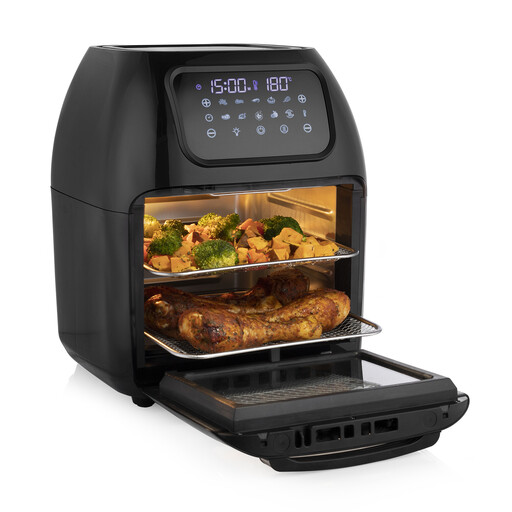
This air-fryer oven is relevant if you want an appliance for other cooking as well as occasional small-batch tart baking. Confirm its usable baking space and placement requirements against your tin and worktop before choosing it.
 No image available
Consider this format if you expect to use air frying as well as baking; before buying it for a tart, confirm that your tin sits level inside and that you can meet the model’s placement instructions.
The product title specifies 10 L capacity, 1800 W, touchscreen controls and 10 programmes. It also describes dishwasher-safe parts and a non-stick coating; check the care instructions for each part.
Measure the outside dimensions of your actual tart tin, including any handles or loose-base rim, then compare them with the oven’s usable rack or tray dimensions and vertical clearance. A 20 L, 23 L or 30 L capacity figure cannot establish whether the tin fits.
Choose an oven-style model if a rack or tray and adjustable baking heat are your main priorities; consider an air-fry mini oven if you will also use its other modes regularly. For either format, check that your tin fits level, the temperature range covers your recipe and the appliance has a suitable baking setting.
Follow the clearance instructions for the exact model. The Russell Hobbs 22780 Mini Kitchen manual specifies at least 50 mm all round and warns against use near or below combustible materials; another oven may have different requirements.
If you start or take over a food business, Food Standards Agency guidance says to register with your local authority at least 28 days before trading. Baking tarts solely for your own household is different from starting a food business; check the registration process that applies where you intend to sell.