Buffet batch bakers
You need enough properly spaced macaroons across repeated trayfuls. Usable pan area, tray handling and cooling time matter more to your plan than a capacity figure on its own.


Choose a mini oven by the usable area of its baking tray and the number of batches you can manage, not by cavity capacity alone. A compact oven can work if you have time for repeated trayfuls; for a larger buffet, check the supplied tray dimensions before choosing a larger model. The Great British Bake Off coconut-macaroon recipe starts at 150°C conventional heat or 130°C fan heat, so check that the oven offers a suitable baking setting and leave room on the worktop for the clearance specified in its manual.
You need enough properly spaced macaroons across repeated trayfuls. Usable pan area, tray handling and cooling time matter more to your plan than a capacity figure on its own.
You want an oven for occasional entertaining without giving up too much worktop space. A compact model may suit you if the tray fits your portions and you can bake sequentially.
You also want to use the appliance for tasks such as air frying, grilling or toast. For macaroons, check for a usable baking setting rather than assuming an air-fry programme follows an oven recipe.
Start with the number of macaroons you need per tray, then check the baking controls, repeat-batch routine and space required to operate the oven.
| Concern | What to check | Who this matters to |
|---|---|---|
| Usable tray area | Compare the supplied pan’s width and depth with your planned macaroon spacing; check the rack width too. A 34 × 28.9 cm pan is listed for one HOMCOM model, illustrating the sort of measurement to seek for the exact oven you choose. | For a buffet, I want enough spaced macaroons on each tray without too many baking runs; around 36% of consumers put usable batch area first. |
| Baking control | Check for an adjustable baking setting around your recipe’s temperature and a timer. The Great British Bake Off recipe starts at 150°C conventional or 130°C fan heat; test a small tray before relying on its timing in a mini oven. | If I am aiming for lightly golden macaroons, I want to use my recipe’s baking setting rather than assume an air-fry preset behaves the same way; roughly 29% of consumers prioritise baking control. |
| Repeated batches | Check which tray, rack and crumb tray are supplied and how the manual says to handle and clean them. Allow for hot-tray handling and cooling between baking and cleaning. | When trayfuls keep coming, I need a manageable way to handle hot accessories and clean up afterwards; around 21% of consumers make repeat-batch handling and cleaning their primary concern. |
| Worktop and socket | Measure the oven’s footprint plus the clearance required by its own manual. Check that your socket arrangement suits the appliance; Electrical Safety First warns against overloading or daisy-chaining extension equipment. | With a crowded worktop, I need room for ventilation and a suitable electrical setup, not just space for the oven itself; roughly 14% of consumers put safe placement first. |
Cavity volume does not tell you how many spaced macaroons fit on the supplied pan. A larger oven can still come with a tray that is too small for your intended batch.
Lay out your planned spacing on paper, then compare the required area with the exact pan dimensions and rack width before buying.
Air Fry and Bake are separate functions on the Russell Hobbs 26680. A coconut-macaroon recipe’s oven timing should not be assumed to transfer unchanged to an air-fry setting.
Start with the recipe’s appropriate baking temperature and try a small tray, checking the colour and texture before adjusting the time.
The Russell Hobbs 26680 manual specifies 150 mm of surrounding space for heat flow and calls for regular crumb-tray cleaning. That clearance is model-specific, not a rule for every mini oven.
Follow the manual for your chosen model, keep paper away from hot surfaces, use oven gloves for trays and let the appliance cool before cleaning.
Electrical Safety First warns that overloaded extension equipment can overheat and cause a fire.
Use a suitable wall socket where possible. If you need an extension lead, check its marked rating against the appliance, fully unwind any cable reel and do not daisy-chain extension devices.
Tefal’s Optimo OF445840 is a compact 19L mini oven for considering when several smaller baking runs suit your buffet plan.
The 20L Russell Hobbs 26680 combines a dedicated Bake setting with Air Fry, Grill, Toast and Keep Warm functions.
De'Longhi identifies the Sfornatutto Chef EO34302 as a 34L electric oven, a larger-capacity model to investigate for repeated buffet baking.
The Quest 35379 is listed as a 26L convection mini oven with variable temperature control.
This 10L air-fryer oven is a compact option to assess if you can bake your buffet macaroons in smaller runs. Confirm its usable pan area, baking controls and placement requirements against your recipe and worktop before choosing it.
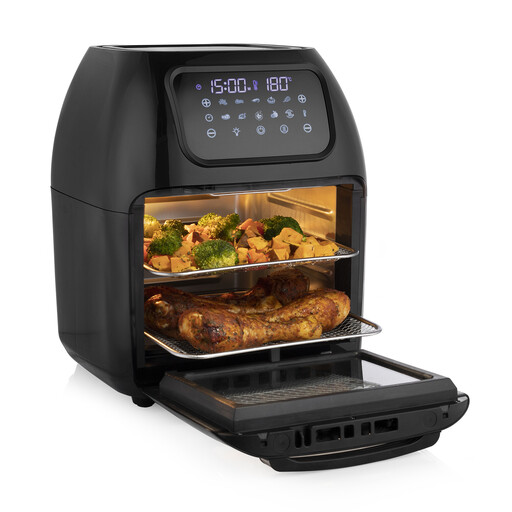 No image available
Consider this for smaller, repeated runs if its baking pan accommodates your planned macaroon spacing.
The product name specifies 1800W, a touch screen, 10 programmes and dishwasher-safe parts. Check the exact model instructions for a suitable baking setting, its temperature adjustment and the clearance needed on your worktop.
Check that its baking controls cover the starting temperature in your chosen recipe. The Great British Bake Off coconut-macaroon recipe uses 150°C conventional heat or 130°C fan heat; bake a small test tray because timing may change in a smaller or fan-assisted oven.
Not necessarily: litres describe the oven cavity, not the flat space on its baking pan. Compare the supplied pan’s dimensions, rack width and the spacing you plan to leave between macaroons before deciding whether a larger model reduces the number of runs.
Follow the clearance instructions for the exact model, in addition to measuring its footprint. The Russell Hobbs 26680 manual calls for 150 mm around that unit for heat flow; do not apply its figure automatically to another oven.
Check the appliance’s rating against the extension lead’s marked rating before considering one, and use a suitable wall socket where possible. Electrical Safety First advises against overloading or daisy-chaining extension equipment and says cable reels should be fully unwound.