Choose a fan-assisted mini oven if baking is the main job and you want to use conventional trays and racks. Choose a convection combination microwave if the same appliance also needs to reheat food, but check that your tart tin can fit and rotate in its oven mode. Either way, confirm the recipe temperature, tin fit, ventilation clearance and electrical load before buying.
Who is this for?
Small-kitchen tart bakers
If pastry and custard are your main reason for buying, prioritise an oven mode that suits your recipe and a cooking space that takes your tart tin. Good Food advises baking its egg custard tarts until the filling looks set with a slight wobble, so a cooking preset alone is not a substitute for checking the tart.
One-appliance kitchen consolidators
If worktop space is scarce, a convection combination microwave may cover oven-style baking and microwave reheating in one appliance. Check its cookware instructions and usable cooking area before counting on it for your tart tin.
Safety-conscious countertop buyers
If sockets are limited or cupboards sit close to the intended position, check the model's ventilation instructions and electrical rating before choosing a spot. Electrical Safety First warns against blocking appliance ventilation or overloading sockets.
What matters when choosing?
For a custard tart, decide whether you mainly need a baking oven or an appliance that also handles microwave reheating. Then check the exact model against your recipe, tart tin and available worktop space.
Fan-assisted mini oven
Choose it when: Baking with a conventional tray and rack is the main task.
Allow for: Dedicated worktop space; a capacity in litres does not establish that your tin will fit.
Convection combination microwave
Choose it when: One appliance needs to provide both microwave reheating and oven-style baking.
Allow for: A rotating cooking area that may restrict the shape or size of bakeware.
| Concern | What to check | Who this matters to |
|---|
| Controlled baking |
Confirm an oven-style Bake or convection mode and a temperature range that covers your chosen recipe. |
When I bake pastry and custard, I want an oven mode that reaches my recipe temperature rather than relying on a reheating preset; around 39% of consumers place controlled baking first. |
| Placement and tin fit |
Measure the intended spot with the required ventilation clearance, then compare your tin's outer dimensions with the usable cavity or turntable. |
With little worktop room, I need a safe place for the appliance and enough room inside for my tart tin; roughly 38% of consumers put placement and tin fit first. |
| Multiple uses |
Decide whether microwave reheating is essential or whether conventional baking trays and racks matter more. |
If one machine must cover baking and everyday reheating, its other cooking modes need to earn their space; about 23% of consumers prioritise replacing several appliances. |
Mistakes to avoid
-
Assuming capacity tells you whether a tart tin fits
A litre figure does not show shelf width, door clearance or whether a tin can rotate on a turntable.
Measure the tin at its widest point, including its rim or handles, and check the exact model's usable dimensions and cookware instructions.
-
Choosing a crisping or grill function instead of an oven mode
For a custard tart, the appliance needs an oven-style mode and a temperature range suitable for the chosen recipe; an air-fry or grill label alone does not establish that.
Check the model's Bake, fan-assisted or convection setting and its temperature range before buying.
-
Putting the appliance where its vents are blocked
Electrical Safety First warns that objects placed on appliances such as microwaves can obstruct ventilation and cause overheating or fire.
Follow the manufacturer's clearance instructions, keep the top clear and route the lead away from heat, water and walkways.
-
Adding an oven to an overloaded extension lead
A countertop cooking appliance adds to the load on a socket or extension lead. Electrical Safety First gives 13 A, or about 3,000 W, as the maximum load for a single socket.
Check the appliance rating and any extension lead's marked limit, account for other connected devices and do not daisy-chain leads.
Brands to consider for these oven formats
Russell Hobbs
The 22780 Mini Kitchen is a countertop-oven example for buyers considering conventional-style baking with a tray and rack.
- Russell Hobbs specifies fan assist, a 60°C–230°C thermostat, a 30-litre capacity, an oven tray and a grill rack for the 22780.
- Its hotplates may not suit a kitchen where dedicated worktop space is scarce. Check the cavity dimensions against your tart tin rather than relying on capacity alone.
Panasonic
The NN-CD58RS illustrates the convection combination microwave route for kitchens that also need microwave functions.
- Panasonic specifies a 30°C–220°C convection mode, a 27-litre capacity and a 34 cm turntable for the NN-CD58RS.
- Check that the tin fits the rotating cooking area and is permitted in the selected oven mode.
Ninja
The DT200UK is a multifunction countertop-oven example for buyers comparing cooking functions.
- The DT200UK is listed with 10 preset functions, a 2400 W rating and a programmable timer.
- Use the exact model manual to check internal dimensions, tart-tin fit and placement requirements.
Sage
The Smart Oven Air Fryer SOV860BSS is another countertop mini-oven option with programmable controls.
- The SOV860BSS is listed as a 22-litre, 2400 W mini oven with a programmable timer.
- Check its usable baking dimensions and your recipe's requirements; those listed features do not establish tart-tin fit.
Joybuy product choices
These combination microwaves suit shoppers who want to consider oven-style baking alongside other countertop cooking functions. Check each model's oven-mode temperature, permitted bakeware and tart-tin fit before choosing one for a custard tart.
 No image available
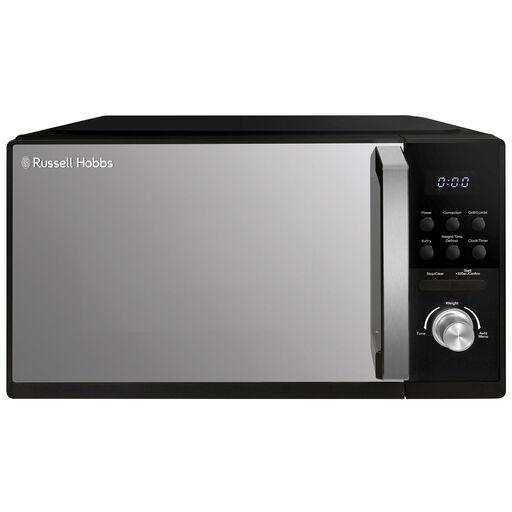
Russell Hobbs RHMAF2508B 25 L Digital Combination Microwave, Black
Consider this combination model if you want oven-style baking alongside microwave cooking in one countertop appliance.
Its product name specifies a 25 L capacity and 4-in-1 digital design. Before baking a tart, check the convection temperature against your recipe and confirm that your tin is permitted and fits the usable cooking area.
View on Joybuy
 No image available
Toshiba MW3-SAC23SF(MB) 23 L Air Fry Combination Microwave, Mirror Black
Consider this model if microwave, grill and oven-style cooking all matter in your small kitchen.
Its product name specifies a 23 L capacity, a 1000 W grill, smart app control and 10 cooking presets. Check the convection temperature, cookware instructions and whether your tart tin can rotate freely before relying on it for baking.
View on Joybuy
 No image available
Daewoo SDA2618GE 26 L 5-in-1 Combination Microwave
Consider this model if you want a stated Bake function alongside microwave, grill and air-fry modes.
Its product name specifies a 26 L capacity and a 2400 W rating. Check the baking temperature and internal dimensions against your recipe and tin, and follow the model's cookware and ventilation instructions; metal cookware must not be used in microwave mode.
View on Joybuy
Common questions
Can a compact oven bake a custard tart?
Yes, provided it has an oven-style baking mode, reaches your recipe's required temperature and safely accepts your tart tin. Good Food advises baking its egg custard tarts until they look set with a slight wobble; follow your chosen recipe and check the filling rather than relying on a preset alone.
Will a tart tin work in a convection combination microwave?
It can if the tin fits the usable rotating area and the model permits that cookware in convection mode. Panasonic specifies a 34 cm turntable for the NN-CD58RS, but that measurement alone does not establish safe fit for a particular tin; check its full outer dimensions and the model instructions.
Can I use an extension lead with a countertop oven?
Check the oven's electrical rating, the lead's marked limit and the combined load before using one; do not daisy-chain extension leads. Electrical Safety First gives 13 A, or about 3,000 W, as the maximum load for a single socket.
How much space should I leave around a compact oven?
Follow the clearance distances in the exact model's instructions rather than using one distance for every appliance. Keep ventilation openings and the top clear: Electrical Safety First warns that objects placed on appliances such as microwaves can obstruct ventilation and cause overheating or fire.


