Start with the outside dimensions of your pie dish, the available worktop space and the socket arrangement, rather than choosing by oven capacity alone. A compact oven may suit one small pie if the dish fits; consider an air-fryer oven if you also want its other cooking modes, or a mini kitchen with hotplates if you need space to prepare more of the meal. Each choice still needs a dish-fit and shared-kitchen safety check.
Who is this for?
Single-dish cottage-pie cooks
If you mainly want to bake one small casserole dish, check its fit and the oven’s baking controls before choosing extra functions. Capacity in litres cannot tell you whether a dish with handles will clear the rack and door.
Shared-kitchen safety and clean-up planners
If counter space and sockets are shared, you need a place with the clearance required by the appliance, a suitable electrical connection and a clean-up routine everyone can follow. Electrical Safety First warns against wet-hand contact and overloaded sockets.
Multi-meal cooks
If the appliance will do more than bake pie, an oven with air-fry or hotplate functions may be worth considering. Check that its additional functions are useful for your meals without compromising dish fit or shared worktop space.
What matters when choosing?
Check whether your dish and the appliance fit the space first; then compare baking controls, the demands of shared use and any functions you will use for other meals.
| Concern |
What to check |
Who this matters to |
| Dish and worktop fit |
Measure your dish including handles. Check usable rack dimensions, door clearance, exterior size and the manual’s ventilation clearances. |
I need the pie dish to fit while leaving room to use the shared counter safely. Around 36% of consumers put dish and worktop fit first. |
| Baking and browning |
Check for a Bake or convection setting, temperature control, a timer and usable rack positions. |
I want the filling heated through without the potato topping browning too soon. For around 29% of consumers, baking control and the finish are the primary concern. |
| Shared use and cleaning |
Check appliance wattage against everything sharing the connection, and review ventilation and cleaning instructions. |
When several people use the kitchen, I need to avoid overloaded connections and leave the oven clean for the next person. Safe shared use and clean-up come first for around 21% of consumers. |
| Other cooking needs |
Compare the cooking modes you would use; read the food, temperature and comparator behind any speed or energy claim. |
I would use the oven for meals beyond cottage pie, so its additional functions matter to me. Around 14% of consumers make speed and versatility their first priority. |
Mistakes to avoid
-
Assuming a litre rating proves your dish will fit
Capacity does not describe the rack footprint, usable height or clearance for dish handles. A deep pie dish may be awkward even when the stated capacity looks sufficient.
Measure the outside of your dish and check the chosen model’s usable internal dimensions and door clearance before ordering.
-
Overloading a shared extension lead
An oven used alongside other appliances can overload a lead or socket. Electrical Safety First advises checking the total connected load and warns against chaining extension leads.
Check the oven’s electrical rating, the lead’s marked rating and what else will be running on the same connection.
-
Treating an energy claim as a cottage-pie result
Russell Hobbs bases its 26680 energy comparison on cooking 400 g of frozen French fries in a conventional oven at 213°C. That comparison does not establish the result for a filled casserole dish.
Read the stated test conditions before using a speed or energy claim to choose between ovens.
-
Letting communal storage block the oven
Objects placed on or around an appliance can obstruct ventilation, while grease and food residue add a fire risk. Electrical Safety First highlights both hazards in its kitchen advice.
Keep the space required by the model’s instructions clear, do not use the oven as a shelf and clean residue after use.
Brands to consider for these oven types
Russell Hobbs
Its 26680 air-fryer mini oven and 22780 mini kitchen illustrate two different ways to add functions beyond compact baking.
- Russell Hobbs lists five cooking settings and a 20L capacity for the 26680. The 22780 has a 30L fan-assisted oven and two hotplates.
- Choose by the functions and space you need, then check your dish against the chosen model’s usable dimensions. The brand’s speed and energy comparisons for the 26680 should not be treated as cottage-pie results.
Tefal
The Optimo OF445840 is a compact 19L option for shoppers focused on conventional oven controls.
- Tefal lists baking and convection functions, a thermostat, a timer and a maximum temperature of 240°C for this model.
- Its capacity alone cannot establish whether your particular pie dish will fit; check rack and cavity dimensions.
Breville
The Halo Rotisserie Air Fryer Oven offers an air-fryer-oven format with rack-based cooking.
- Breville specifies a 10.6L capacity, three cooking levels and temperatures up to 200°C.
- Check whether its rack arrangement accommodates your casserole dish before treating it as a pie-baking option.
Joybuy product choices for baking a pie
These choices cover a countertop oven with hotplates and a smaller air-fryer oven with a bake function. For either format, check your pie dish against the usable cooking space and leave the worktop clearance required by the appliance.
 No image available
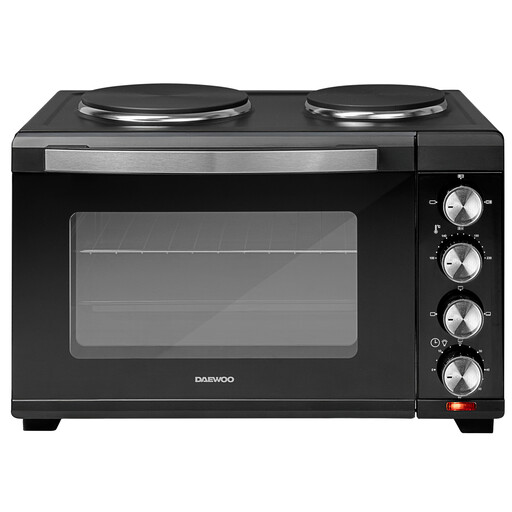
DAEWOO SDA1609GE 32L oven with dual hotplates
Consider this format if you want to bake the pie and use hotplates while preparing the meal. The product name states a 32L capacity and 3000W; check the dish dimensions, required worktop clearance and total electrical load before using it in a shared kitchen.
View on Joybuy
 No image available
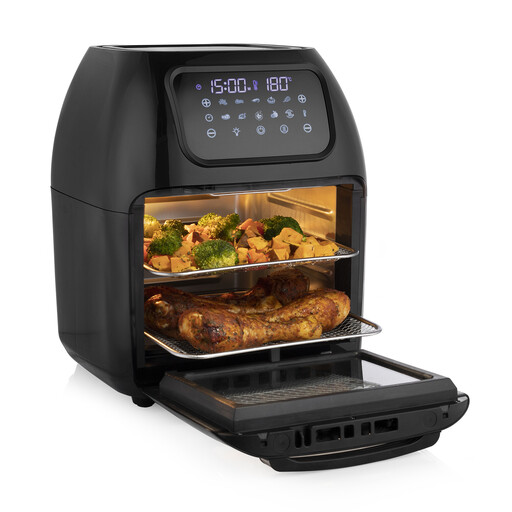
Tristar FR-6964 Multi Crispy 10L air-fryer oven
Consider this smaller format if you want an air-fryer oven for baking and other cooking, provided your pie dish fits. The product name states 1800W, touch controls, 10 programmes and dishwasher-safe parts; check the usable rack space, worktop clearance and your recipe’s temperature requirements.
View on Joybuy
Common questions
Is a 19L or 20L mini oven large enough for a cottage pie?
It can be, but capacity alone cannot establish whether your dish fits. Measure the dish including its handles, then check the chosen model’s usable rack width, depth and height, as well as door clearance.
Can I use an extension lead for a mini oven?
Only if the oven and every other connected appliance stay within the lead’s marked rating. Electrical Safety First says most extension leads are rated at 13A, while some are rated at 10A or less; do not chain extension leads.
What should everyone agree on when sharing a mini oven?
Agree where it can stand, how to keep its required ventilation space clear and who cleans it after use. Electrical Safety First also advises against handling electrical equipment with wet hands or leaving cooking appliances unattended.
Do the same product-marking rules apply throughout the UK?
Do not assume they do. GOV.UK’s product-marking guidance addresses Great Britain and notes different processes for Northern Ireland; check the product information for the market where the oven will be supplied.


