What matters when choosing?
Check permission, placement and power before comparing baking controls, tart-tin fit and functions you may use beyond one tart.
| Concern |
What to check |
Who this matters to |
| Permission and safe use |
Confirm the kitchen’s appliance rules and the model’s intended use. Check its required clearance and whether the available socket arrangement is suitable. |
I need to know whether the kitchen allows my oven and whether it has a safe place and socket; around 36% of consumers put permission and safe use first. |
| Baking controls |
Check the temperature range, timer, cooking modes and rack positions against your recipe and tart tin. |
I want to follow a staged custard-tart recipe without guessing when to change the setting; for around 29% of consumers, baking control is the primary concern. |
| Worktop space and storage |
Measure the proposed position with the exact model’s ventilation clearance, not just its cavity capacity. |
If the worktop is shared, I need room to use the oven and somewhere to keep it after it cools; around 21% of consumers prioritise space and storage. |
| Capacity and extra functions |
Compare the usable rack area with your tart tin. Consider hotplates only if you need hob cooking as well. |
I also need room for other dishes or a way to cook on hotplates, not just bake one tart; roughly 14% of consumers make capacity and extra functions their primary concern. |
Brands and models to consider
These model examples show different ways to balance baking controls, capacity and additional cooking functions; suitability still depends on the exact kitchen and appliance instructions.
Tefal
The 19L Optimo OF445840 is a compact, baking-focused option with mechanical controls.
- Tefal lists six cooking modes, six shelf heights, a baking tray and a maximum setting of 240°C for this model.
- Its manual specifies household use and excludes staff kitchen areas in shops, offices and other working environments.
Russell Hobbs
The range considered here includes the 30L 22780 Mini Kitchen with double hotplates and the 12.6L 26090 Express Mini Oven.
- Russell Hobbs lists fan assistance and a 60°C–230°C thermostat for the 22780; the 26090 has bake, grill, toast and keep-warm settings.
- The reviewed manuals specify household use. The 22780 needs at least 50 mm clearance around it, while the 26090 needs 150 mm.
Tower
Tower’s conventional-dial examples include the 23L T14043 mini oven and the larger 32L T14044 with hotplates.
- Tower lists a 90°C–230°C adjustment range, a 90-minute timer, a baking tray and a wire rack for the T14043.
- The T14044 adds hotplates, so assess whether hob cooking justifies the worktop space in your shared kitchen.
Joybuy products with hotplates
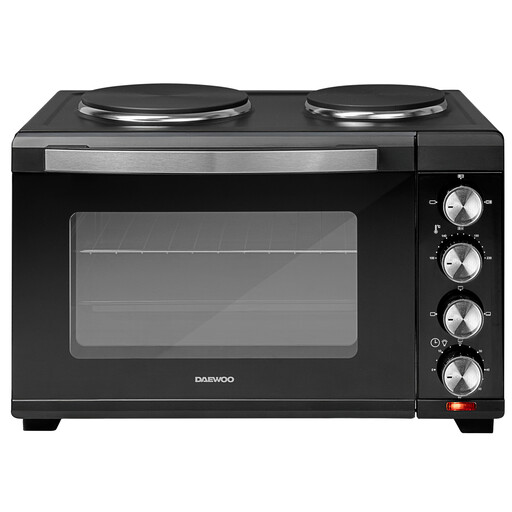
This countertop oven is relevant if you want to bake custard tarts and also use hotplates for other cooking. Confirm tart-tin fit, operating clearance and permission for your kitchen before choosing it.
 No image available
DAEWOO SDA1609GE 32L electric oven with dual hotplates, 3000W
Consider this model if you want hotplates as well as an oven for tart baking. Check that your tart tin fits inside, that the proposed position meets the model’s clearance instructions and that the shared electrical arrangement is suitable for its stated 3000W rating.
For a staff kitchen, confirm both the operator’s permission and the appliance’s intended use before buying.
Joybuy
Frequently asked questions
What temperature range do I need for custard tarts?
Choose an adjustable thermostat that covers your chosen recipe’s settings. Tesco Recipes’ mini custard tarts start at 200°C, or 180°C with a fan, then reduce to 180°C, or 160°C with a fan; check the recipe’s finishing cue as well as the timer, because a dial setting alone does not establish how your tart will bake.
Can I use a household mini oven in an office kitchen?
Do not assume a household model is suitable for an office kitchen. Tefal’s reviewed manual excludes staff kitchen areas from the oven’s intended uses, and the reviewed Russell Hobbs manuals specify household use; check the workplace’s rules and the exact appliance instructions before purchase.
Is annual PAT testing required for a mini oven in a workplace kitchen?
Annual portable appliance testing is not automatically required under the Great Britain rules described by the Health and Safety Executive. The Health and Safety Executive says the Electricity at Work Regulations 1989 require electrical equipment that could cause injury to be maintained in a safe condition, but do not prescribe an annual testing interval; the appropriate checks depend on the equipment and its working environment.
Can I plug a mini oven into an extension lead in a shared flat?
Use an extension only if it is suitable and the combined load stays within its marked rating. Electrical Safety First warns against overloading and daisy-chaining extension leads; check the oven’s stated electrical requirements and what else would be connected.
What should I check before moving or storing a mini oven?
Let the oven cool before cleaning or storing it, and keep its ventilation space clear during use. Check the plug and lead for damage; for the Russell Hobbs 26090, its manual also calls for regular emptying and cleaning of the crumb tray.


