Choose a compact oven with usable baking controls if custard tarts are your main reason for buying; consider a larger mini kitchen with hotplates if you also need those cooking functions. Before choosing either, check that your tart tin fits the rack, that the oven offers settings suited to your recipe, and that it can sit on your worktop with the ventilation space its manual requires. Recipe settings are a starting point: a small trial bake can help you judge when the filling is lightly set.
Who is a mini oven for?
Custard-tart-focused baker
If tarts are the main job, look at the available baking settings, timer and tart-tin fit before paying attention to extra cooking functions. Recipes from Tesco Recipes and the National Trust use different fan temperatures and describe a filling that is set but still has a slight wobble.
Small-kitchen all-round cook
If one countertop appliance must handle baking and hob cooking, an oven with hotplates may be relevant. Check its full worktop footprint and the clearance required by its manual, as well as whether you will use the hotplates.
Occasional baker with very little space
A small-capacity oven may be worth considering for occasional, small bakes. Its litre capacity alone cannot tell you whether your tart tin fits or whether its settings suit your chosen recipe.
What matters when choosing?
Start with the tin you intend to use and the space available around the oven, then compare the baking controls. Treat hotplates and extra capacity as reasons to choose a larger appliance only if you will use them.
Compact baking-focused oven
Consider it when: Custard tarts are the main task and you want a choice of baking settings. Tefal UK lists conventional, convection, pastry and bain-marie modes for the 19 L Optimo OF445840.
Trade-off: Those modes do not establish how a particular recipe will turn out or whether your tin fits its rack.
Mini kitchen with hotplates
Consider it when: You also want hob cooking from the same countertop appliance. Russell Hobbs UK lists a 30 L fan-assisted oven and two hotplates for model 22780.
Trade-off: The hotplates do not improve a custard tart by themselves, and the 22780 manual requires at least 50 mm of space all round.
Very compact oven
Consider it when: Available worktop space is your overriding constraint. De'Longhi UK identifies the EO14902.S as a 14 L compact electric oven.
Trade-off: Check its internal fit and cooking settings against your tin and recipe; capacity alone cannot establish either.
| Concern |
What to check |
Who this matters to |
| Gentle, controllable baking |
Compare the exact oven's temperature range, cooking modes and timer with the stages in your chosen recipe. |
If I mainly bake custard tarts, I want to follow the recipe's heat settings and stop while the filling is lightly set. Around 42% of consumers put controllable baking first. |
| Worktop fit and ventilation |
Measure the intended position and use the exact model manual for its required airflow space; Russell Hobbs specifies at least 50 mm all round for the 22780. |
With little room on the worktop, I need space to position and use the oven as its maker instructs. Roughly 33% of consumers make fit and ventilation their primary concern. |
| Capacity and other cooking tasks |
Check usable rack dimensions against your tart tin, then decide whether you will use extra oven capacity or hotplates. |
If this appliance must handle meals beyond tarts, I care whether its additional cooking functions will be useful. About 25% of consumers prioritise that broader use. |
Buying pitfalls to avoid
-
Choosing by litre capacity alone
A stated capacity does not show whether your tart tin will sit on the supplied rack with suitable space around it.
Measure your tin's diameter and height, then check the exact oven's usable rack or tray dimensions.
-
Using one fan setting for every recipe
Tesco Recipes and the National Trust give different fan temperatures for their custard tarts, so a single setting is not a reliable substitute for your chosen recipe.
Start with that recipe's instructions, try a small bake and look for a lightly set centre with a slight wobble.
-
Squeezing the oven into a tight gap
Restricted airflow conflicts with the manufacturers' placement instructions, while oven surfaces can become hot during use.
Measure the appliance together with its model-specific clearance. Russell Hobbs requires at least 50 mm all round the 22780; Tefal instructs users to keep air flowing freely around the Optimo.
-
Adding hotplates you will rarely use
Integrated hotplates add cooking options, but they do not by themselves help set a custard filling.
If tart baking is your main task, compare oven controls, tin fit and worktop placement before deciding whether hotplates are useful to you.
Relevant brands to consider
Tefal
The UK Optimo OF445840 is a 19 L compact oven with several manufacturer-listed cooking modes relevant to baking.
- Tefal UK lists conventional, convection, pastry and bain-marie modes, six cooking heights and a 120-minute timer for this model.
- Those specifications do not establish custard-tart results or confirm that your tart tin fits.
Russell Hobbs
The UK 22780 combines a 30 L fan-assisted oven with two hotplates for consumers seeking more than a baking oven.
- Russell Hobbs UK lists a 60°C–230°C thermostat, baking tray and grill rack for model 22780.
- Its manual requires at least 50 mm of space all round and warns that surfaces become hot.
De'Longhi
De'Longhi UK identifies the EO14902.S as a 14 L compact electric oven worth investigating where space is tight.
- Its stated 14 L capacity gives you a starting point for considering a smaller oven.
- Confirm the internal dimensions and cooking settings for the EO14902.S before deciding whether it suits your tin and recipe.
Joybuy products for this choice
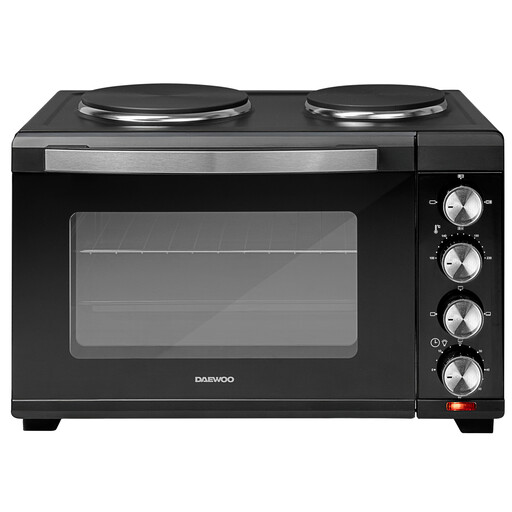
This countertop oven is a choice to consider if you want hotplates for other cooking as well as an oven for tarts. Check its baking controls, tart-tin fit and placement requirements against your kitchen before buying.
 No image available
DAEWOO SDA1609GE 32 L electric oven with dual hotplates, 3000 W
Consider this model if you want an oven and two hotplates in one countertop appliance. Its stated capacity is 32 L and its stated power is 3000 W; check the rack dimensions against your tart tin and consult the model instructions for temperature settings and safe placement.
View on Joybuy
Frequently asked questions
What temperature should I use for custard tarts in a mini oven?
Start with the temperature in your chosen recipe rather than assuming one setting works for every tart or oven. Tesco Recipes reduces its mini custard tarts to 160°C fan, while the National Trust gives 130°C fan for its custard tart; a small trial bake can help you judge your oven's behaviour.
How can I tell when the custard is baked?
Look for a filling that is lightly set but still has a slight wobble, as described in the National Trust custard-tart recipe. Follow your chosen recipe's cooling instructions before removing the tart from its tin.
How much space should I leave around a mini oven?
Follow the clearance instructions for the exact model. The Russell Hobbs 22780 manual requires at least 50 mm all round, while the Tefal Optimo instructions call for air to flow freely around that appliance; neither instruction sets a universal clearance for other ovens.
How should I store leftover custard tart?
Keep egg-and-dairy custard tart chilled and follow the recipe's storage instructions. GOV.UK advises food businesses in England, Wales and Northern Ireland to keep chilled food at 8°C or below and to set fridges to 5°C or below; those figures are business guidance, not a household-specific rule for custard tart.


