Hosts baking repeated family batches
If guests will be eating while you bake more flatbreads, compare the dough you make with the usable tray area and permitted rack positions. A cavity’s litre rating alone cannot tell you how many will fit.


For repeated family batches and side dishes, start with a conventional or multi-level countertop oven, but check usable tray dimensions and rack arrangements rather than relying on litre capacity. A specialist high-temperature pizza oven makes more sense when pizza-style heat is the main priority; allow for its narrower cooking role and follow the exact model’s placement instructions.
If guests will be eating while you bake more flatbreads, compare the dough you make with the usable tray area and permitted rack positions. A cavity’s litre rating alone cannot tell you how many will fit.
If blistered, pizza-style flatbreads matter more than general oven functions, a specialist high-temperature pizza oven is worth considering. Check that its cooking surface suits your dough and that its narrower role fits the rest of the meal.
If one worktop appliance must handle flatbreads and accompaniments, check both its cooking functions and the space it needs around it. Follow the exact model’s instructions for placement and hot surfaces.
Consider it when: You want a general-purpose second oven for successive flatbread batches and accompaniments.
Trade-off: Even a 28–30 L capacity does not establish the usable tray size or flatbread count.
Consider it when: You also want air-frying functions and value separate cooking levels.
Trade-off: Check which levels can be used for your flatbread recipe; multiple racks do not establish simultaneous batch capacity.
Consider it when: Pizza-style heat and a blistered finish take priority over varied tray cooking.
Trade-off: Its specialist cooking surface is a narrower choice for sides and general family baking.
| Concern | What to check | Who this matters to |
|---|---|---|
| Usable batch capacity | Compare your rolled dough with the stated pizza diameter or usable tray dimensions; check permitted rack use. | If I am feeding guests in successive rounds, I need to know how many of my flatbreads can fit without assuming the litre rating tells me. Around 42% of consumers would put batch capacity first. |
| Heat and finish | Compare the stated temperature range and heating design with the flatbread style you intend to make. | If I want a crisp or blistered pizza-style finish, heat delivery matters more to me than extra general-purpose functions. Roughly 33% of consumers would make that finish their primary concern. |
| Worktop fit and versatility | Check the appliance footprint, exact-model clearance instructions and any limits on using its cooking functions together. | When preparation space is tight and I am making sides as well, I need an appliance I can place safely and use for both tasks. For about 25% of consumers, worktop fit and versatility would come first. |
A 20 L or 30 L cavity may still have a tray too narrow for your usual dough, leaving you to bake more rounds than planned.
Measure your rolled flatbreads and compare them with the exact model’s stated pizza diameter or usable tray dimensions. Tefal’s stated 30 cm pizza fit for its 20 L FW605840 is a model-specific measurement, not a rule for other 20 L ovens.
An oven needs space on a suitable worktop as well as room inside for food. Crowding it against nearby surfaces may conflict with its placement instructions.
Read the exact manual before choosing a spot. Russell Hobbs specifies at least 50 mm around its 22780 Mini Kitchen; do not apply that figure to another model. Use a stable, heat-resistant surface and handle hot parts as instructed.
Russell Hobbs states a maximum of 230°C for its 22780 Mini Kitchen, while Sage states that its specialist Pizzaiolo reaches 400°C. An air-fry or fan setting does not, by itself, indicate the same heating approach.
Decide whether you mainly need flexible oven baking or a high-heat pizza-style approach, then check the chosen model’s temperature range and cooking surface.
Its 22780 Mini Kitchen is a conventional countertop option with fan assistance, a 30 L stated capacity, a 60–230°C thermostat, two hotplates, an oven tray and a grill rack, according to Russell Hobbs.
Tefal’s published countertop range includes conventional mini ovens and multi-level air-fryer ovens. It states that the 20 L Easy Fry FW605840 has three cooking levels, two racks and room for a 30 cm pizza.
Sage describes its countertop Pizzaiolo as a specialist pizza oven that reaches 400°C and uses a heated cordierite stone.
These countertop air-fryer ovens offer baking-related functions for the flatbread task. Compare each stated size reference with your dough, and check the exact model’s tray, placement and electrical details before choosing for a gathering.
 No image available
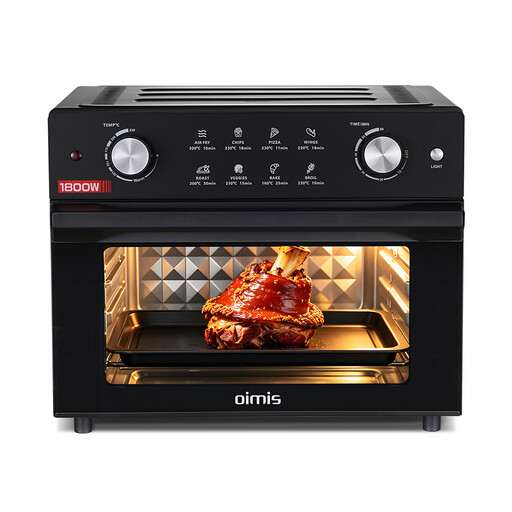
Consider this model if your flatbreads fit within its stated 13-inch pizza size and you also want other cooking modes.
The product name specifies 21 presets, rotisserie and dehydrator functions, and 1800 W. Compare your dough with the usable tray, and check the exact model’s clearance instructions and supplied plug.
 No image available
Consider this model if you prefer manual controls and your flatbreads fit its stated 13-inch pizza size.
The product name specifies manual operation and 1800 W. Check the usable tray dimensions and temperature range for your recipe, as well as the exact model’s clearance instructions and supplied plug.
 No image available
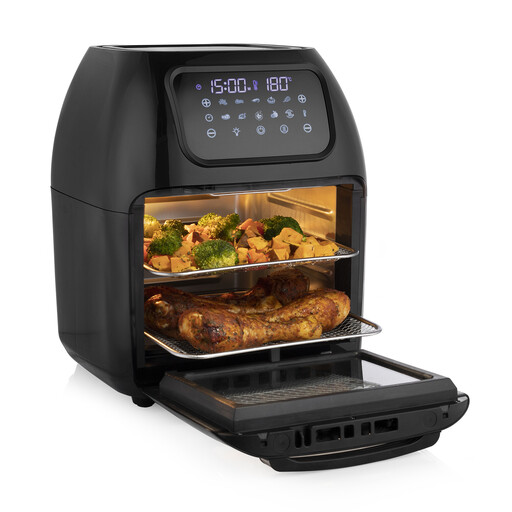
Consider this air-fryer oven if its usable cooking area suits your flatbreads and you want a 10 L model rather than choosing by family-batch assumptions.
The product name specifies 1800 W, a touch screen, 10 programmes, a non-stick coating and dishwasher-safe parts. Check tray dimensions, permitted rack use, temperature range, supplied plug and exact-model placement instructions.
No: cavity volume does not establish the usable width of a tray or how many of your flatbreads fit. Compare your dough size with model-specific dimensions; for instance, Tefal states that its 20 L FW605840 accommodates a 30 cm pizza. Check permitted rack use if you plan to bake on more than one level.
Follow the clearance instructions for the exact model. Russell Hobbs specifies at least 50 mm around its 22780 Mini Kitchen, but that is not a universal figure. Check that your chosen position provides the required space and a stable, heat-resistant surface.
Do not assume the two will use the same heat or cooking surface. Russell Hobbs states that its 22780 Mini Kitchen reaches 230°C, whereas Sage states that its specialist Pizzaiolo reaches 400°C and uses a heated cordierite stone. Choose according to your recipe and whether general tray baking or pizza-style heat matters more.
Check the rated voltage and supplied plug for the exact unit you intend to buy, alongside its manual’s placement instructions. Do not assume a similar-looking variant has the same electrical fittings or that an undocumented adapter is suitable.