Small-batch biscuit bakers
If you bake ginger biscuits occasionally and have little worktop room, a compact cavity may appeal. Check that your recipe temperature and a suitably sized tray fit the oven before choosing by its litre capacity.


Choose a mini oven with baking controls that cover your ginger-biscuit recipe and a tray that fits the number of biscuits you want to bake with space between them. A compact oven may suit small batches, while a larger fan-assisted model offers more stated cavity capacity; a multifunction air-fryer oven makes sense if you will use its other modes, provided its baking controls and tray arrangement suit biscuits.
If you bake ginger biscuits occasionally and have little worktop room, a compact cavity may appeal. Check that your recipe temperature and a suitably sized tray fit the oven before choosing by its litre capacity.
If you bake several batches but need a countertop appliance, compare tray space, temperature controls and whether fan assistance is available. Included baking hardware can also affect what you need to buy separately.
If biscuits are only one of the foods you plan to make, an oven with baking and other cooking modes may suit you. Judge its biscuit-baking controls and tray fit separately from speed claims based on other foods.
Start with the amount you normally bake and the worktop space available; then check the exact model’s baking controls, usable tray area and placement instructions.
Consider it when: You usually bake small batches and want a smaller countertop appliance.
Trade-off: A compact cavity restricts the trays you can use and may mean baking in more rounds.
Consider it when: You bake regularly and want to assess a larger cavity for your biscuit trays.
Trade-off: Allow for the appliance and its model-specific ventilation clearance, not just its footprint.
Consider it when: You also want air frying or other cooking modes from one countertop appliance.
Trade-off: Extra modes do not establish how well a flat biscuit tray fits or how your recipe will bake.
| Concern | What to check | Who this matters to |
|---|---|---|
| Recipe temperature | Check the baking controls and thermostat range against your recipe’s conventional or fan setting. Lakeland’s biscuit recipe gives 180°C conventional or 160°C fan as one example. | If I want to follow my recipe, I need to know which heat setting the oven uses and watch how the first batch turns out. Around 33% of consumers put temperature control and heat distribution first. |
| Tray space | Check usable rack and tray dimensions against your bakeware and the space needed between biscuits; litre capacity alone does not establish tray fit. | When I want more biscuits per baking round, the usable tray area matters more to me than the cavity figure. For around 27% of consumers, batch capacity is the primary concern. |
| Safe placement | Read the exact model’s clearance and electrical instructions, and plan a suitable worktop position and socket. The Russell Hobbs 22780 manual specifies at least 50mm clearance all around that model. | With limited worktop space, I need to accommodate the oven’s required clearance and power it safely. Placement and electrical suitability come first for around 27% of consumers. |
| Other cooking uses | Check the modes you will actually use, then confirm that the baking controls and tray arrangement also suit biscuits. | If biscuits are only one use for the appliance, I want its other cooking functions to earn their space. Around 13% of consumers prioritise that multi-function convenience. |
Capacity gives a sense of oven scale, not the size of a tray that will fit. De'Longhi specifies a maximum round-plate size of 26cm for its 12L EO12012, while biscuits also need space between them as they bake.
Compare the usable rack and supplied tray with your bakeware, biscuit cutters and intended batch size.
If your existing baking sheets do not fit, you may need compatible mini-oven bakeware.
Russell Hobbs’ speed and energy comparisons for its 26095 use specified preheating or frozen-pizza conditions, not ginger-biscuit baking.
Assess the oven’s baking controls, recipe-temperature coverage and tray fit instead of treating those comparisons as a biscuit result.
The Russell Hobbs 22780 manual calls for at least 50mm clearance all around that model. Electrical Safety First also warns that plugged ovens and grills may overload an extension lead when used with other large appliances.
Check the exact manual, available worktop space and socket arrangement before ordering. If you are unsure whether the electrical setup is suitable, consult a qualified electrician.
Its countertop range includes a fan-assisted Mini Kitchen and an air-fryer mini oven with a Bake mode.
The EO12012 is a compact conventional mini oven to consider for smaller batches.
The Halo Rotisserie Air Fryer Oven VDF127 combines baking with other countertop cooking functions.
These air-fryer-style countertop ovens may interest you if you want to bake biscuits alongside other cooking. For either model, check the baking controls, usable tray area and placement instructions against your recipe and kitchen.
 No image available
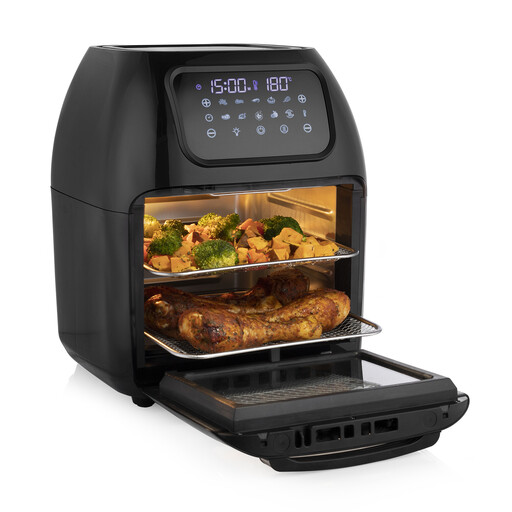
For biscuits alongside other cooking, check that its baking controls cover your recipe and that a suitable flat tray fits. The product name specifies 10L capacity, 1800W, touch-screen controls and 10 programmes. Check the exact model’s clearance and electrical instructions before choosing where to place it.
 No image available
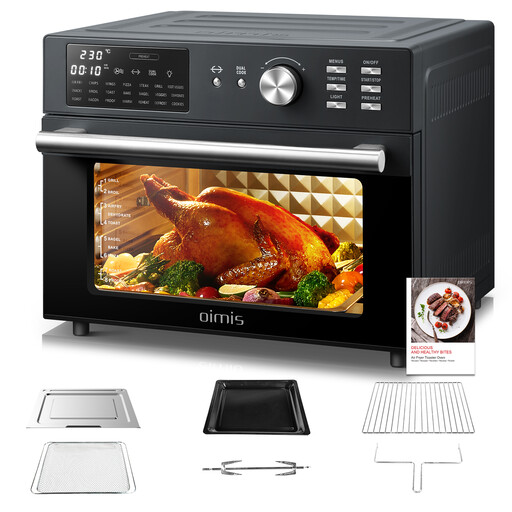
If you want a 30L countertop oven for biscuits, confirm its baking controls, temperature range and usable flat-tray dimensions before choosing it. The product name also specifies 1800W, rotisserie and dehydrator functions. Check the included accessories and model-specific placement instructions.
Choose a range that covers your own recipe’s stated setting. Lakeland gives 180°C conventional or 160°C fan for one biscuit recipe; Russell Hobbs specifies 60–230°C for the 22780, and De'Longhi specifies 100–220°C for the EO12012. Watch the first batch rather than assuming the timing will transfer unchanged to a smaller oven.
No: a conventional mini oven can be considered if its baking controls cover your recipe and a suitable tray fits. Fan assistance is another option, but it does not remove the need to check the first batch against your recipe’s doneness cues.
Do not assume an extension lead is suitable for your setup. Electrical Safety First warns that plugged ovens and grills can overload an extension lead when used with other large appliances. Check the oven’s instructions and your socket arrangement; ask a qualified electrician if you are unsure.
Follow the clearance stated in the manual for the exact model. The Russell Hobbs 22780 manual, for example, requires at least 50mm of free space all around the appliance and a stable, level, heat-resistant surface; that measurement should not be applied to other ovens.