Small-batch biscuit bakers
If you mainly make modest batches, start with a Bake setting and a temperature range that covers your recipe. Check the usable rack and tray dimensions before deciding that a compact cavity will hold your baking sheet.


Choose a mini oven with a Bake setting, temperature controls that cover your lemon-biscuit recipe and a rack or tray that fits your intended batch; capacity in litres alone will not tell you whether a baking sheet fits. A compact oven can suit occasional small batches, while a larger multifunction model makes more sense if it will handle other cooking too. In either case, check the worktop clearance, cleaning arrangements and shared electrical load before buying.
If you mainly make modest batches, start with a Bake setting and a temperature range that covers your recipe. Check the usable rack and tray dimensions before deciding that a compact cavity will hold your baking sheet.
If other people need the same counter, agree where the oven will sit or be stored and how it will be cleaned after use. Allow the clearance specified for the exact model, as well as space for handling its trays.
If the oven will be used for meals beyond biscuits, a larger cavity, fan assistance or hotplates may be worth considering. Plan how those functions will share counter space and electrical capacity with other appliances.
Settle the baking temperature and tray fit first, then decide how much counter space and shared electrical capacity the oven can use.
| Concern | What to check | Who this matters to |
|---|---|---|
| Baking control | Check for a Bake setting and a thermostat range covering your recipe; review the manual's tray-position guidance. | If I want to make the same lemon-biscuit recipe again, I need to set its required temperature rather than assume every programme bakes alike. Around 40% of consumers put baking control first. |
| Space and clean-up | Compare usable rack or tray dimensions and required ventilation clearance with your proposed worktop space; check which parts can be removed for cleaning. | When the counter must be handed back to housemates, I need room to use the oven and a manageable clean-up afterwards. Worktop fit and handover are the primary concern for around 30% of consumers. |
| Shared electrical use | Check the model's power rating against the socket or extension-lead rating and other appliances used at the same time. | If other cooking appliances run nearby, I need to know how the oven fits into our shared electrical setup, especially if I also want hotplates. Around 30% of consumers place shared-power or wider-cooking needs first. |
Cavity capacity does not specify the usable width and depth of the rack or supplied tray.
Measure the sheet you intend to use, check the exact model's tray dimensions and allow the ventilation clearance required by its manufacturer.
Russell Hobbs' comparison for the 26680 used 400 g of frozen French fries at 213°C, not lemon biscuits. It cannot establish what a different recipe will use.
Consider the oven's stated power, the number of batches you expect to bake and the relevant test conditions rather than treating that comparison as a result for your recipe.
Electrical Safety First warns that overloaded or chained extension leads can overheat. A countertop oven also needs clear ventilation and attention while it is operating.
Check the lead's rating and the combined load of appliances in use, avoid connecting extension leads to one another and do not leave the oven unattended.
GOV.UK says food businesses must register with their local authority. Using a shared kitchen does not, by itself, remove food-business considerations.
If you intend to sell the biscuits, check registration and food-hygiene requirements with the relevant local authority for the premises and activity you plan to use.
Its 26680 and 22780 illustrate different approaches to a shared-kitchen oven: a 20 L air-fryer mini oven with Bake mode and a 30 L mini kitchen with hotplates.
The EO12012 provides a compact-oven reference for occasional small batches.
The DT200UK represents a larger multifunction countertop-oven approach for cooks who also want to prepare other meals.
This air-fryer oven is a compact option to consider for small biscuit batches. Check its baking controls and whether the supplied tray fits your recipe before choosing it.
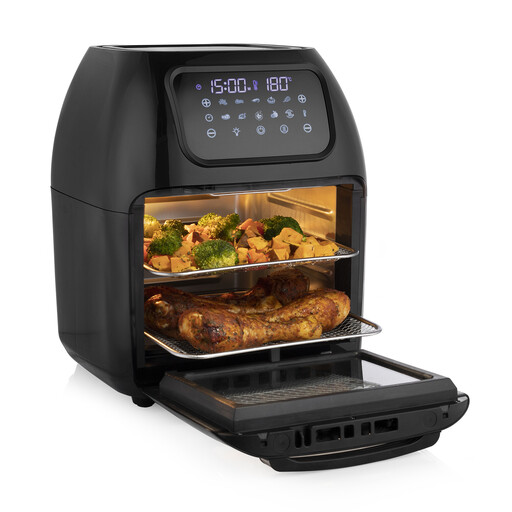 Image unavailable
For small biscuit batches, check that its baking controls cover your recipe and that the tray fits your intended batch.
The product name lists a 10 L capacity, 1800 W rating, touch screen, 10 programmes, non-stick coating and dishwasher-safe parts.
Confirm the manufacturer's ventilation clearance for your worktop, and account for the 1800 W rating when checking the combined load in your shared kitchen.
No: litres describe cavity volume, not the usable width and depth of its rack or tray. Compare your intended biscuit sheet with the exact model's dimensions and check the clearance required around the appliance.
Only use an extension lead that is suitable for the combined load of the appliances connected to it. Electrical Safety First warns against overloading leads or connecting one extension lead to another; check the rating marked on the particular lead rather than assuming all leads have the same limit.
Check food-business registration and hygiene requirements before trading. GOV.UK says food businesses must register with their local authority, while City of Winchester's home-baker guidance explains that preparing food in another kitchen, such as a community hall kitchen, does not remove food-safety duties for a food business.
Follow the exact appliance manual and let removable parts cool before cleaning them. For the Russell Hobbs 26680 specifically, Russell Hobbs says its removable accessories can be washed in a dishwasher or sink; check the instructions for any other model rather than assuming its parts are cleaned the same way.