Tart bakers with little counter space
You need room for both your tart tin and the oven’s required clearances. Measure the allocated worktop and check the exact model’s usable tray space, external footprint and door opening.


Choose a mini oven by checking whether your tart tin fits its usable baking space and whether the appliance can sit safely on your allocated counter; litre capacity alone cannot answer either question. A compact oven may be enough for occasional baking, while hotplates or air-fry functions make more sense if you will use them regularly and can accommodate the appliance’s clearance, socket and cleaning requirements.
You need room for both your tart tin and the oven’s required clearances. Measure the allocated worktop and check the exact model’s usable tray space, external footprint and door opening.
If you mainly bake tarts and reheat food, focus on a suitable baking setting and temperature control. Extra cooking modes matter only if you expect to use them.
An oven with hotplates or additional cooking modes may cover more tasks, but it also calls for an agreed counter position, suitable socket arrangement and regular cleaning.
Measure your tart tin and the available counter before comparing oven functions; a model is only a practical choice if it fits both spaces safely.
| Concern | What to check | Who this matters to |
|---|---|---|
| Safe placement and power | Check the exact model’s required clearances and power requirements, the counter surface and access to a suitable socket. | When the counter and sockets are shared, I need a place to cook without crowding the oven or overloading an extension lead. Around 42% of consumers put safe placement and electrical setup first. |
| Tart fit and baking control | Compare your tin’s widest point with the usable tray or cavity and door opening; check the baking setting and temperature range against your recipe. | If my tart tin cannot go in and come out comfortably, extra oven capacity on paper will not help me bake it. Roughly 33% of consumers make dish fit and baking control their primary concern. |
| Functions and cleaning | Decide which additional cooking modes you would use, and check the exact model’s accessories and cleaning instructions. | I may want hotplates or air-fry cooking as well as tart baking, but only if everyone using the appliance can keep it clean. About 25% of consumers place multifunction use and cleanup first. |
Cavity volume does not tell you the usable tray width or whether the dish will pass through the door. De'Longhi specifies a maximum 26 cm round plate for its EO12012, illustrating the value of a model-specific dish-size check.
Measure your tin including its rim or handles, then compare it with the exact oven’s tray or cavity information and door access.
Electrical Safety First warns that plug-in ovens and grills may overload an extension lead when used with other large appliances.
Check the oven’s power requirements and plan for a suitable socket rather than sharing an extension lead with other high-power appliances.
A countertop oven needs the clearances specified for that model. Its position must also keep heat and the opening door away from nearby items and cables.
Map the manual’s clearance requirements onto the actual counter, including space above and beside the oven and room to remove a hot tart safely.
Hotplates and air-fry settings add cooking options, while crumbs and grease still need regular attention in a shared kitchen.
Choose additional functions for repeated cooking needs, and agree who will clean the appliance according to its manual.
De'Longhi’s EO12012 illustrates a compact, 12 L oven with bake and grill functions.
Tefal’s 19 L Optimo OF445840 illustrates a mini oven with convection, conventional cooking, grill, pastry, bain-marie and defrost modes.
Russell Hobbs lists both the 30 L 22780 Mini Kitchen with two hotplates and the 26095 mini oven with air-fry and bake modes.
Sage’s Smart Oven Air Fryer illustrates a countertop oven with 10 listed functions, including Bake, Roast and Air Fry.
These choices cover an oven with hotplates and an air-fryer oven. For either format, check your tart tin against the usable baking space and confirm that the appliance can be placed safely in your shared kitchen.
 No image available
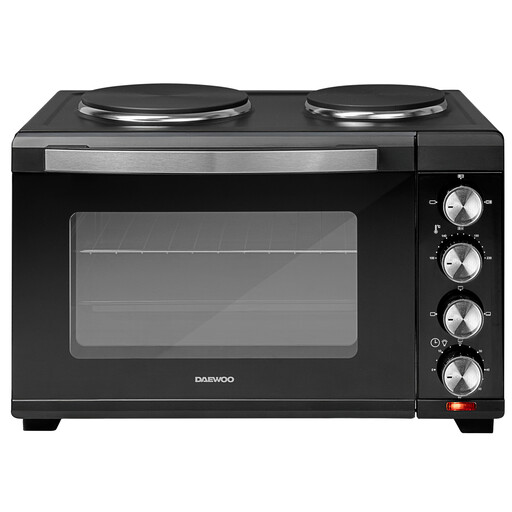
Consider this format if you want an oven and hotplates on the same shared counter. The product name specifies a 32 L oven, dual hotplates and 3000 W; check tart-tin fit, the exact model’s clearances and the available socket arrangement before buying.
 No image available
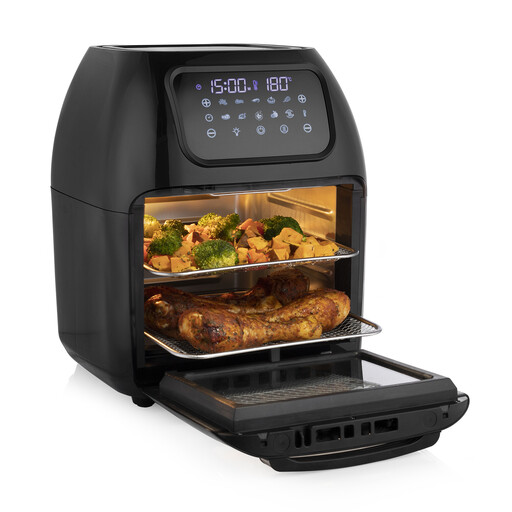
Consider this format if you want air-fryer-oven functions alongside tart baking. The product name specifies 10 L, 1800 W, touch-screen controls, 10 programmes and dishwasher-safe parts; check usable tart-tin space, the recipe’s temperature needs and the model’s installation clearances.
Measure the tart tin at its widest point, including any rim or handles, and check it against the oven’s usable tray or cavity and door opening. Measure the allocated counter too, allowing for the exact model’s required clearances rather than relying on litre capacity.
Do not plan to run it on an extension lead shared with other large appliances. Electrical Safety First warns that this arrangement may overload the lead; check the oven’s power requirements and seek a qualified electrician’s advice if the kitchen’s electrical setup is in doubt.
Do not leave the tart cooking unattended. Greater Manchester Fire and Rescue Service advises against leaving cooking unattended; use the timer as a reminder rather than a substitute for staying available.
Let it cool and follow the exact model’s cleaning instructions, paying regular attention to crumbs and grease. Agree on cleaning after use so the next person does not inherit a build-up around the cooking area.