Small-kitchen tart bakers
If a full-size oven is impractical, a countertop oven can provide another way to bake. Which? identifies mini ovens as an option for small living spaces, but you still need to check the shelf space for your own tart tin.


Choose a mini oven for a mushroom tart by checking whether your tin fits the usable shelf, then whether the oven offers the temperature control your recipe needs. A multifunction fan model may suit frequent baking and other meals, while a compact conventional oven may be enough for occasional tarts; an integrated hotplate is useful only if its operating restrictions fit your cooking sequence.
If a full-size oven is impractical, a countertop oven can provide another way to bake. Which? identifies mini ovens as an option for small living spaces, but you still need to check the shelf space for your own tart tin.
If you bake regularly as well as roasting or grilling, fan or convection cooking, a timer and useful cooking modes may matter more than a minimal footprint. Check those features on the exact model rather than assuming every multifunction oven has them.
If you need to prepare a mushroom filling or side dish as well as bake the tart, integrated hotplates may be useful. Check whether the hob and oven can run at the same time: the Russell Hobbs 22780 listing says they cannot.
Measure the tart tin and available worktop first. Then compare the oven controls and any extra cooking functions with the way you prepare the meal.
| Concern | What to check | Who this matters to |
|---|---|---|
| Pastry baking control | Compare the stated temperature range with your recipe, and check for a timer and any specified fan or convection setting. | If I bake tarts regularly, I want control over the pastry and filling rather than choosing by the number of presets alone. For around 36% of consumers, baking control would be the primary concern. |
| Tin fit and worktop space | Measure the tin, including its rim or handles, against usable shelf dimensions; allow the model's required external clearances. | When my worktop is limited, the oven has to accommodate both my tart dish and the space around the appliance. Tin fit and footprint would come first for roughly 29% of consumers. |
| Cooking the rest of the meal | Check the functions you would use and, for a hotplate model, whether hob and oven operation can overlap. | If I prepare the filling or sides alongside the tart, the cooking sequence matters as much as the oven cavity. Around 21% of consumers would make meal versatility their main priority. |
| Simple upkeep | Check how the tray, rack and interior should be cleaned, and whether the controls suit occasional use. | For an occasional tart, I may prefer straightforward operation and cleaning to functions I rarely use. That would be the leading concern for about 14% of consumers. |
Capacity does not tell you whether a tin clears the shelf supports and door. Even the 9-inch pizza tray supplied with the Dualit 89220 is only a size reference for a different dish.
Measure the widest part of your tin and confirm the exact oven's usable shelf width, depth and height before ordering.
An integrated hob may not help you cook a filling while the tart bakes. The Russell Hobbs 22780 listing says its hotplate cannot be used at the same time as its oven cavity.
Check the simultaneous-use instructions for the exact model and plan the cooking sequence accordingly.
The space an oven needs can exceed its external dimensions. The Ninja DT200UK is stated as 50 cm deep, while the Sage BOV820BSS listing specifies at least 100 mm clearance at the sides.
Measure the intended worktop position and follow that model's installation instructions, including clearance around nearby surfaces.
Pastry and filling residue can leave grease behind. Electrical Safety First identifies built-up fat and grease as a major cause of fire.
Once the oven has cooled, clean its interior and accessories as the manufacturer instructs, and do not leave it operating unattended.
The DT200UK illustrates a multifunction convection route for frequent countertop cooking.
The Mini Kitchen 22780 combines a fan-assisted oven with a hotplate for compact meal preparation.
The Smart Oven Pro BOV820BSS is a countertop option for buyers considering a fan oven with several cooking presets.
The IG7130 combines an oven and two hotplates for cooking beyond a single bake.
The 89220 illustrates a compact conventional-heat option for modest bakes.
These countertop choices cover an oven with hotplates and a multifunction air-fryer oven. For either one, confirm your tart tin's fit and the model's installation and operating instructions before choosing.
 No image available
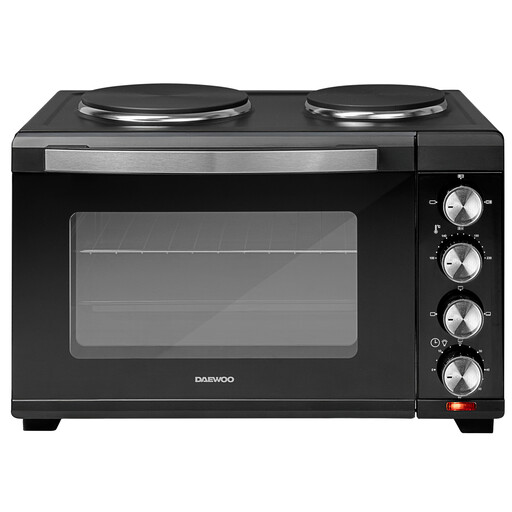
Consider this model if you want an oven and hotplates in one countertop appliance for the tart and other parts of the meal.
Its product title specifies a 32L capacity, dual hotplates and 3000W. Check usable shelf dimensions for your tin and the model instructions for hotplate operation, positioning and electrical connection.
 No image available
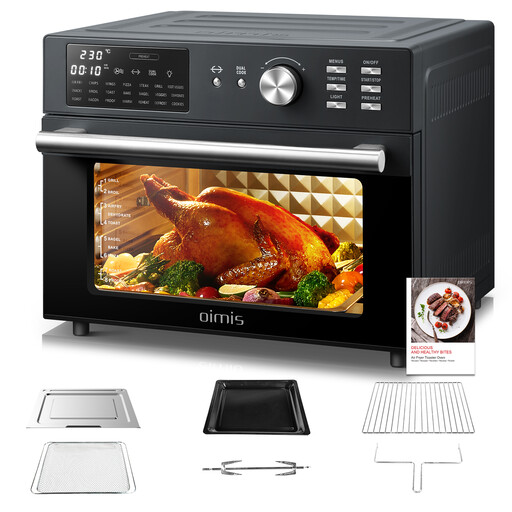
Consider this model if you want a countertop oven for tart baking alongside other cooking tasks.
Its product title specifies 1800W, rotisserie and dehydrator functions, and a fit claim for a 13-inch pizza. That pizza claim does not establish tart-tin clearance; confirm usable shelf dimensions, recipe temperature controls and electrical instructions for the exact model.
Measure the tin's widest outside dimensions, including its rim or handles, and compare them with the exact oven's usable shelf width, depth and height. Litre capacity alone is not a fit measurement; even a supplied tray, such as the Dualit 89220's 9-inch pizza tray, is only a reference point.
Some can: Which? describes mini ovens that plug into a standard 13A socket, and the Sage BOV820BSS listing specifies a plug for a 13A socket. Confirm the connection requirements and supplied plug in the documentation for the exact model you intend to buy.
Follow the clearance instructions for the exact appliance rather than applying one distance to every model. For instance, the Sage Smart Oven Pro BOV820BSS listing specifies at least 100 mm at the sides; check the manual before placing an oven near a wall or cabinet.
Let the oven cool, then clean its tray, rack and interior according to the manufacturer's instructions. Electrical Safety First warns that built-up fat and grease are a major fire cause and advises against leaving electrical appliances operating unattended.