Small-kitchen nut-loaf baker
If you make occasional small bakes but have little room to leave an appliance out, compare the tin’s outside dimensions with the usable oven space. A litre-capacity figure alone cannot tell you whether your tin will fit.


Choose a mini oven with an oven-style Bake setting, a temperature range that covers your recipe and enough usable space for your loaf tin with clearance around it. A compact model may suit an occasional small loaf when worktop space is tight; a larger fan-assisted model offers more stated capacity for regular cooking. If you also want air-fry functions, check the Bake setting and tin fit rather than assuming the air-fry programme will suit the loaf.
If you make occasional small bakes but have little room to leave an appliance out, compare the tin’s outside dimensions with the usable oven space. A litre-capacity figure alone cannot tell you whether your tin will fit.
If the oven will also handle other bakes or roasted meal components, look closely at its oven heating modes, thermostat range, rack arrangement and timer. Extra cooking modes matter less if the loaf tin cannot sit properly inside.
If you want one appliance for a nut loaf as well as air frying, grilling or toasting, check that it has a separate Bake setting. Measure the tin and check the available rack space before choosing an air-fry oven.
Start with the tin and recipe, then decide how much worktop space and versatility you need.
| Concern | What to check | Who this matters to |
|---|---|---|
| Loaf-tin fit | Measure the tin externally, including its rim or handles; compare it with the current model’s rack dimensions and clearance above the loaf. | If I already own a loaf tin, I need it to sit level without touching the oven walls, door or heating elements. Around 36% of consumers would put tin fit first. |
| Baking control | Check for an appropriate Bake or oven-heating mode, a thermostat that reaches your recipe temperature and a suitable timer. | When I bake a thick loaf, I want control over the heat and time rather than choosing by the number of programmes. Roughly 29% of consumers would make baking control their main concern. |
| Worktop space | Compare external dimensions with your available space, allowing for the ventilation clearance specified in the manual; check the intended electrical connection. | With limited counter space, I need an oven I can place and use as instructed without giving up too much room. About 21% of consumers would prioritise its footprint and setup. |
| Extra functions | Check whether Bake is separate from Air Fry and which trays or racks are supplied. Read the conditions behind any speed or energy comparison. | If I also want to grill, toast or air fry, I need those modes alongside a suitable way to bake the loaf. Around 14% of consumers would put multi-function use first. |
Two ovens with different stated capacities can still leave you uncertain about rack width, depth and height. The space your particular tin needs is the deciding measurement.
Measure the tin’s outside dimensions and check the exact oven model’s usable rack space and clearance before ordering.
Russell Hobbs’ speed and energy comparisons for its air-fry mini oven relate to specified tests; they do not establish a shorter bake time or different energy use for a nut loaf.
Start with your recipe and the appliance’s Bake instructions, then monitor the loaf during the first bake.
Grill, Toast and Air Fry can broaden an oven’s uses, but their presence alone does not tell you how to bake a loaf.
Check the oven-heating mode, thermostat, timer and rack position before weighing up extra functions.
An unsuitable extension arrangement can create an electrical hazard. A nut loaf also needs clear ingredient communication when anyone eating it has an allergy.
Follow the oven manual and the lead’s marked electrical rating; do not daisy-chain extension leads. Tell anyone eating the loaf that it contains nuts.
Its UK range illustrates the choice between a 30 litre fan-assisted Mini Kitchen and a 20 litre air-fry mini oven with a separate Bake function.
Its 23 litre and 32 litre dial-controlled models illustrate smaller and larger worktop-oven choices; the larger cited model includes hotplates.
Its DT200UK is an example of a larger multi-function countertop oven for cooks who want Bake and Roast alongside other modes.
The 89200 illustrates a compact oven with baking and convection settings and physical controls.
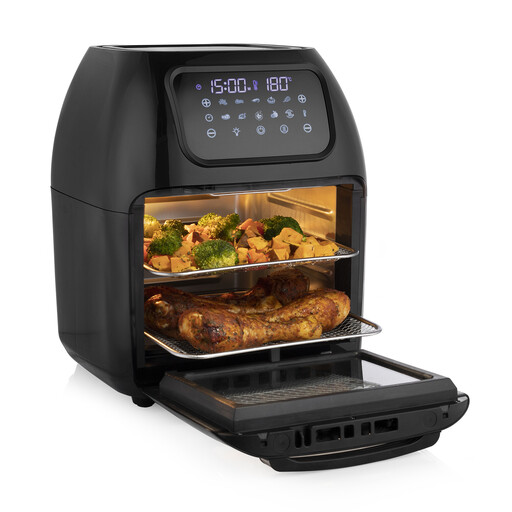
This air-fry oven is a multi-function option to consider if you want to bake a nut loaf as well as use other cooking modes. Check its Bake instructions, your tin’s fit and your recipe requirements before choosing it.
 No image available
Consider this model if you want an air-fry oven for baking and other cooking, and can confirm that its Bake setting suits your recipe.
The product name specifies a touch screen, 10 programmes, dishwasher-safe parts and a non-stick coating. Measure your loaf tin against the usable rack space, and check the current instructions for the temperature and time your recipe requires.
Measure your loaf tin’s outside width, depth and height, including any rim or handles. Compare those measurements with the exact oven model’s usable rack space and clearance; litre capacity alone cannot confirm the fit.
Start with the recipe and the appliance’s Bake or conventional oven instructions where that setting is available. An air-fry speed claim based on another food does not establish the cooking time for a nut loaf, so monitor your first bake.
Tell anyone eating the loaf clearly that it contains nuts, and take care to avoid cross-contact where an allergy is relevant. If you provide food as part of a business, follow the Food Standards Agency’s allergen-information guidance for food businesses.
Use an extension lead only if its marked rating accommodates the oven and any other connected load, and the appliance manual permits that setup. Electrical Safety First notes that many extension leads are rated at 13A but some older ones have lower ratings; do not daisy-chain leads.