Small-batch oat-bar bakers
If you mainly bake one small tray at a time, check your tin against the usable rack area and look for the temperature and timer controls your recipe needs. Extra cooker functions may be less important.


Choose a mini oven by whether your oat-bar tin fits its usable rack area, then check the temperature controls and the space needed to position it safely. A compact oven makes sense for small batches; a larger model with hotplates is worth considering only if you also need pan cooking and have room to accommodate it.
If you mainly bake one small tray at a time, check your tin against the usable rack area and look for the temperature and timer controls your recipe needs. Extra cooker functions may be less important.
Limited worktop room makes both oven placement and usable baking space important. Allow for the model’s required clearances around nearby surfaces and anything above it.
If you need to bake and occasionally cook in pans, an oven with hotplates is relevant. It also calls for more careful planning of worktop space and the electrical arrangement.
Choose it when: You mainly want to bake a small tray of oat bars rather than replace other cooking appliances.
Trade-off: A smaller stated capacity may limit your choice of tin; check the usable rack dimensions before ordering.
Choose it when: The same countertop appliance must handle baking and occasional pan cooking.
Trade-off: Hotplates do not establish a better oat-bar bake and make placement and electrical planning more important.
| Concern | What to check | Who this matters to |
|---|---|---|
| Tin fit and baking controls | Compare your tin, including its rim or handles, with the oven’s usable rack dimensions. Check the temperature range and timer against your recipe. | If I already have an oat-bar tin, I want it to fit and need controls suited to my recipe. Around 40% of consumers put tin fit and baking control first. |
| Placement and electrical safety | Check the manual’s placement clearances and the appliance’s rated electrical load against the intended worktop and socket arrangement. | In a cramped kitchen, I need a place where the oven can be positioned and powered safely; for around 40% of consumers, that is the primary concern. |
| Other cooking tasks | Decide whether you will use hotplates or additional modes, then check the space and electrical requirements of that model. | If this appliance must also handle pan cooking, those added functions matter to me. They are the first priority for around 20% of consumers. |
A stated capacity does not tell you whether your particular square or rectangular oat-bar tin will fit on the rack.
Measure the tin’s full outside dimensions and compare them with the selected oven’s internal and rack measurements. The supplied baking tray does not establish that your own tin fits.
Hotplates or a rotisserie may be useful for other meals, but neither establishes a better fit for baking oat bars.
Choose those functions if you expect to use them; otherwise focus on tin fit, controls, placement and cleaning access.
Electrical Safety First warns that an oven used with other large appliances may overload an extension lead.
Check the appliance’s rated load and the lead’s stated rating before use. Do not exceed that rating or connect extension leads to one another, and follow the oven’s siting instructions.
Markings, manufacturer details and instructions help you identify the electrical product you are buying. Product registration, where offered, can help a manufacturer contact you about a recall.
Check the product’s appropriate marking and manufacturer name and address, retain your purchase details, and use the GOV.UK product-safety alerts and recalls service if a concern arises.
The Russell Hobbs UK 22780 is a 30L mini kitchen for shoppers who want an oven and double hotplates in one appliance.
The Tefal Optimo OF445840 is a 19L option for shoppers considering a compact oven with several cooking modes.
Tower Housewares lists a 23L T14043 mini oven and a 32L T14044 model with hotplates, covering different cooking needs.
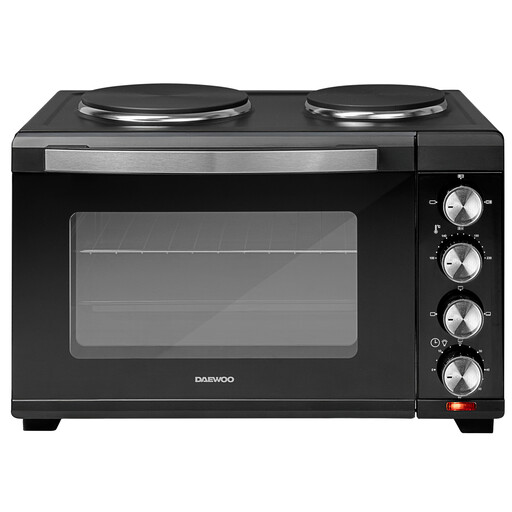
This oven-and-hotplate option is for a small kitchen where the appliance needs to handle oat-bar baking and pan cooking. Check that your tin fits and that the oven can be positioned and powered as its instructions require.
 No image available
Consider this model if you need an oven for oat bars as well as hotplates for pan cooking.
Its product name specifies a 32L capacity and dual hotplates. Compare your tin with the usable rack dimensions before choosing it.
Check the model’s required clearances and rated electrical input against your worktop and socket arrangement; do not assume the 3000W figure describes the oven alone.
Not necessarily: whether a 19L oven works depends on your tin and the usable rack space, not capacity alone. Tefal UK specifies a baking tray and six cooking heights for its 19L Optimo OF445840; compare your tin’s outside dimensions with the model’s internal measurements before buying.
Fan assistance is a feature to consider, not a guarantee of a particular baking result. Russell Hobbs UK specifies it for the 22780, while Tefal UK lists convection for the Optimo OF445840. Follow your chosen oven’s instructions and check the bars towards the end of your first bake.
Check the oven’s rated load against the extension lead’s stated rating, including any other connected appliances, before using one. Electrical Safety First warns that ovens may overload a lead when used alongside other large appliances; do not exceed the lead’s rating or connect one extension lead to another.
Read and follow the model’s instructions, and register it if the manufacturer offers registration. Allow it to cool fully before cleaning, check the plug and socket for scorch marks, and consult the GOV.UK product-safety alerts and recalls service if a safety concern arises.