Family batch cooks
You want room to spread out onion wedges rather than pile them up, perhaps while cooking another dish. Ninja and Tefal describe multi-level ovens intended for family meals; check the usable tray area for your planned quantity.


For a family gathering, choose a mini oven by usable tray space, cooking levels and worktop fit before comparing preset counts. A multi-level oven gives you more options for spreading out a larger batch of onion wedges, while a compact 12L model makes more sense if you can cook in successive batches. Air-fry functions may appeal if crisp edges are your priority, but claims based on other foods do not establish how onion wedges will turn out.
You want room to spread out onion wedges rather than pile them up, perhaps while cooking another dish. Ninja and Tefal describe multi-level ovens intended for family meals; check the usable tray area for your planned quantity.
You want an air-fry mode for onion wedges made with little oil. Ninja and Tefal list relevant cooking functions, but their published results for other foods are not promises about your wedges.
You need the appliance to fit your worktop and can accept successive batches when guests visit. De'Longhi’s 12L EO12012 illustrates the compact-oven option.
Choose when: You need a substantial wedge batch or want to prepare another dish alongside it. Ninja describes the DT200UK as a two-level oven for family meals.
Trade-off: Ninja lists the DT200UK at 50.5cm deep, so measure your counter and the clearances required by its instructions.
Choose when: You want air-fry and bake options with multiple rack positions. Tefal lists its 20L FW605840 with two racks and three cooking levels.
Trade-off: Those capacity figures do not tell you the usable area of each tray or how your onion wedges will cook.
Choose when: Worktop space matters more than finishing the gathering’s wedges in one batch. De'Longhi lists the EO12012 as a 12L bake-and-grill oven.
Trade-off: Its stated maximum round-plate diameter is 26cm; plan for successive batches if your serving quantity needs more space.
| Concern | What to check | Who this matters to |
|---|---|---|
| Batch capacity | Check usable tray dimensions and whether the intended cooking mode permits more than one level. | I want enough room to spread the wedges out and serve the planned quantity without repeated batches. Around 31% of consumers would put batch capacity first. |
| Cooking functions | Check for the air-fry or bake mode you intend to use and the relevant accessory and rack-position instructions. | If crisp edges with little oil matter most to me, I want an appropriate cooking mode without assuming that results for fries apply to onions. Roughly 25% of consumers would prioritise cooking functions. |
| Worktop and socket fit | Measure the appliance space and required clearances; check its electrical requirements and the intended socket. | I have limited counter space or socket access, so the oven must fit the place where I can use it safely. Around 25% of consumers would make worktop and socket fit their primary concern. |
| Use and upkeep | Check the controls, cleaning instructions, removable parts and model-specific repair support. | After cooking for guests, I would rather have straightforward controls and manageable cleaning than extra modes. Approximately 19% of consumers would put ease of use and upkeep first. |
Cavity capacity does not tell you how widely wedges can be spread. Tefal lists two racks for the 20L FW605840, while De'Longhi specifies a maximum round-plate diameter of 26cm for its 12L EO12012.
Compare tray dimensions, supplied accessories and usable cooking levels against the quantity you intend to make.
A family-size oven may occupy more of the counter than its width suggests: Ninja lists the DT200UK at 50.5cm deep. Electrical Safety First also advises taking care with an oven’s location and nearby items.
Measure the counter and door-opening area, follow the model’s clearance instructions and keep flammable items away from the appliance.
Ninja’s faster-cooking claim and Tefal’s comparisons use other test foods or cooking arrangements. Onion size, moisture and crowding may change the result.
Start with the model’s cooking guidance, spread the wedges out and try a small batch before the gathering.
Electrical Safety First warns that an oven or grill used with other large appliances may overload an extension lead.
Check the model’s power requirements and socket instructions. If the suitability of your wiring or socket is uncertain, ask a qualified electrician rather than improvising with shared extensions or adaptors.
Ninja positions its DT200UK as a large, two-level countertop oven for family meals.
Tefal presents its 20L FW605840 air-fryer oven as a family-meal option with two racks and three cooking levels.
The EO12012 is a compact bake-and-grill option for kitchens where worktop space is a priority.
These air-fryer ovens offer cooking modes relevant to onion wedges. Before choosing one for a family gathering, compare the usable tray area, worktop dimensions and model instructions with your planned batch.
 No image available
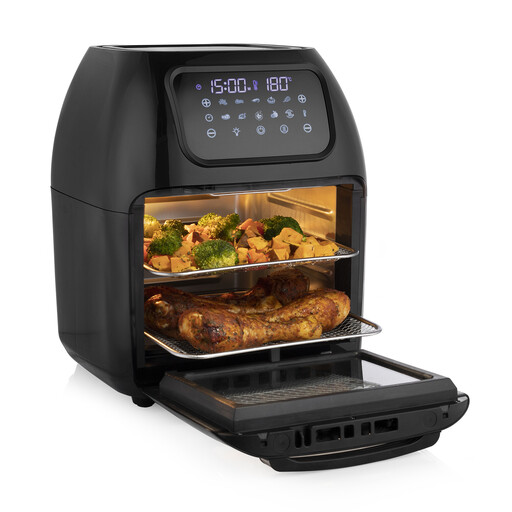
Consider this air-fryer oven if you are willing to check whether its cooking space accommodates your wedge batch.
The product name specifies 1800W, touch-screen controls, ten programmes and dishwasher-safe parts. Confirm usable rack or tray dimensions, worktop fit and electrical requirements before ordering.
 No image available
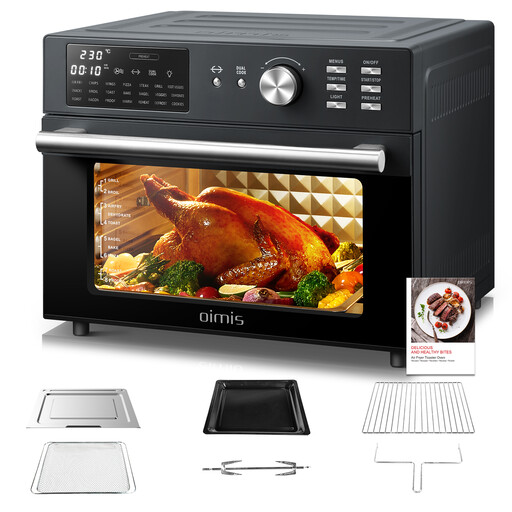
Consider this oven if you need to assess a larger cavity for a family gathering; capacity alone does not establish how many wedges fit on its trays.
The product name specifies 1800W, 21 presets, rotisserie and dehydrator functions, and room for a 13-inch pizza. Check the supplied cooking accessories, usable tray area, worktop dimensions and clearance instructions.
 No image available
Consider this model if you want air-fry and bake options, then check whether its usable cooking area suits the quantity of wedges you plan to make.
The product name lists nine cooking functions, including Bake, Roast and Grill. Check accessory dimensions, usable rack positions, worktop fit and the model’s electrical instructions. The specifications of Tefal’s 20L FW605840 do not apply to this 15L model.
Yes, but expect successive batches if you need more wedges than its cooking area can hold in one layer. De'Longhi states that its EO12012 has a 12L cavity and accepts a round plate up to 26cm in diameter; compare that space with your intended serving quantity.
An air-fry mode is an option to try for crisp edges, not a guaranteed result for onion wedges. Published claims for the Ninja and Tefal models discussed here use other test foods; follow the chosen model’s instructions and test the timing and spacing with your preferred wedge size.
Check the oven’s instructions and power requirements rather than assuming an extension lead is suitable. Electrical Safety First warns that ovens and grills may overload an extension lead when used with other large appliances; ask a qualified electrician if your socket or wiring arrangement is uncertain.
Follow the instructions for your exact model, including its placement, preparation and initial-use steps. Tefal’s guidance for the Optimo 19L, for example, calls for a stable surface, removal of packaging, cleaning and drying of accessories, and an initial empty heat cycle; do not assume that sequence applies unchanged to another oven.
Let the appliance cool fully, then clean the trays, racks and crumb or drip area as directed by its manual. Electrical Safety First advises keeping ovens and grills free of accumulated fat and grease because buildup can contribute to fires.