Hosts planning several batches
Prioritise the usable tray and shelf layout against your serving schedule. A larger cavity can offer flexibility, but its litre rating does not tell you how many wedges fit in one layer.


For birthday-party wedges, choose by usable tray space and the number of batches you can serve on time, rather than cavity litres alone. A larger fan-assisted mini oven suits a menu needing flexible oven space, while an air-fry mini oven suits hosts who want that cooking function and can manage staged batches. Check the exact model’s worktop clearance and try your wedge recipe before the party.
Prioritise the usable tray and shelf layout against your serving schedule. A larger cavity can offer flexibility, but its litre rating does not tell you how many wedges fit in one layer.
Consider whether that function fits your preferred way of making wedges, then allow for staged batches if the cooking area is small. Test your own potatoes and tray arrangement rather than relying on a speed claim.
Measure the space needed around the oven as well as its body. Russell Hobbs specifies different clearances for its 22780 and 26680 models, so check the manual for the appliance you intend to use.
Start with the number of uncrowded batches your serving plan allows, then assess cooking functions, safe worktop fit and cleanup.
Consider it when: You need oven space for wedges and other party food.
Trade-off: A larger cavity needs worktop room, and its litre rating does not establish the usable tray area.
Consider it when: An Air Fry function matters more to you than fitting the whole wedge plan into fewer batches.
Trade-off: You may need to cook in stages; a function name does not establish the result for your recipe.
| Concern | What to check | Who this matters to |
|---|---|---|
| Batch capacity | Compare internal tray dimensions, shelf positions and included racks; plan batches around your recipe or packet instructions. | If I have several batches to serve, I need enough uncrowded tray space to keep the food schedule manageable. Around 42% of consumers put usable batch capacity first. |
| Cooking function | Check for an Air Fry mode, the temperature controls and the conditions behind any speed claim. | When I want to use an air-fry function for wedges, I can make room in the schedule for staged cooking. For around 33% of consumers, that cooking approach is the primary concern. |
| Worktop fit | Measure the appliance and its manual-specified clearance on a stable, level, heat-resistant surface. | If kitchen space is tight during the party, I need an oven position that leaves room to use it as instructed. Safe worktop fit comes first for around 17% of consumers. |
| Cleanup and serving | Check the included crumb tray, accessory-care instructions and how you will serve successive batches. | With batches finishing at different times, I want a serving plan that does not leave all the washing-up until later. Around 8% of consumers make cleanup and serving flow their main priority. |
A 20-, 30- or 34-litre rating does not show the flat space available for an uncrowded layer of wedges. Basing the serving schedule on litres could leave more batches than planned.
Check the internal tray and rack dimensions, then work out the batches using your actual recipe or the frozen-potato pack instructions.
The Russell Hobbs 22780 manual calls for at least 50 mm of space all round, while its 26680 manual specifies 150 mm around the unit. Either appliance needs more room in use than its body dimensions alone suggest.
Measure the full space required by the exact model’s manual and place the oven on a stable, level, heat-resistant surface away from combustible materials.
Russell Hobbs bases its 26680 energy-saving claim on a comparison involving 400 g of frozen French fries cooked at 213°C in a conventional oven. That comparison does not establish the result for homemade wedges or repeated party batches.
Try one batch with your potatoes, cut size and tray arrangement before setting the party timetable.
The Russell Hobbs 26680 manual warns that food can burn, says not to leave the appliance unattended while in use and notes that surfaces remain hot after use.
Arrange for an adult to supervise cooking, keep children clear of the appliance and let it cool before cleaning or moving it.
Its 22780 Mini Kitchen and 26680 Express Air Fry Mini Oven illustrate two different countertop-oven approaches.
The DT200UK represents a multi-function countertop oven with Air Fry, Roast, Bake and Pizza among the functions Ninja lists.
The EO34302 Sfornatutto Chef illustrates a larger-cavity fan-convection mini oven for comparing cooking layouts.
These countertop ovens offer two ways to plan party wedges: an air-fryer oven and a pizza-style oven. Compare their usable cooking space and instructions against your batch schedule; their cavity ratings alone cannot establish how many wedges will fit.
 No image available
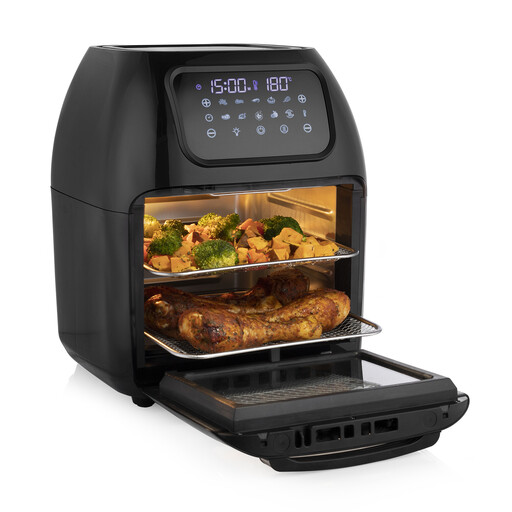
For a host considering an air-fryer oven for wedges, check how its cooking space fits the batches you plan to serve.
The product name specifies 10L, 1800W and 10 programmes. Confirm the usable tray dimensions and required worktop clearance before choosing a position for it.
 No image available
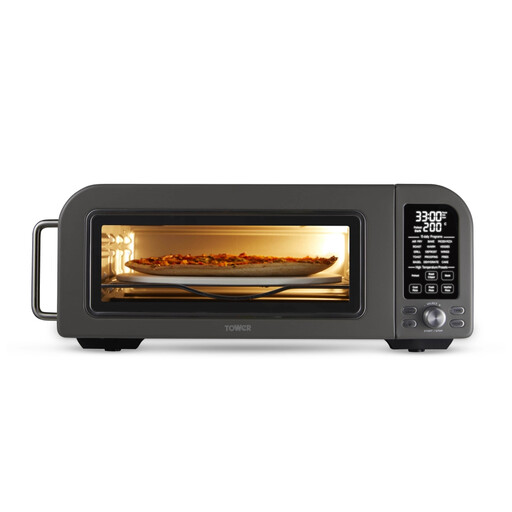
If a pizza-style countertop oven also fits the party menu, compare its cooking tray with the wedge batches you need to make.
The product name specifies 18L, 2000W and 15 cooking functions. Check the tray dimensions, worktop clearance and relevant cooking controls for your recipe.
Choose by tray layout and the batches your serving schedule can accommodate, not by converting cavity litres into portions. Compare internal tray dimensions, shelf positions and included accessories against your recipe or frozen-potato pack instructions.
An Air Fry function alone does not establish energy use for your recipe and batch plan. Russell Hobbs bases its 26680 saving claim on cooking 400 g of frozen French fries at 213°C in a conventional oven, so do not apply that claimed saving to homemade party wedges.
Follow the clearance in the exact model’s manual as well as checking its external dimensions. Russell Hobbs specifies at least 50 mm all round for the 22780 and 150 mm around the 26680; place the appliance on a stable, level, heat-resistant surface.
A Keep Warm setting can help coordinate serving, but its name does not guarantee a particular food temperature or preserve just-cooked texture. Plan to serve wedges promptly and follow the food’s cooking instructions rather than relying on the setting to solve a long gap between batches and serving.