Hosts making several trays
If you plan to serve plenty of wedges, look at flat tray area, supplied accessories and rack positions. A litre figure alone will not tell you how many wedges can sit in a shallow layer.


For several trays of birthday-party beetroot wedges, start with usable tray space and rack layout rather than cavity litres alone. A 20–30L countertop or multi-rack oven is a sensible starting point for repeated batches, while a compact air-fryer oven suits smaller loads. Check tray dimensions, worktop clearance and electrical instructions before choosing.
If you plan to serve plenty of wedges, look at flat tray area, supplied accessories and rack positions. A litre figure alone will not tell you how many wedges can sit in a shallow layer.
A compact oven may fit your preparation area more readily, but check its installation clearances as well as its external dimensions. Smaller cooking space can mean more rounds for a party batch.
Multiple oven levels, separate cooking zones or an integrated hob can help you plan another dish alongside the wedges. Check how much room remains for each dish when those functions are in use.
Consider it when: You want a supplied baking tray for successive wedge batches or a hob for another party dish. Russell Hobbs UK specifies both for the 30L 22780 Mini Kitchen.
Allow for: The stated capacity does not establish tray area or portions, and a combined oven-and-hotplate unit needs suitable worktop space.
Consider it when: Separate rack positions and roast or bake modes suit your menu. Tefal UK specifies three cooking levels for its 20L FW605840 and 15L FW556DG0.
Allow for: Rack count does not establish how much beetroot fits per level; accessories may also add to cleaning.
Consider it when: You are making smaller loads or want to prepare two small dishes separately. Breville UK specifies that its Halo Flexi VDF138 can operate as one 11L zone or two 5.5L zones.
Allow for: Dividing the space leaves less room for one batch of wedges, so plan for extra rounds if needed.
Once you have chosen a format, check whether its trays can hold your planned batch without crowding and whether the appliance can be used safely where you intend to place it.
| Concern | What to check | Who this matters to |
|---|---|---|
| Usable batch space | Internal tray or rack dimensions, included trays and the number of cooking levels. | If I need to get several trays of wedges ready for guests, I want room to spread them out without adding too many rounds. Around 42% of consumers put usable batch space first. |
| Roasting control | Temperature range, cooking modes and the manufacturer’s instructions for roasting vegetables. | When I am timing fresh wedges for a party, I need settings that let me check and adjust each batch. Roasting control is the main concern for around 33% of consumers. |
| Worktop and electrical setup | External dimensions, required clearances and the appliance’s power instructions. | If preparation space is tight or other appliances will be running, I need a place where the oven can be used as instructed. Around 25% of consumers prioritise space and safe setup. |
Cavity capacity does not show how much flat tray area is available for wedges. A deep pile may also make batches harder to manage.
Check the usable tray or rack dimensions against the quantity you intend to cook, and confirm which trays are supplied.
Tefal’s published speed and energy comparisons use specified frozen-fries tests and comparator ovens. They do not establish timings or results for fresh beetroot wedges.
Follow a beetroot-wedge recipe suitable for your appliance, check the first batch as it cooks and leave time for further rounds.
Electrical Safety First warns that an oven or grill used with other large appliances on an extension lead can cause an overload and fire risk.
Follow the appliance’s power instructions, avoid sharing an extension lead with other high-load appliances and stop using damaged or overheating plugs, sockets or cables.
A mini oven’s ability to bake wedges does not establish that it is suitable for holding them hot. UK government caterer guidance distinguishes hot-holding equipment from equipment used to cook or reheat food.
Plan batches close to serving time. If you intend to hold food hot, check that the equipment and its instructions are suitable for that purpose.
The 22780 Mini Kitchen is relevant if you want a conventional countertop oven and hotplates for party preparation.
Its Easy Fry ovens offer multi-level layouts for buyers considering an air-fryer-oven format.
The Halo models are worth considering when smaller loads, separate zones or several cooking levels suit your menu.
The EO12012 is a small conventional bake-and-grill oven to consider for supplementary cooking.
This compact air-fryer oven is a choice to consider for a smaller batch of beetroot wedges or a side dish. Check its usable rack area before relying on it for several party trays.
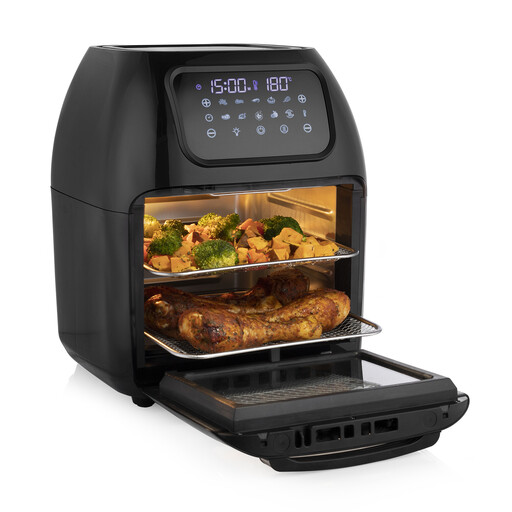 Image unavailable
Consider this compact oven for a smaller wedge batch or side dish; confirm its usable rack area before planning how many rounds you will need.
Stated capacity: 10L. Power: 1800W. The product name also specifies 10 programmes and dishwasher-safe parts; check which parts the care instructions cover.
Start with usable tray and rack space rather than a litre figure. The 20L and 30L models described by Tefal UK and Russell Hobbs UK provide multi-level or supplied-tray options to investigate for repeated batches, but you still need to confirm tray dimensions against the quantity you plan to serve.
No; a conventional mini oven with suitable temperature settings can be considered for roasting beetroot wedges. An air-fryer oven may appeal for its rack layout or cooking modes, but check the recipe and the food during cooking rather than assuming the same timing or browning across appliances.
Do not assume an extension lead is suitable for your mini oven. Electrical Safety First warns that ovens and grills can overload one when used with other large appliances; follow the appliance instructions and seek advice from a qualified electrician if you are unsure about the electrical setup.
Do not assume a mini oven is suitable for hot holding simply because it can cook the wedges. Plan to serve batches promptly, or check the instructions for equipment intended to hold food hot. UK government guidance for caterers distinguishes hot holding from cooking and reheating; it should not be read as a statement of a specific legal obligation for a private home party.