Home bakers taking dessert to a picnic
You plan to bake before leaving. Check that the oven accommodates your chosen dish, reaches your recipe’s temperature and gives you a practical way to time the bake.


Choose a mini oven only after checking that your bread-pudding dish and, if your recipe uses a water bath, its larger roasting tin will fit: litre capacity alone cannot establish this. Match the oven’s baking mode and temperature range to the recipe. For a picnic, baking at home avoids the need for an outdoor electrical setup; Electrical Safety First advises dry conditions and residual current device (RCD) protection when electrical equipment is used outdoors.
You plan to bake before leaving. Check that the oven accommodates your chosen dish, reaches your recipe’s temperature and gives you a practical way to time the bake.
Worktop space matters, but a compact exterior does not tell you whether a pudding dish and water-bath tin will fit inside. Measure the cookware before choosing a size.
Establish the power arrangement before choosing an oven for on-site use. Electrical Safety First advises dry conditions and RCD protection for outdoor electrical equipment; leads and connectors must also be suitable for the setup.
Decide whether the pudding will be baked at home or at the picnic venue, then check cookware fit before comparing cooking controls and extra functions.
| Concern | What to check | Who this matters to |
|---|---|---|
| Dish and water-bath fit | Measure the dish and any larger roasting tin, including handles. Compare them with the oven’s internal space, shelf position and door opening. | I need to get both vessels in and out without tipping a hot water bath; around 25% of consumers put cookware fit first. |
| Baking controls | Check the baking mode, temperature range and timer against your recipe. Good Food’s bread-pudding recipe specifies 180°C conventional or 160°C fan. | If my pudding needs a steady bake, I want controls that let me follow the recipe rather than rely on a crisping setting; roughly 31% of consumers prioritise baking control. |
| Picnic power and transport | For outdoor use, establish dry conditions, an RCD-protected supply and suitable, correctly rated outdoor leads and connectors. Otherwise, plan to bake at home. | I need to know whether cooking at the venue is workable before carrying an oven there; around 31% of consumers place the power and transport plan first. |
| Other meals | Consider hotplates or additional cooking modes only if they suit food you expect to prepare beyond this pudding. | If the oven will regularly help with other dishes, extra functions matter to me; about 13% of consumers make broader meal preparation their primary concern. |
Good Food’s bread-pudding recipe puts a 20 × 30 cm dish inside a larger roasting tin. An oven’s stated capacity does not show whether that two-vessel arrangement will pass through the door or sit level on a shelf.
Measure your complete setup, including handles, and compare it with confirmed internal and door-clearance dimensions. Allow room to remove the hot water bath without tilting it.
Choosing a smaller counter-top appliance does not remove the electrical risks associated with moisture, cables and connectors outdoors.
Follow Electrical Safety First’s advice on dry conditions and RCD protection, and use leads and connectors suitable for outdoor use and the appliance’s electrical requirements. If the venue cannot support that arrangement, bake at home and transport the pudding.
A custard-based bread pudding needs the cooking mode and temperature specified by its recipe. Good Food’s example calls for 180°C conventional or 160°C fan and a 40–45 minute bake.
Check the exact oven’s modes and temperature range, then use the recipe’s fan or conventional setting as appropriate. Check that the custard has set rather than relying on the timer alone.
Hotplates and additional oven modes may help with other food, but they cannot establish that your dish fits or that cooking outdoors is appropriate.
Choose those functions for meals you expect to make regularly; settle cookware fit, baking controls and placement first.
These examples illustrate different counter-top oven configurations. Check specifications for the exact model rather than assuming that every oven from a brand has the same features.
The Mini Kitchen 22780 is a 30L option for someone who also wants hotplates for preparing other food.
The SDA1608 offers a 23L mini-oven configuration to consider where worktop space and a smaller dish matter.
The 19L Optimo OF445840 is relevant if you want a compact model with a stated bain-marie mode.
The Foodi 10-in-1 Multifunction Oven may interest households considering counter-top cooking beyond one picnic dessert.
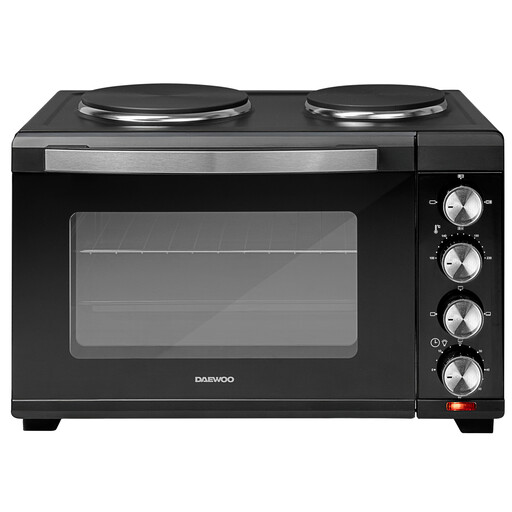
This oven-and-hotplate model is a choice for preparing bread pudding and other picnic food at home, provided its internal space and controls suit your recipe. Its counter-top format alone is not a reason to plan outdoor use.
 No image available
Consider this counter-top oven if you want hotplates for other food alongside home preparation of a picnic pudding. Check that your dish and any water-bath tin fit and that the oven’s controls match your recipe.
The product title states 32L capacity, two hotplates and 3000W. Confirm the appliance’s electrical requirements against the socket and setup you intend to use.
It might, but capacity cannot establish the fit. Good Food’s bread-pudding recipe uses a 20 × 30 cm dish inside a larger roasting tin; measure your own vessels and compare them with the exact oven’s internal, shelf and door-clearance dimensions. The stated 19L Tefal OF445840 and 23L Daewoo SDA1608 capacities do not answer that measurement question.
Look for a baking mode, a temperature range that covers your recipe and a timer. Good Food’s recipe specifies 180°C conventional or 160°C fan for a 40–45 minute bake; choose the corresponding setting on the exact oven and check that the custard has set.
Only plan on-site cooking if the venue can support an appropriate electrical setup and dry conditions. Electrical Safety First advises RCD protection for outdoor electrical equipment; check that leads and connectors are suitable for outdoor use and correctly rated for the appliance. Otherwise, bake at home and transport the pudding.
No: the more important check is whether your oven has a setting that matches the recipe you are following and room for the cookware. Good Food’s recipe gives separate conventional and fan temperatures, so use the appropriate one rather than applying the conventional temperature to a fan setting without adjustment.