Cooks using a casserole dish in a compact kitchen
If you already own an ovenproof dish, measure it with its handles and lid before choosing an oven. Check both the usable cooking space and the room available on your worktop.


Start with your casserole dish’s outside measurements, then consider a 28–30-litre mini oven if its usable cavity will accommodate it; Fan-assisted models are listed in that range, but capacity alone does not prove fit. A model with integrated hobs suits cooks without a separate hob, while a 12-litre oven is an option for small portions only if the dish fits.
If you already own an ovenproof dish, measure it with its handles and lid before choosing an oven. Check both the usable cooking space and the room available on your worktop.
If you need to brown sausages or prepare sauce as well as use the oven, an integrated-hob model is worth considering. Check the appliance instructions for permitted use, electrical requirements and placement.
If you already have other cooking equipment and want a compact secondary oven, a 12-litre model may suit a small casserole dish. Confirm the dish fits before treating it as a practical option.
For consumers choosing a mini oven for a sausage casserole, dish fit is the starting point. Then consider how you will control the cook, where the appliance will stand and whether you need hobs.
| Concern | What to check | Who this matters to |
|---|---|---|
| Casserole-dish fit | Compare the dish’s outside width, depth and height, including handles and lid, with the oven’s usable internal dimensions. | I need my ovenproof dish to fit without relying on the litre figure alone. Around 36% of consumers put dish fit first. |
| Heat control and timing | Check the temperature range, cooking functions, fan assistance and timer against your recipe; check that the food is cooked all the way through. | When cooking sausages in a casserole, I need settings that suit the recipe without treating the timer as proof the food is done. Roughly 29% of consumers prioritise heat control and timing. |
| Worktop placement | Measure the oven’s external footprint and allow the clearances specified in its instructions; check the socket and avoid overloading extension leads. | With limited worktop space, I need a place for the oven that also meets its clearance requirements. About 21% of consumers put safe placement first. |
| Integrated hobs | Check the number of hobs, electrical requirements and whether the manual permits hob and oven operation together. | Without a separate hob, I need to prepare the sausages or sauce as well as bake the casserole. Around 14% of consumers prioritise an integrated hob. |
A capacity figure does not give the usable shelf width, depth or height, or account for handles and a lid.
Measure your dish and confirm the oven’s usable internal dimensions before buying.
Integrated hobs add cooking options, but the unit still needs suitable worktop clearance and an appropriate electrical connection. Do not assume the hobs and oven can run together.
Read the model’s instructions for placement, power requirements and permitted simultaneous use. Electrical Safety First warns against overloading extension leads.
A timer or selected oven temperature cannot establish that sausages in a casserole are cooked all the way through.
Follow the food packaging or recipe instructions and check the food is cooked through. The Food Standards Agency advises cooking food until it is steaming hot and cooked all the way through.
The Russell Hobbs 22780 is an oven-focused, fan-assisted 30-litre option for a casserole dish that fits its usable cavity.
The 28L Mini Oven with Hob is relevant if you need both an oven and hob space for preparing a casserole.
The IG7131 is a 30-litre oven-only route for cooks who already have a hob.
The EO12012 is a compact option to consider for a small dish and limited portions.
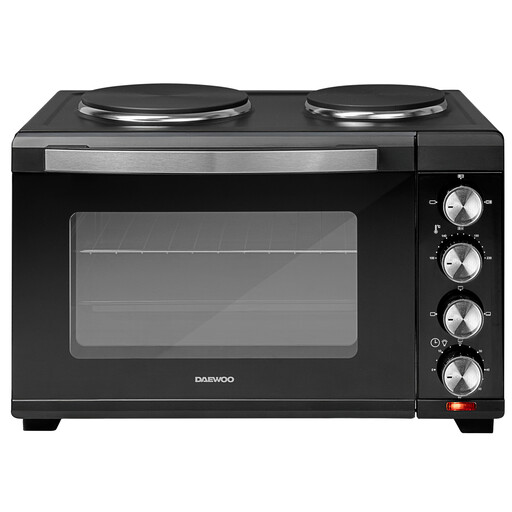
This countertop oven has integrated hotplates for cooks who need a hob stage as well as an oven stage when making a casserole.
 No image available
If you do not have a separate hob, this model’s hotplates make it a candidate for preparing the hob stage of a sausage casserole.
The product name states a 32L capacity and 3000W power rating. Check your dish against the usable cavity dimensions, and consult the instructions for electrical requirements, worktop clearances and whether the oven and hotplates may operate together. If your recipe calls for fan assistance, confirm that feature before buying.
Not necessarily: 30 litres describes cavity volume, not the usable dimensions for your dish. Compare the dish’s outside measurements, including handles and lid, with the oven’s usable internal width, depth and height.
Fan assistance is a feature to consider, not a requirement established by dish size alone. Check that the model’s temperature range and cooking functions suit your recipe, then follow the preparation instructions and check that the food is cooked all the way through.
Do not assume an extension lead is suitable. Electrical Safety First warns that ovens can overload one; follow the appliance instructions, check the lead’s rating if its use is permitted, and do not overload or daisy-chain extension devices.
Let the appliance cool before cleaning it, and follow its instructions for removing food residue. If the plug or socket shows scorch marks, or the appliance trips a breaker repeatedly, stop using it and seek appropriate electrical advice.