Frequent small-batch cracker bakers
If you bake often, controllable heat, a timer and access to the tray or rack may matter more to you than space for a large meal.


Choose a mini oven by the tray space your crackers need, the temperature range you use and where the appliance can safely stand—not by litre capacity alone. A conventional mini oven suits familiar tray baking; an air-fryer oven may suit frequent small batches if removable racks fit your method. Either needs room for ventilation and a suitable electrical connection in a shared kitchen.
If you bake often, controllable heat, a timer and access to the tray or rack may matter more to you than space for a large meal.
You need to fit the oven, its door swing and its required ventilation space around other people’s use of the worktop.
You share equipment and surfaces, so cleaning access and a routine for keeping ingredients separate are part of the decision.
Decide whether your cracker method calls for a conventional tray or removable airflow racks, then check the usable baking area and the appliance’s placement requirements.
Choose it when: You want a familiar tray-and-rack arrangement for rolling out and baking crackers.
Trade-off: A capacity figure does not tell you whether your preferred tray fits inside.
Choose it when: You make frequent small batches and removable racks suit the way you portion your crackers.
Trade-off: Check how small pieces or baking paper can be used safely with the model’s circulating air, as well as whether its temperature range suits your recipe.
| Concern | What to check | Who this matters to |
|---|---|---|
| Control over baking | Compare the stated temperature range with your recipe and check the timer and access to the tray or racks. | Thin crackers can brown quickly, so I want to watch a batch and adjust the heat when needed. Around 33% of consumers put baking control first. |
| Space and batch size | Measure the exterior, door-opening space and usable tray or rack area; allow for the model’s required clearance. | If the worktop is shared, I need enough room for a useful batch without blocking preparation space. For around 27% of consumers, fit and throughput come first. |
| Cleaning and allergens | Check which parts can be removed and how the manufacturer says to clean them. | When others use the oven, I want to clear crumbs and keep ingredients from crossing into their food. Cleaning and allergen separation are the first concern for around 20% of consumers. |
| Safe placement and power | Check the appliance rating, available socket arrangement and the exact model’s ventilation and hot-surface instructions. | I need a place where the oven can run and cool without crowding other users or overloading a lead. Around 20% of consumers prioritise safe placement and electrical use. |
Capacity describes the cavity, not the usable shape of a baking tray or the space the oven takes up on the worktop.
Measure your preferred tray or baking-paper layout, then compare it with the model’s rack supports, supplied tray and exterior dimensions.
Rack layout, airflow and temperature limits differ. For example, Breville states a 200°C maximum for its Halo Rotisserie Air Fryer Oven VDF127, while Tefal states 240°C for its Optimo OF445840.
Check your recipe temperature and whether a suitable tray or accessory will hold small cracker pieces securely in the appliance you choose.
Electrical Safety First warns that ovens and grills may overload an extension lead when other large appliances use it too. A crowded worktop can also obstruct ventilation.
Check the oven’s rating and connection instructions, and follow its manual for clearance, stable placement and cooling.
Accessible racks and trays help with cleaning, but ingredients, utensils and preparation surfaces need attention as well.
Agree a cleaning and storage routine for household sharing. If you supply crackers through a food business, check the applicable allergen-information and management duties.
These examples illustrate different countertop-oven formats; check the exact model and its instructions rather than treating a brand name as a specification.
The Optimo OF445840 is a compact conventional-oven example for tray baking.
The IG7131 is a larger conventional tabletop-oven example.
The Halo Rotisserie Air Fryer Oven VDF127 illustrates a rack-based air-fryer-oven format.
The Smart Oven Pro BOV820BSS is a countertop-oven option to examine if its controls interest you.
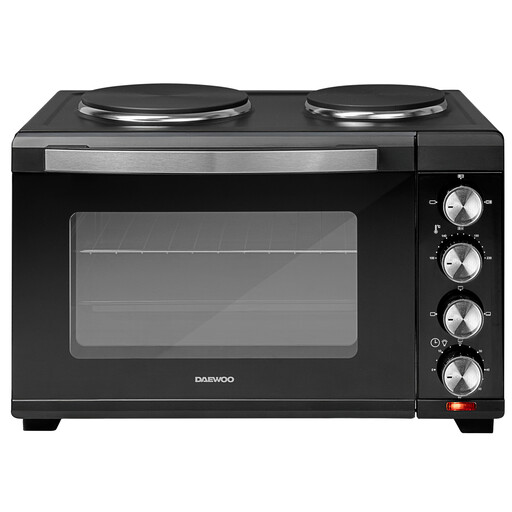
This countertop electric oven is an option to consider if you want a conventional oven layout for cracker batches and can accommodate its dual-hotplate design. Check its baking-tray fit, placement instructions and electrical requirements before choosing it for a shared worktop.
 No image available
Consider this conventional countertop format if your cracker tray fits and the appliance can stand clear of other shared-kitchen tasks.
The product name states a 32L capacity and 3000W total power. Check the exact model’s tray dimensions, ventilation instructions and electrical requirements before buying; capacity alone cannot establish tray fit.
Measure the available worktop and door-opening space, then allow for the clearance required by the exact model’s manual. Check the usable tray or rack dimensions against your cracker batches; litre capacity does not establish whether a tray fits.
Only use a connection arrangement that meets the oven manufacturer’s instructions and the lead’s marked rating. Electrical Safety First warns that ovens and grills may overload an extension lead when used alongside other large appliances.
Let the oven cool and follow its model-specific cleaning instructions before another user prepares food. For Breville’s Halo Rotisserie Air Fryer Oven VDF127, the manual identifies removable racks and a drip tray; do not assume that another model has the same removable parts or washing instructions.
Sharing a kitchen for personal household baking does not, by itself, make the activity a food business. If you plan to sell or supply crackers as a food business, check the rules for where you operate: the Food Standards Agency says food businesses using its registration service must register with their local authority at least 28 days before trading, and its guidance for England, Northern Ireland and Wales addresses allergen information and management.