Weekly batch-roast meal preppers
If you roast several portions for lunches, sides or later meals, compare usable tray area and shelf positions before settling on a cavity size.


For regular sweet potato batch cooking, choose by the tray space and shelf arrangement you can actually use, not cavity volume alone. A two-level countertop oven may suit separate trays, while a roughly 30-litre mini oven is worth considering for a substantial single-tray batch if your tray fits. A compact oven makes more sense for light batches; whichever format you choose, check its controls, worktop clearance and cleaning access.
If you roast several portions for lunches, sides or later meals, compare usable tray area and shelf positions before settling on a cavity size.
A countertop oven can provide another roasting space, but its footprint, required clearance and access for cleaning all matter alongside capacity.
If you usually roast one small tray at a time, a compact cavity may be enough, provided that tray fits and you are comfortable cooking larger quantities in separate rounds.
Consider when: You regularly need separate trays or want to cook other meal components alongside your sweet potatoes; Ninja describes its DT200UK as cooking on two levels.
Allow for: A larger appliance needs suitable counter space, and the Good Housekeeping Institute found the interior of its tested Ninja Foodi 10-in-1 oven tricky to clean.
Consider when: You want space for a substantial single-tray batch and would use conventional oven controls; the Russell Hobbs 22780 also has hotplates.
Allow for: Hotplates may add little value if roasting is your only task. The 22780 manual calls for a heat-resistant surface and at least 50 mm clearance all round.
Consider when: Your batches are small and counter space is limited; De'Longhi lists the EO12012 as a 12-litre bake-and-grill oven.
Allow for: Check that your usual tray fits before relying on a compact cavity for weekly batch preparation.
| Concern | What to check | Who this matters to |
|---|---|---|
| Usable roasting space | Compare your tray with the internal dimensions and shelf positions; check which trays or racks are included. | If I roast several portions for the week, I want them to fit without extra cooking rounds. For around 50% of consumers, usable roasting space would come first. |
| Roasting controls | Check the exact model's bake or roast functions and adjustable temperature range. | When I want control over how my usual load roasts, I need settings I can adjust rather than a general speed claim. Around 30% of consumers would make roasting control their primary concern. |
| Worktop fit and upkeep | Allow for the model's specified clearance and a heat-resistant surface; consider access for cleaning. | My worktop is tight, so I need to place the oven safely and clean it after repeated use. Worktop fit and upkeep would take priority for around 20% of consumers. |
Cavity volume does not tell you whether your roasting dish fits or whether two trays can be used at once.
Measure the dish you plan to use, then check the exact oven's internal dimensions, shelf positions and supplied accessories.
Russell Hobbs bases comparisons on its 26095 product page on specified conventional-oven tests, including a frozen cheese pizza at 200°C. Those conditions do not establish the cooking time or energy use of your sweet potato batch.
Compare the stated test conditions with your intended load, then choose the oven by usable space and controls rather than an assumed saving.
The Russell Hobbs 22780 manual requires at least 50 mm of space all round, a heat-resistant surface and care around hot appliance surfaces.
Measure your intended position and follow the placement instructions for the exact model you buy; do not apply the 22780 clearance figure to other ovens.
The Russell Hobbs 26095 page calls the oven “20 Litre” in its title but uses “12.6l” in its convection description. That difference matters when planning a batch.
Ask the manufacturer or retailer to clarify the exact variant's technical specification before deciding whether your tray will fit.
Ninja positions the DT200UK as a large, 10-in-1 countertop oven for cooking on two levels.
The 22780 Mini Kitchen combines a 30-litre conventional oven cavity, fan assistance and double hotplates.
The EO12012 is a compact, conventional 12-litre oven with bake and grill functions.
These air-fryer-style ovens offer a 10L option to assess for smaller loads and a 30L option to assess for larger batches. For either one, confirm that your roasting tray fits and that you can meet the model's placement instructions.
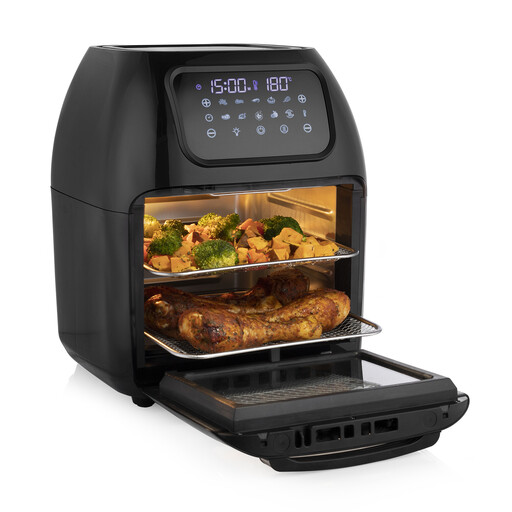 No image available
Consider this for smaller roasting loads if your intended tray fits. Its product name specifies 10L, 1800W, 10 programmes and a touch screen. Check internal tray dimensions and required clearance before choosing it for batch cooking.
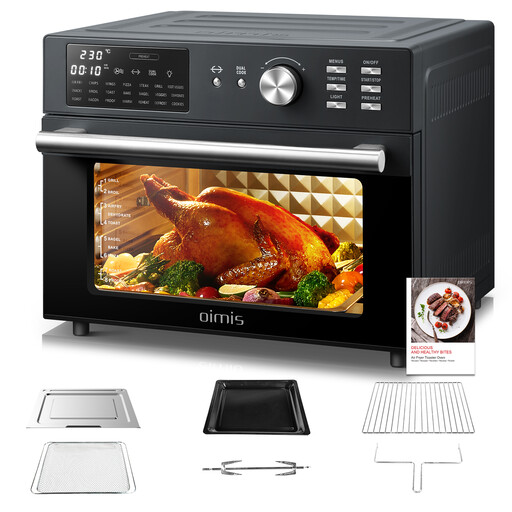 No image available
Consider this for a larger batch if its usable tray area suits the amount you roast. Its product name specifies 30L, 1800W and 21 presets. Check the shelf arrangement, temperature controls and required clearance for your intended use.
A 12-litre oven can suit a light batch, but do not assume it will take the tray you use for several portions. De'Longhi lists the EO12012 as a 12-litre model; compare its internal tray space with your usual load before choosing it for weekly preparation.
No particular cooking mode is required to make the purchase decision: choose an air-fry model if you want that mode as well as suitable space and controls. Brand speed or energy comparisons may use different foods and conditions; Russell Hobbs, for instance, cites a frozen cheese pizza at 200°C in comparisons for its 26095, not a sweet potato batch.
Follow the manual for the exact oven rather than using one clearance figure for every model. The Russell Hobbs 22780 manual specifies a stable, heat-resistant surface and at least 50 mm of space all round, and warns that appliance surfaces become hot.
Which? says mini ovens plug into a standard 13A socket. Before use, check the particular appliance's plug, voltage and manual against the socket arrangement in your kitchen, and do not use damaged equipment.
Check the UK Government's product safety alerts, reports and recalls service, then follow the instructions for the affected model from its manufacturer or retailer. The service includes alerts concerning electrical appliances and equipment.