Dinner-party side-dish hosts
You need room to spread out the sweet potatoes you plan to serve while leaving the main oven available for other dishes.


Choose a mini oven by the usable tray or basket space needed for your portions, not by its litre capacity alone. A tray-and-rack oven with hotplates suits a host who also needs another cooking station; an air-fryer oven is worth considering for smaller pieces if its basket and rack layout can hold the batch. Before buying either format, allow the clearance required by its manual and check how it will be powered alongside other kitchen appliances.
You need room to spread out the sweet potatoes you plan to serve while leaving the main oven available for other dishes.
You want extra cooking capacity on the worktop, but the appliance must fit with its required ventilation clearance and a suitable power arrangement.
You are considering an air-fryer basket or multiple rack positions for smaller pieces, and need to check how much food those accessories can hold without crowding.
Decide how you will cut and serve the sweet potatoes before comparing oven formats: whole potatoes, halves and wedges need different tray layouts. Then check whether the appliance and its required clearances fit the space available.
Consider it when: sweet potatoes are one part of dinner and you also want hotplates for another dish.
Trade-off: the additional cooking functions make worktop space and electrical loading especially important to plan.
Consider it when: you are cooking smaller pieces and can use a basket or separate cooking levels.
Trade-off: a compact cavity may restrict how much you can spread out at once; check the accessories rather than assuming two levels will hold the full batch.
Consider it when: you mainly need another oven for straightforward roasting, without hotplates or air-fry functions.
Trade-off: the tray and rack still need to fit your planned portions, and functions vary by model.
| Concern | What to check | Who this matters to |
|---|---|---|
| Batch layout | Compare usable tray, rack or basket dimensions with your planned portions; check how many cooking levels you can use. | If I am serving sweet potatoes alongside other dishes, I need room to spread out the whole potatoes or cut pieces I plan to cook. Around 36% of consumers put batch layout first. |
| Browning and control | Check the exact model's cooking functions and temperature settings, along with the basket or tray supplied. | For wedges or cubes, I want a cooking setup that lets me manage browning without crowding the pieces. Crisp edges and cooking control come first for around 28% of consumers. |
| Worktop and power | Measure the footprint plus the manual's clearance requirements; check the socket arrangement and any shared appliance load. | In a small kitchen, I need the oven to sit clear of nearby surfaces and have a suitable power connection. Around 36% of consumers prioritise space and safe electrical use. |
Cavity capacity does not tell you the usable dimensions of a supplied tray or basket, or how easily you can space out a dinner-party batch.
Decide whether you will roast whole potatoes, halves or cut pieces, then compare that plan with the accessories and cooking levels of the exact model.
Cuisinart lists the TOA60U air-fryer oven as discontinued. Its two shelves and basket are useful points of comparison, but do not establish that you can obtain that model for your dinner-party date.
Check current availability, included accessories and warranty terms with the seller before making it part of your cooking plan.
The Cuisinart TOA60U manual requires 100 mm clearance around its front, back and sides and warns that some nearby furniture surfaces can be affected by heat. Other models may have different instructions.
Measure the appliance and the clearance specified in its own manual; keep the surrounding space clear and do not use the oven top for storage.
Electrical Safety First warns that overloading extension leads, cable reels or block adaptors can cause overheating and fire, a particular concern when several kitchen appliances are running.
Use a suitable wall socket where possible. If you use an extension device, check its marked rating against the combined load, do not daisy-chain devices and fully unwind cable reels.
The Russell Hobbs UK listing for the 22780 illustrates a mini oven that combines tray-and-rack cooking with hotplates.
The Cuisinart UK TOA60U illustrates the smaller, two-level air-fryer mini-oven format.
The Igenix IG7131 illustrates a basic 30 L tray-and-rack mini oven for hosts who do not need integrated hotplates.
These choices cover two different ways to add worktop cooking space: an electric oven with hotplates for a second cooking station, and a smaller air-fryer oven to consider for cut sweet potatoes. Compare each model's usable accessories and clearance requirements with your planned batch.
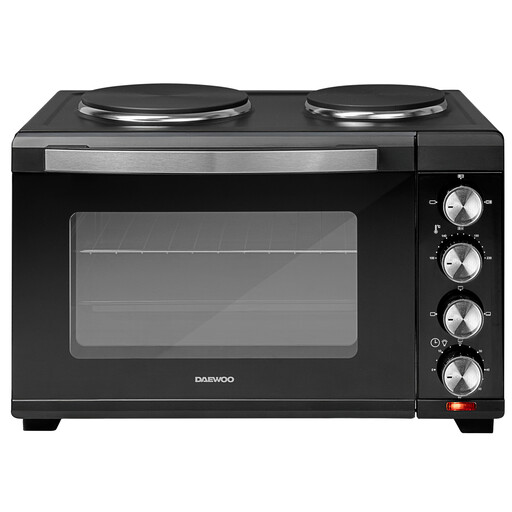 Image unavailable
Consider this format if you want oven space for a sweet-potato side dish and hotplates for other cooking tasks. Its stated capacity is 32 L and its stated power is 3000 W; neither figure tells you how many potatoes will fit. Check usable tray dimensions, the model's ventilation instructions and the intended socket arrangement before buying.
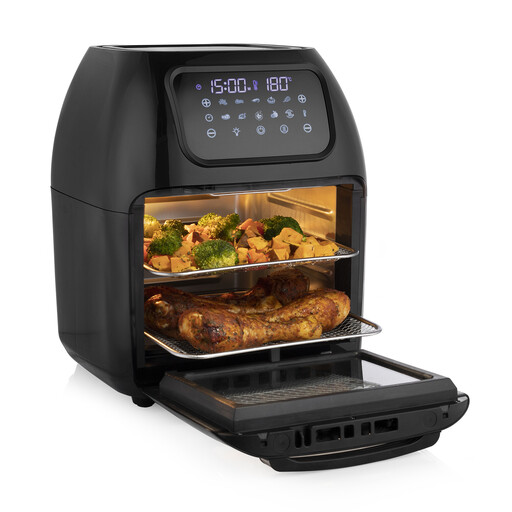 Image unavailable
Consider this smaller air-fryer-oven format if you plan to cook wedges or other cut pieces rather than relying on cavity litres to fit whole potatoes. The product name specifies 10 L, 1800 W and 10 programmes. Check the usable basket or rack dimensions against your portions, and allow the clearance required for this model.
A 30 L capacity alone cannot tell you whether your planned batch will fit. Compare the supplied tray's usable dimensions and cooking-level layout with the number and cut of potatoes you intend to roast; allow room to spread them out rather than relying on the cavity figure.
Position it according to the exact model's clearance instructions, not a clearance figure borrowed from another oven. For example, the Cuisinart TOA60U manual specifies 100 mm around the front, back and sides and warns against use near or under combustible materials.
Only use an extension arrangement whose marked rating accommodates the combined load of connected appliances. Electrical Safety First advises against overloading or daisy-chaining extension devices and says cable reels should be fully unwound; a suitable wall socket avoids having to share an extension device with other kitchen appliances.